
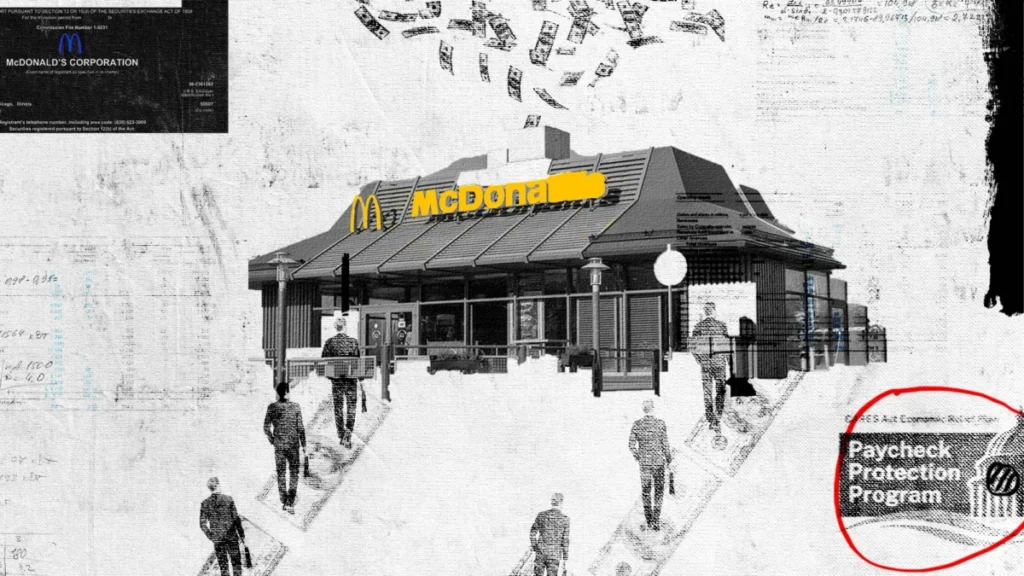
The onset of the global COVID-19 pandemic in early 2020 sent shockwaves through the American economy, forcing businesses of all sizes to navigate unprecedented uncertainty. Among the hardest hit were the restaurant and hospitality sectors, where dining rooms closed overnight and revenue plummeted. To weather the sudden economic downturn, business owners urgently sought financial lifelines. In the fast-food industry, a critical structural conflict quickly emerged between independent franchise operators and corporate headquarters. While franchisees looked to their parent companies for rent relief and operational support, major corporations—most notably McDonald’s Corporation—largely held firm on financial obligations. Consequently, thousands of franchise owners turned to a taxpayer-backed federal emergency initiative: the Paycheck Protection Program (PPP).
An investigative analysis of loan application data reveals that U.S. McDonald’s franchisees planned to allocate more than $31 million in taxpayer-backed COVID-19 relief funds directly toward rent payments. Because the corporate office owns or leases the vast majority of the real estate on which its restaurants operate, these federal funds ultimately bypassed workers’ pockets to land directly on the balance sheets of McDonald’s real estate holdings. This systemic routing of small business relief highlights significant vulnerabilities in pandemic-era economic policies, raising critical questions about corporate accountability, real estate dominance, and the true beneficiaries of government bailouts.
The Real Estate Engine: How McDonald’s Structured Its Empire
To understand how federal relief funds wound up in corporate accounts, one must examine the foundational business model of McDonald’s. Established in its modern form during the 1950s under the guidance of Ray Kroc, the company’s hyper-growth strategy pivoted away from relying strictly on a percentage of hamburger sales. Instead, McDonald’s engineered a massive real estate portfolio. The corporate parent company buys or leases the land and physical buildings for its franchise locations, subsequently leasing those properties back to the independent operators.
Solutions for Local Slaughter: Small Abattoirs in Local Meat Supply Chains – Groundswell 2026
This dual-revenue structure generates immense wealth. Franchisees are contractually obligated to pay both standard corporate royalties and a base rent, often supplemented by a percentage of monthly gross sales. According to corporate financial filings, McDonald’s collected a staggering $7.5 billion globally in rental payments in 2019 alone. This figure accounted for more than the corporation collected in franchise royalties and represented over a third of its total combined revenues across both the parent corporation and its vast network of stores. By the end of 2020, McDonald’s Corporation held roughly $37.9 billion in real estate assets before depreciation.
As food historian and author Marcia Chatelain has noted, McDonald’s operates fundamentally as a real estate enterprise that uses the cultural footprint of a burger chain to secure an immense portfolio of physical wealth. This property ownership model provides the corporation with exceptional insulation during economic downturns, guaranteeing a steady stream of income regardless of operational challenges at the restaurant level—unless, of course, the franchisees themselves face total insolvency.
Chronology of the Crisis: The Spring 2020 Clash
As federal lockdowns and stay-at-home orders took effect in March 2020, the vulnerability of the franchise model became starkly apparent. Recognizing the impending financial catastrophe, the National Franchisee Leadership Alliance—an organization representing McDonald’s franchise owners—approached corporate leadership with an urgent appeal. Specifically, they requested temporary rent relief, asking for a waiver or forgiveness of rental payments for a brief period to help them stay afloat while revenues evaporated.
Unlike numerous other hospitality and restaurant chains that offered immediate rent deferrals or complete waivers to their operators, McDonald’s corporate leadership initially refused to grant even a two-week rent forgiveness period. While the company eventually agreed to defer—rather than forgive—the collection of roughly $490 million in rental income, alongside a similar deferral on royalties, the initial refusal shocked and infuriated operators. Internal communications revealed deep resentment among franchisees who believed the world’s largest restaurant chain should absorb short-term losses to support its network, much like smaller restaurant parent companies were doing across the industry.
Faced with rigid corporate rent collection policies, franchise advocacy groups quickly pivoted their strategy toward Washington, D.C. Recognizing that the federal government was preparing an unprecedented injection of liquidity into the economy via the Coronavirus Aid, Relief, and Economic Security (CARES) Act, industry representatives encouraged their members to prepare applications for the newly minted Paycheck Protection Program.
Blake Casper, then-chair of the National Owners Association, wrote in an April 7, 2020, letter to company executives that franchisee groups had helped prepare their members to be "first in line" for federal funds. The letter noted that while the government was less solvent than the global corporation, it was at least attempting to provide desperately needed cash flow.
The Paycheck Protection Program and the Influx of Federal Dollars
Signed into law in March 2020, the Paycheck Protection Program was designed as an emergency measure to keep small businesses afloat and American workers attached to their payrolls during mandated economic shutdowns. The program offered low-interest, federally guaranteed loans of up to $10 million per business. Crucially, these loans featured a built-in forgiveness mechanism: if borrowers used the funds on eligible expenses—primarily payroll, but also mortgage interest, utilities, and rent—within a specified covered period, the debt would be entirely forgiven by the federal government.
For cash-strapped franchise owners facing unyielding rent demands from corporate headquarters, the PPP offered an ideal, taxpayer-backed solution to satisfy their landlords. Data released by the Small Business Administration (SBA) indicates that 2,389 individual McDonald’s franchises successfully collected approximately $1.3 billion in PPP funds. This made McDonald’s stores the second-largest corporate franchise recipient by total dollar amount nationwide, trailing only General Motors dealerships.

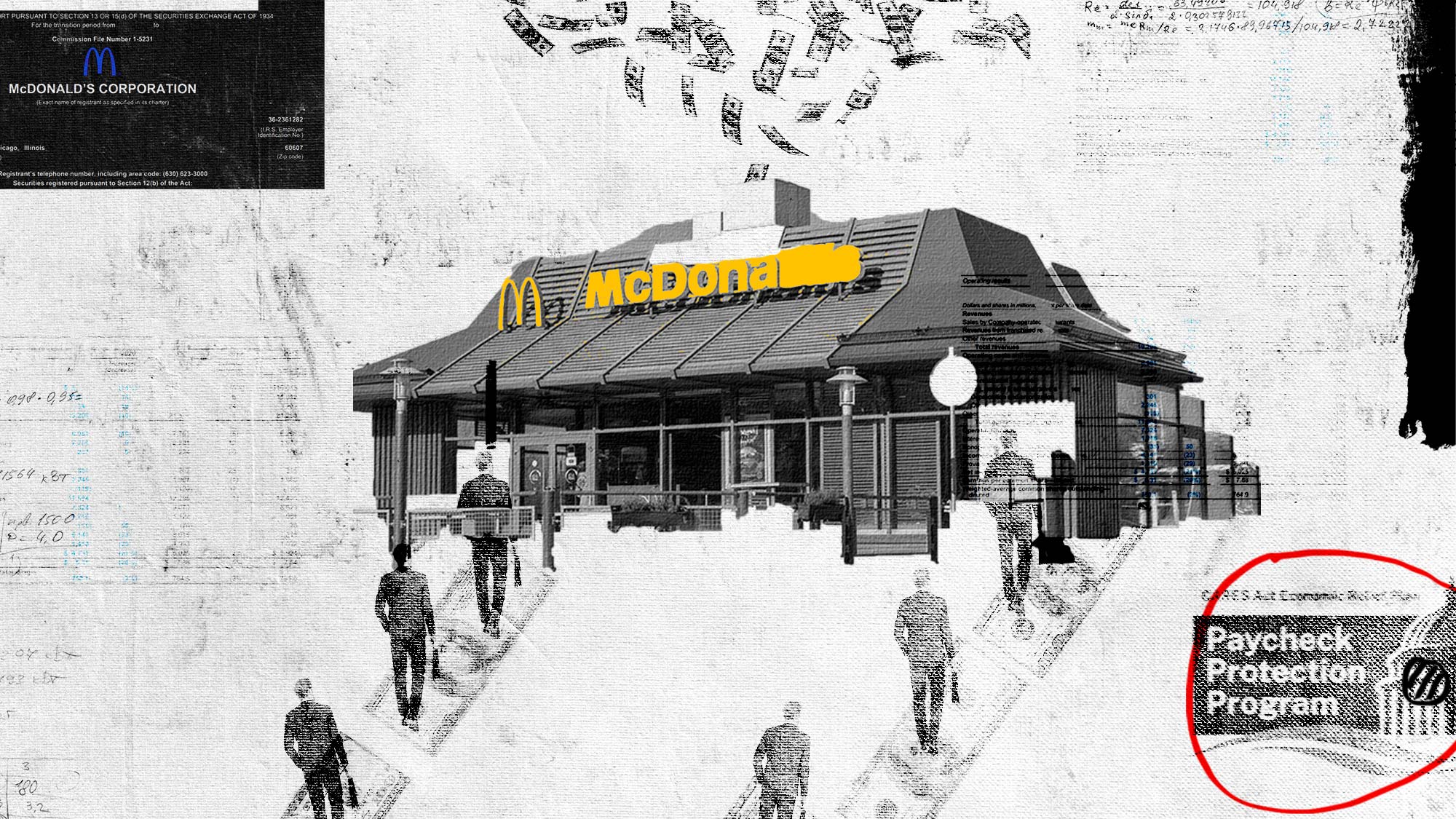
An in-depth analysis of available loan application data conducted by investigative outlets reveals that at least 421 of these McDonald’s franchise loans explicitly listed rent figures in their proposed budgets, totaling more than $31 million intended for property payments. Because the corporate office remained the landlord for an estimated 85 to 90 percent of U.S. franchises, a significant portion of these taxpayer-backed funds functioned effectively as an indirect government subsidy to the corporate parent’s real estate division.
Transparency Gaps and Regulatory Hurdles
Despite the substantial sums involved, determining the exact final destination of every PPP dollar disbursed to McDonald’s franchises remains a challenge due to structural limitations within the SBA’s data collection framework.
When business owners applied for PPP loans, they submitted nonbinding estimates outlining how they intended to spend the funds. Roughly three-quarters of McDonald’s franchisee applications claimed they would allocate 100 percent of the money toward payroll costs. Government accountability analysts, such as Sean Moulton of the Project on Government Oversight (POGO), have pointed out the curious nature of these uniformity metrics across the broader program, noting that lenders and the SBA placed minimal scrutiny on initial spending projections so long as the paperwork was complete.
Furthermore, the actual distribution of funds and subsequent loan forgiveness tracking were decentralized. To manage the immense administrative burden of the $789 billion program, the SBA offloaded processing and forgiveness decisions to private banks and credit unions. Consequently, the SBA does not maintain centralized, itemized records of how individual borrowers ultimately spent their forgiven funds. Freedom of Information Act (FOIA) requests and outreach to dozens of lenders who processed loans for McDonald’s franchisees yielded little concrete data regarding final expense breakdowns.
This lack of transparency extends to regulatory shifts that occurred midway through the program. In June 2020, following intensive lobbying by organizations like the International Franchise Association and various franchisee groups, Congress passed the Paycheck Protection Program Flexibility Act. This legislation loosened statutory restrictions, expanding the percentage of loan proceeds that businesses could allocate to nonpayroll expenses—such as rent and utilities—from 25 percent to 40 percent. While industry lobbyists argued these changes were essential to save small businesses from rigid regulatory traps, critics contend that the rules change further enabled the channeling of federal rescue funds toward overhead and real estate costs rather than direct worker retention.
Corporate Responses and Official Statements
Throughout the reporting and public scrutiny surrounding the use of PPP funds, corporate representatives maintained a strict distance from the program. In statements provided to investigative journalists, Joseph LaPaille, McDonald’s global communications manager, asserted that the corporation "never asked for assistance from any government entity."

A formal corporate statement issued later emphasized the autonomy of individual business owners: "As the Paycheck Protection Program intended, some independent small business owner franchisees independently applied for and used PPP loans to support payroll for the continued employment of the nearly 800,000 local restaurant employees who work in McDonald’s-brand restaurants throughout the U.S."
While McDonald’s Corporation itself did not formally submit PPP applications, the structural reality of its franchise agreements ensured that corporate coffers benefited from the federal liquidity injected into its operator network. Financial reports from late 2020 and 2021 demonstrated a rapid corporate recovery. Despite pandemic disruptions, McDonald’s collected $6.8 billion in rent in 2020 alone, recouping the vast majority of its deferred rents by the end of that year. By January 2022, corporate leadership hailed the previous year as a "banner year," reporting worldwide revenues of $23.2 billion—the company’s highest total since 2016.
Broader Economic Implications and Policy Lessons
The intersection of federal emergency relief and corporate real estate structures within the fast-food industry offers profound lessons regarding the design and oversight of macroeconomic stimulus programs. Watchdog organizations and public interest advocates argue that the episode underscores systemic flaws in how emergency relief is monitored.
Lisa Gilbert, executive vice president of Public Citizen, noted that while the PPP possessed noble intentions and unquestionably helped the nation navigate the initial shock of the pandemic, its structural vulnerabilities led to deeply troubling outcomes. When government programs lack granular tracking for loan forgiveness, accountability dissolves into a bureaucratic "black hole."
Policy analysts emphasize that the primary stated objective of the PPP was the preservation of employment. When funds are permitted to flow laterally toward overhead expenses like rent, mortgage interest, and utility bills—especially when those payments are funneled directly to highly profitable corporate parents—the intended impact on worker livelihood is diluted. As oversight experts question whether the massive expenditure of public funds achieved its primary job-saving mandate efficiently, the case of McDonald’s franchises and their rent-funded relief loans remains a prominent example of how corporate architecture can absorb and redirect emergency public funds designed for Main Street survival.









0 Komentar
Sampaikan opini dan diskusi yang membangun dengan bahasa yang santun.
No Comments Yet
Be the first to share your thoughts on this story.