The Physics and Chemistry of Pour-Over and Immersion Coffee Extraction

The pursuit of the ideal cup of coffee has long bridged the gap between culinary arts and empirical science. At the heart of this endeavor is the physics and chemistry of extraction, a complex interplay of solubility, fluid dynamics, and thermodynamics. While coffee roasting establishes the foundational flavor profile, the brewing method dictates how those chemical compounds are ultimately expressed in the cup. Understanding the distinction between selective percolation and uniform immersion allows both home enthusiasts and professional baristas to navigate the myriad variables that influence flavor, body, and overall extraction yield.
Chemical Composition and the Mechanics of Extraction
A typical cup of brewed coffee contains an extraordinarily diverse array of chemical compounds, with concentrations spanning nine orders of magnitude. Each individual compound possesses a distinct solubility and extraction rate. This chemical variance is advantageous for the brewer; if every compound extracted at an identical rate, the resulting beverage would lack nuance, leaving little room for culinary creativity.
Achieving an extraction that accurately reflects the total soluble portion of a coffee bean requires maximizing contact time and grinding the beans as fine as possible, occasionally supplemented by thermal energy. This approach mirrors the preparation of traditional, unfiltered Turkish coffee without added sugar or spices, yielding extraction rates approaching 30 percent. While undeniably strong, such high-extraction methods often fail to produce a balanced flavor profile.
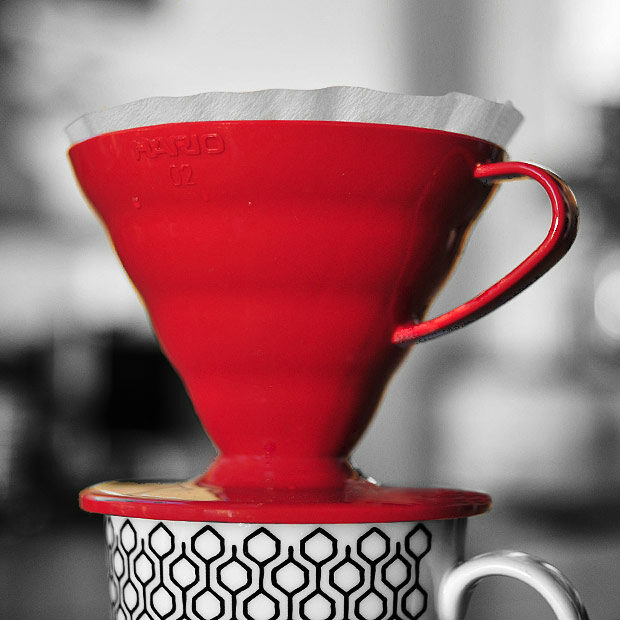
Instead, master brewers generally aim for a selective, uneven extraction. Rather than extracting all compounds to the same degree, the goal is to optimize the extraction of desirable organic acids, sugars, and aromatic oils while leaving behind undesirable, overly bitter or astringent compounds. The pour-over, or percolation, technique has historically served as the primary mechanism for achieving this selectivity.
The Complexity of Pour-Over Parameters
Pour-over brewing appears deceptively simple: hot water is poured over a bed of ground coffee, relying on gravity filtration to draw the brew through a paper, metal, or cloth filter. However, a rigorous examination of the physical process reveals a complex system governed by numerous correlated variables.
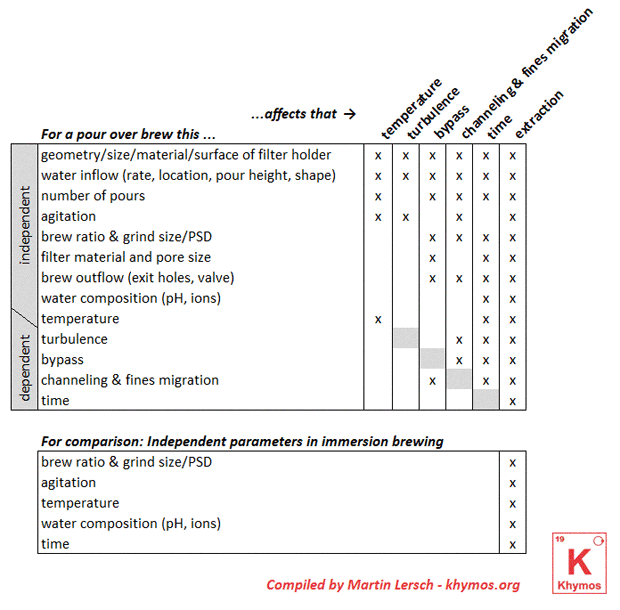
Independent variables—those directly controlled by the operator—include brew ratio, particle size distribution (PSD), water composition, water temperature, filter material, and pouring technique. These independent factors directly influence dependent variables such as flow rate, contact time, thermal loss, and the degree of fluid bypass.
Particle size distribution plays a critical role in fluid dynamics. Finer grinds increase the total surface area available for extraction while simultaneously restricting water flow, thereby extending contact time. However, this restriction introduces the risk of filter clogging and fluid channeling. Water, taking the path of least resistance, may bypass the dense coffee bed entirely by flowing down the sides of the filter holder. This phenomenon is exacerbated by filter holder designs featuring prominent internal ridges or patterns that reduce direct contact between the wet paper and the inner wall. Consequently, unmanaged bypass leads to under-extraction and dilution, introducing random variations that often fuel persistent coffee preparation myths.
Evolution of Coffee Brewing Hardware
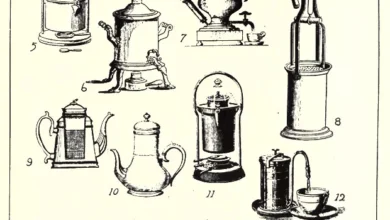
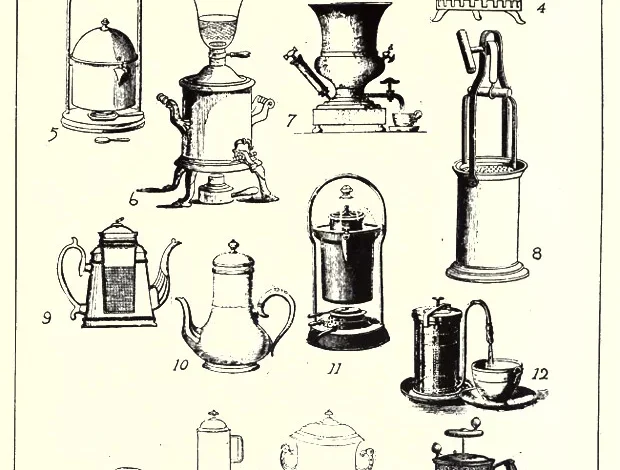
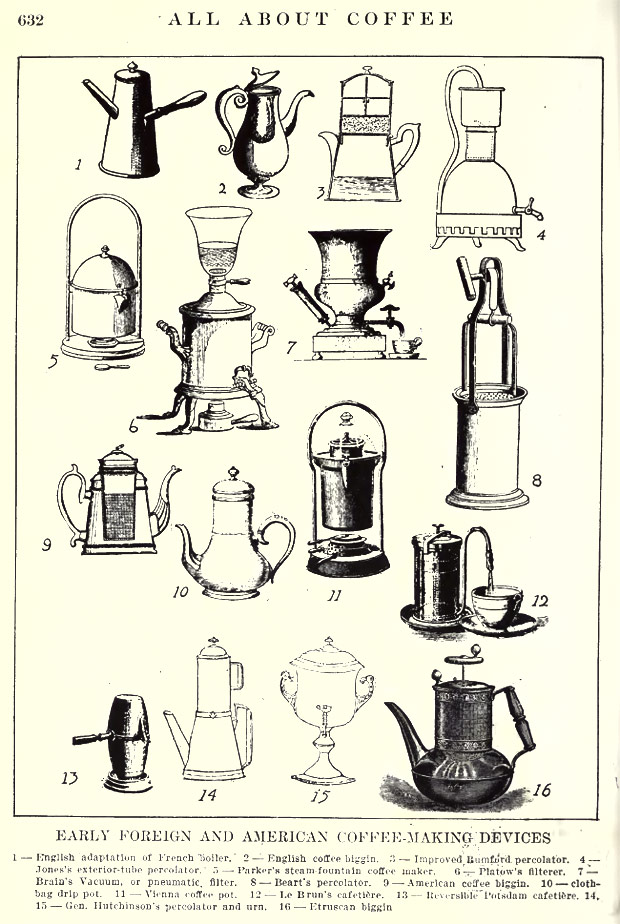
To mitigate the inherent inconsistencies of manual percolation, inventors and engineers have spent over two centuries refining brewing apparatuses. Historical records, such as W.A. Ukers’s comprehensive 1922 publication All about Coffee, document decades of continuous innovation aimed at optimizing extraction efficiency.
Modern pour-over equipment can be categorized by several structural characteristics:
- Material and Thermal Insulation: Materials such as plastic, ceramic, and double-walled vacuum-insulated metal minimize thermal loss during the brewing cycle, maintaining the elevated temperatures necessary for optimal extraction. Conversely, high-conduction single-wall metals can rapidly draw heat away from the slurry unless compensated for by significant thermal mass.
- Geometry and Bed Shape: Designs range from traditional trapezoidal Melitta-style cones to modern flat-bottomed brewers like the Kalita Wave and steep-sided cylindrical units. Cylindrical beds promote uniform contact but slow flow rates, whereas flat-bottom beds encourage faster drawdowns with a higher susceptibility to channeling.
- Flow and Inflow Control: Advanced accessories, such as the Gabi Dripmaster or Melodrip, regulate water inflow by dispersing droplets evenly across the coffee bed, preventing surface disturbance and subsequent channeling. Similarly, integrated stop-valves found in devices like the Clever Dripper or Hario Switch allow operators to combine immersion and percolation phases, decoupling contact time from grind size.
Comparative Analysis of Brewing Equipment
To benchmark current market offerings, industry analysts frequently categorize brewers based on material composition, thermal retention, bypass mitigation, and flow control mechanisms:
| Filter Holder | Material | Shape | Filter Type | Bypass (Yes/No) | Inflow Control | Outflow Control |
|---|---|---|---|---|---|---|
| Aeropress | Plastic | Cylindrical | Paper/Metal | No | No | Pressure / Dd |
| Chemex | Glass | Tapered Cone | Paper (Plain) | No | No | Diameter |
| Clever Dripper | Plastic | Tapered Cone | Paper (Plain) | Yes | No | Stop Valve |
| Hario V60 | Plastic/Ceramic | Tapered Cone | Paper (Plain) | Yes | No | Diameter |
| Kalita Wave | Metal/Glass/Ceramic | Tapered Flat | Paper (Folded) | Yes | No | Diameter |
| Stagg X/XF | Metal (Vacuum) | Tapered Flat | Paper (Folded) | Yes | No | Diameter |
| Tricolate | Plastic | Cylindrical | Paper (Plain) | No | Yes | Diameter |
Immersion Brewing as a Reproducible Alternative
While pour-over methods offer exceptional control, their sensitivity to human technique can hinder repeatability. This limitation highlights the advantages of immersion brewing methods, such as the French Press.
In immersion systems, coffee grounds steep in a fixed volume of water for a predetermined duration before separation via physical filtration. Because the entire volume of water contacts the coffee simultaneously and extraction approaches chemical equilibrium, immersion brewing offers superior repeatability between different operators. Pressure-based separation techniques, including standard French presses and inverted Aeropress methods, allow extraction time to be controlled independently of particle size.
Nevertheless, immersion brewing presents its own trade-offs. Traditional wire-mesh filters permit micro-fines and suspended solids to pass into the final cup, contributing heavy body and texture while leaving residual sediment. While these fines enhance mouthfeel, prolonged extraction can impart increased bitterness. Employing paper filtration within immersion brewers yields a cleaner cup clarity, though some critics argue it mutes desirable aromatic volatiles.
Broader Implications and Industry Outlook
The continuous evolution of coffee extraction equipment underscores a broader industry-wide movement toward scientific precision. By identifying and isolating variables such as fluid bypass, particle migration, and thermal decay, manufacturers are equipping baristas with the analytical tools needed to minimize extraction defects.
Ultimately, whether utilizing high-precision percolation devices or robust immersion systems, the fundamental objective remains unchanged: isolating the precise balance of chemical compounds that transforms roasted coffee beans into a consistent, exceptional sensory experience. Ongoing research into fluid dynamics and porous media continues to push the boundaries of modern coffee preparation, promising further refinement in future brewing technology.