The transition from late summer to early autumn frequently brings a clash between meteorological reality and commercial forecasting. While retailers and marketing campaigns begin promoting autumnal items—ranging from spiced beverages to heavy woolen garments—during periods of high temperatures and lingering summer weather, a segment of consumers and culinary professionals routinely push back against premature seasonal shifts. This cultural phenomenon of resisting early autumn marketing highlights a broader culinary trend: extending the lifecycle of seasonal summer produce, particularly tomatoes, well into September. Culinary experts and home cooks are increasingly advocating for recipes that celebrate warm-weather crops rather than prematurely adopting comfort foods typically associated with colder months.

Culinary Background and the Evolution of Risotto Preparation
At the center of this seasonal tug-of-war is the utilization of peak-season tomatoes. Culinary traditions have long dictated that certain ingredients belong strictly to specific times of the year. However, modern home cooking platforms have challenged conventional methodologies, particularly regarding traditional Italian techniques like risotto preparation.
Historically, authentic risotto demands rigorous adherence to specific protocols: constant, unbroken stirring at the stovetop, the gradual addition of heated broth ladle by ladle, and generous quantities of butter and cheese to achieve a creamy emulsion. In recent years, however, food writers and chefs have demonstrated that these traditional rules are largely flexible. Techniques such as oven-baked risotto have gained popularity, proving that starch can be successfully gelatinized without continuous manual agitation. By shifting the cooking process from the stovetop to a controlled oven environment, home cooks can achieve a consistent texture while reducing active preparation time.

Furthermore, traditional risotto recipes almost universally rely on chicken or vegetable stock as the primary liquid medium. Adapting this dish to highlight late-summer tomatoes involves stripping away complex broths in favor of pure, grated tomato pulp and water. This minimalist approach allows the distinct acidity, sweetness, and clarity of ripe tomatoes to take center stage, avoiding the masking effects of heavy, sodium-rich stocks.
The Recipe: Tomato Risotto with Frizzled Red Onions
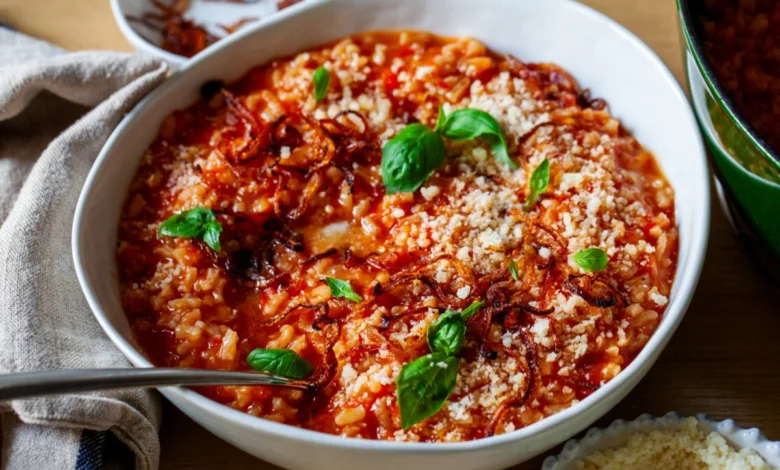
This specific iteration of tomato risotto combines simplified baking techniques with a unique textural element: frizzled red onions.

Ingredients and Preparation
The preparation centers on fresh, high-quality ingredients designed to maximize tomato flavor:
- Tomatoes: Halved tomatoes are grated against the large holes of a box grater, extracting the pulp and juices while discarding the outer skins, yielding approximately 2.5 to 3 cups of pulp.
- Aromatics and Fats: Olive oil serves as the cooking fat, paired with finely sliced red onions, minced garlic, a pinch of red pepper flakes, salt, and freshly ground black pepper.
- Rice and Liquids: Short-grain rice (traditionally Arborio or Carnaroli) is paired with a splash of dry white wine and plain water rather than stock.
- Finishing Elements: Butter or extra-virgin olive oil, grated Parmesan cheese, fresh basil leaves, and reserved crispy frizzled red onions.
Step-by-Step Methodology
- Preheating: The oven is preheated to 350°F (175°C).
- Onion Frizzling: In a 4-quart Dutch oven or deep, oven-safe lidded saucepan, 3 to 4 tablespoons of olive oil are heated over medium-high heat. Thinly sliced red onions are added and cooked, initially softening and eventually turning deeply golden brown and crisp after approximately 8 to 10 minutes. Half of these onions are removed, drained on a paper towel, seasoned with salt, and set aside.
- Toasting the Rice: Minced garlic is added to the remaining onions in the pan and sautéed for one minute, accompanied by salt, black pepper, and red pepper flakes. Uncooked short-grain rice is introduced, gently toasted in the aromatic oil for roughly 3 minutes.
- Deglazing and Baking: White wine is poured in and stirred until evaporated. Grated tomato pulp and 2 cups of water are incorporated, seasoned generously with kosher salt and black pepper. The mixture is brought to a brief simmer, after which the heat is turned off.
- Oven Phase: The pot is covered with a tight-fitting lid and transferred to the oven. Baking proceeds for 25 to 30 minutes until most liquid is absorbed, maintaining a slightly moist consistency.
- Creaming and Finishing: After removing the pot from the oven, the mixture is stirred vigorously for about 2 minutes to release starches and develop a creamy texture. Additional butter or olive oil is stirred in, and the dish is garnished with Parmesan cheese, torn basil leaves, and the reserved crispy red onions.
Consumer Sentiments and Broader Market Implications
The psychological resistance to early autumn marketing touches upon broader shifts in consumer behavior regarding food and seasonality. Market analysts note that while commercial entities advance holiday and seasonal timelines earlier each year—often introducing autumn-themed inventory as early as August—a counter-movement prioritizes localized, seasonal eating.

This tension reflects changing demographics and lifestyle priorities. Consumers increasingly value mindfulness and the preservation of seasonal rhythms over manufactured retail calendars. By insisting on cooking with tomatoes, zucchini, corn, and stone fruits during the final weeks of summer, home cooks assert control over their domestic environments, rejecting the psychological pressure to rush through the calendar year.
From an economic perspective, the extension of summer produce utilization supports local agriculture and farmers’ markets, which continue to harvest warm-weather crops well into September in many temperate regions. Utilizing bulk tomatoes for intensive preparations—such as grated pulps for risottos, sauces, and preserves—minimizes food waste and maximizes the economic value of seasonal produce at its peak ripeness and lowest cost.

Ultimately, culinary innovations that streamline traditional recipes, such as oven-baked risottos utilizing raw vegetable juices, point toward a more practical and accessible future for home cooking. By stripping away unnecessary steps and honoring the intrinsic flavors of seasonal ingredients, contemporary recipes bridge the gap between traditional techniques and the demands of modern schedules.