

A standard cup of black coffee is remarkably simple in its physical appearance, yet it represents an extraordinarily complex chemical matrix. When evaluated through analytical chemistry, a typical brew is composed of more than 98.5 percent water. The remaining 1.2 to 1.5 percent consists of total dissolved solids (TDS)—meaning that a single liter of brewed coffee contains roughly 12 to 15 grams of extracted matter derived from approximately 60 grams of roasted coffee grounds. However, this modest fraction of dissolved material encompasses hundreds, if not thousands, of distinct chemical molecules that dictate the beverage’s color, mouthfeel, aroma, and taste profile. Understanding the intricate balance of these compounds requires moving beyond basic measurements like TDS and examining the profound interplay between volatile aromatics, non-volatile tastes, and human sensory perception.
The Evolution of Coffee Chemistry Research
The scientific quest to map the chemical composition of coffee has evolved significantly over the past several decades, shifting from broad classifications to ultra-precise chromatographic analyses. Historically, food scientists struggled to isolate and identify the countless trace compounds responsible for the characteristic scent of freshly brewed coffee.
A pivotal milestone occurred in 1996, when researchers demonstrated that synthetic "model" coffees could be formulated using just 22 key volatile compounds. While assessors noted that these artificial mixtures were clearly reminiscent of coffee—successfully mimicking basic Arabica and Robusta profiles—they fell far short of replicating the profound depth and complexity of a natural brew.
Further advancements materialized in 2002 through Aroma Extract Dilution Analysis (AEDA). This advanced technique revealed that out of 40 primary odorants present in coffee, 13 remained entirely unknown to science. These unidentified molecules often present dual challenges to researchers: they either exist in concentrations far too low for sufficient sample collection, or they possess large, unwieldy molecular structures that complicate precise structural elucidation. Despite decades of analytical chemistry progress, the natural bean continues to outpace synthetic replication.

Volatile Versus Non-Volatile Compounds
The chemical constituents of coffee are broadly categorized into two primary groups: volatile and non-volatile compounds. Volatile compounds readily vaporize, traveling upward into the nasal passages to deliver the beverage’s rich aromatic profile. Conversely, non-volatile compounds remain in the liquid phase, interacting directly with taste receptors on the tongue.
While occasional molecular crossover exists, human taste thresholds are typically much higher than odor thresholds. Non-volatile components include carbohydrates such as sugars and soluble oligosaccharides, various organic acids, minerals and salts, proteins, lipids, and caffeine. These elements govern the fundamental tastes encountered in the cup, including bitterness, sweetness, acidity, and astringency. Furthermore, non-volatile lipids and microscopic insoluble particles significantly contribute to the physical body and texture of the beverage.
The Logarithmic Scale of Flavor and Odor Activity
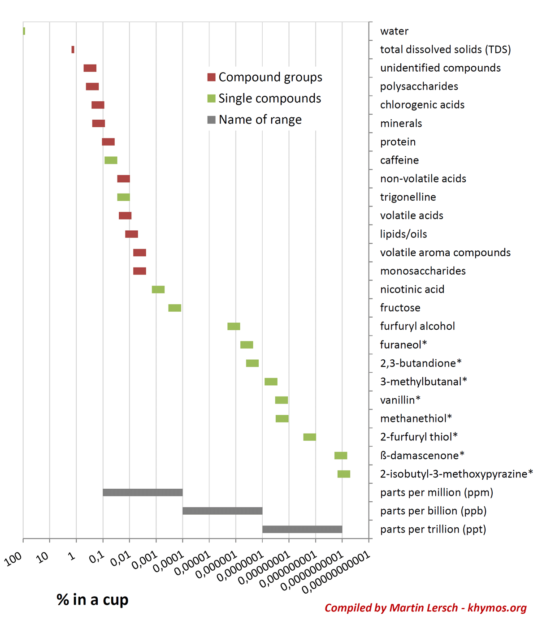
Plotting the concentration ranges of coffee compounds reveals an astonishing span across more than nine orders of magnitude, ranging from major macroscopic components down to minute trace elements measured in parts per trillion (ppt). A common misconception in food science is that lower concentration directly equates to lower sensory impact. While this linear relationship holds true when comparing individual compounds of the same family, it collapses entirely when evaluating disparate molecules.
Human olfactory sensitivity varies wildly across different chemical structures. Consequently, a compound present at an infinitesimal concentration of 0.0000000001 percent can exert just as much influence over the overall flavor profile as a macro-compound present at 0.01 percent.
This phenomenon is quantified using the Odor Activity Value (OAV), defined as a compound’s concentration divided by its specific odor threshold. A prime example is beta-damascenone, a potent molecule belonging to the rose ketone family. Originally discovered in rose oil during the 1960s—and famously utilized in the formulation of luxury fragrances like Dior’s Poison—beta-damascenone is present in coffee at concentrations as low as 1 part per trillion. Despite this minuscule presence, its exceptionally low odor threshold grants it a position among the top five most impactful odorants in coffee. Given the tedious and complex nature of quantifying substances at such extreme dilutions, flavor chemists anticipate the discovery of additional key odorants in future research.
Polar and Non-Polar Extraction Dynamics
The physical process of brewing coffee relies heavily on solvent dynamics, with water acting as the primary polar solvent. Polar compounds—including acids, minerals, proteins, and carbohydrates—readily dissolve in water. Standard brewing parameters allow water to successfully extract more than 75 percent of the available polar compounds from roasted grounds.
In contrast, non-polar compounds, which encompass vital aroma-delivering volatiles and hydrophobic lipids, exhibit very low solubility in water. Typically, only 10 to 30 percent of non-polar compounds make their way into a standard aqueous brew. This disparity highlights the inherent limitations of conventional water-based extraction and opens pathways for alternative solvent experimentation, such as the utilization of ethanol, to explore uncharted dimensions of coffee extraction.
Implications for Quality Control and Future Industry Standards
For commercial roasters, baristas, and quality control laboratories, measuring total dissolved solids remains the industry standard for determining coffee strength. However, the chemical realities of extraction reveal profound limitations in relying solely on TDS metrics.
Because different chemical groups extract at wildly varying rates—and because trace compounds operating at parts-per-trillion levels exert immense sensory influence without shifting the macro-TDS measurement—a standard TDS reading is notoriously poor at predicting actual aroma and flavor quality. While refractometers and TDS meters provide rapid, reliable data regarding extraction efficiency and strength, they cannot replace human sensory panels. As the specialty coffee industry continues to evolve, the combination of advanced chromatographic science and the unmatched analytical sensitivity of the human nose will remain essential for mastering the complex art and science of coffee extraction.







0 Komentar
Sampaikan opini dan diskusi yang membangun dengan bahasa yang santun.
No Comments Yet
Be the first to share your thoughts on this story.