Scaling the Lonely Mountain: A Definitive Exploration of Wat Phu Tok in Thailand’s Bueng Kan Province

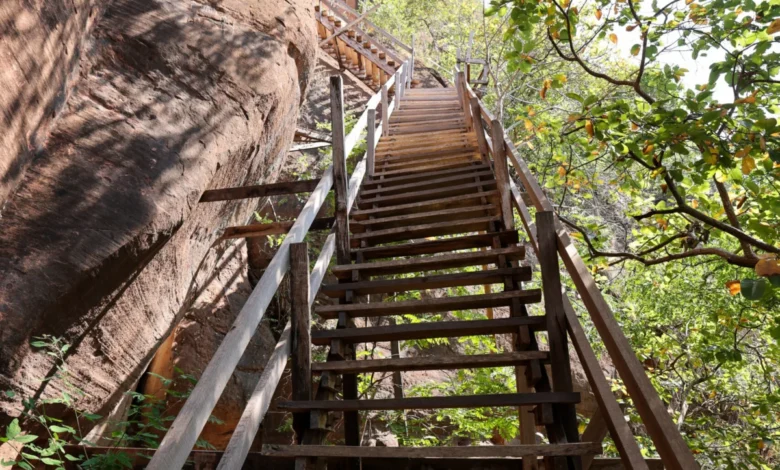
Nestled deep within the remote and tranquil landscapes of Thailand’s northeastern Isan region, the remote province of Bueng Kan houses one of the kingdom’s most architectural and structural marvels: Wat Phu Tok, formally registered as Wat Jetiyakhiri. Rising 359 meters above the flat agricultural plains, this isolated sandstone monolith commands attention not merely for its geographical singularity, but for the intricate, labyrinthine wooden scaffolding and staircases that wrap around its sheer cliffs. Often colloquially translated as the "lonely mountain," Phu Tok presents an intersection of devout Buddhist philosophy, daring engineering, and burgeoning off-the-beaten-path tourism.
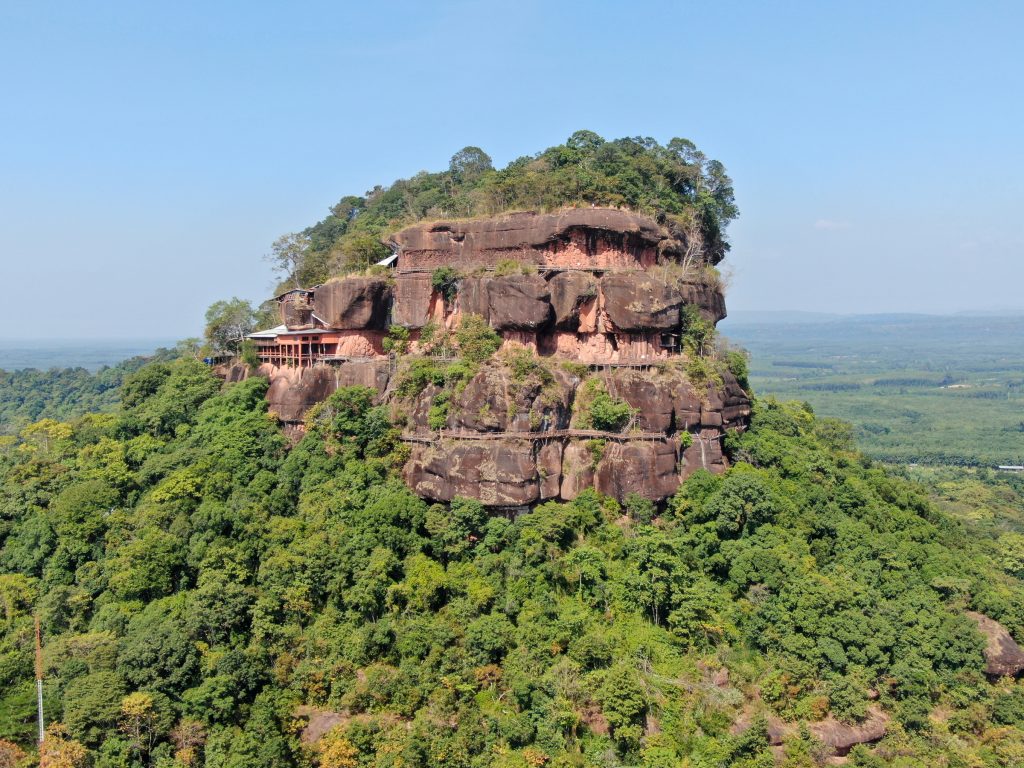
The historical genesis of Wat Phu Tok is deeply intertwined with the ascetic traditions of Thai forest Buddhism. Before the arrival of monastic foundations, the rugged, cavernous terrain of the mountain served as a natural habitat for diverse and potentially dangerous wildlife, most notably venomous snake populations. This remote and hazardous environment paradoxically made the site an ideal sanctuary for meditation. Monks seeking isolation from the secular world found that the inherent dangers of the mountain provided a physical manifestation of the hurdles one must overcome to achieve mental clarity and spiritual liberation.
The monumental task

of transforming the rugged rock formation into a functional temple complex was spearheaded by the revered ascetic monk Luang Pu Juan. Recognizing the spiritual potential of the landscape, Luang Pu Juan orchestrated the construction of a comprehensive network of wooden staircases, ladders, and cantilevered walkways. These structures were meticulously engineered to connect various natural caves, shrines, and isolated meditation cells scattered across the precipice.
Architecturally, the design of the mountain pathways was deliberately structured around Buddhist cosmology. The ascent to the summit is divided into seven distinct levels, meticulously corresponding to the seven stages of spiritual enlightenment in Buddhist meditation. Each tier offers a different physical and psychological challenge, culminating in the upper reaches of the monolith. Although the visionary founder, Luang Pu Juan, tragically perished in a commercial aviation accident years after the project’s inception, his monumental undertaking has been continuously maintained by subsequent generations of monks and local devotees. Today, the site stands as a testament to both human devotion and architectural audacity.

Geographically, Wat Phu Tok is situated approximately 30 minutes by road from the urban center of Bueng Kan city. Upon arrival, visitors are greeted by a sprawling infrastructure comprising a large primary temple complex, an expansive park, and a scenic lake designed to accommodate steady streams of domestic pilgrims and adventurous international travelers. The journey officially begins at the base of the mountain, where a gated entry transitions abruptly from standard terrestrial paths into the signature wooden construction that defines the ascent.
The lower tiers of the mountain—Levels One through Four—serve primarily as a transitional phase for visitors. The wooden planks here begin at a gentle incline before progressively steepening into near-vertical wooden ladders. While the construction utilizes flexible wood that yields slightly underfoot, structural assessments by local authorities and continuous maintenance ensure a high degree of safety, despite the psychological impact on visitors susceptible to vertigo. These initial levels feature sporadic shrines and quiet resting spots, though most travelers utilize them simply as transit zones toward the higher elevations.

Upon reaching the fifth level, the spatial dynamics of the temple change significantly. Unlike the narrow cliff-hugging corridors of the lower and higher tiers, the fifth level broadens into a substantial ground-level terrace. This plateau hosts the complex’s primary ordination hall, alongside numerous secondary shrines, meditation caves, and administrative buildings used by resident monks. The fifth level also serves as a junction for several secondary trails, including a notable detour leading to a small, isolated rock temple situated on a projecting spur of the mountain. Accessible via a narrow elevated rock walkway and a suspension footbridge, this secluded sanctuary represents one of the architectural highlights of the complex, offering a brief respite before the final ascent.
The sixth level of Wat Phu Tok is universally acknowledged as the structural and experiential centerpiece of the site. Comprising a roughly equal split of ground-level paths and precarious wooden plank walkways anchored directly into the vertical sandstone cliffs, this tier delivers the most dramatic visual and physical experience of the journey. The cantilevered wooden balconies wrap entirely around the perimeter of the mountain, affording unobstructed panoramic views of the surrounding Mekong River basin, the patchwork agricultural fields of Bueng Kan, and the dense jungle canopy below. While structural handrails and sound anchoring provide adequate physical security, navigating the sixth level requires intense concentration, as a lapse in attention along the cliff edge carries severe risks.

The culmination of the journey is the seventh level, the summit of the monolith. Historically and ecologically, this uppermost tier is heavily associated with the region’s dense wildlife population, specifically retaining a reputation for harboring venomous snakes. Consequently, local signage and monastic guidelines advise visitors to ascend to the seventh level strictly at their own risk. Architecturally, the summit diverges entirely from the structured lower tiers; it features no wooden walkways, formal shrines, or man-made infrastructure. Instead, it is a wild, forested plateau offering sporadic vantage points of the surrounding horizon. Most architectural historians and travel analysts concur that the seventh level is primarily of symbolic value, cementing the allegorical journey through the seven stages of enlightenment, while the sixth level remains the undisputed architectural masterpiece of the site.
From a socio-economic perspective, the integration of Wat Phu Tok into Thailand’s broader tourism framework reflects a deliberate national strategy to promote secondary destinations. As the Isan region continues to develop its tourism infrastructure, sites like Bueng Kan provide sustainable alternatives to heavily congested hubs such as Bangkok, Chiang Mai, or Phuket. Regional tourism boards emphasize that off-the-beaten-path attractions help distribute economic benefits more equitably across rural provinces while satisfying a growing global demand for nature-based and experiential travel.

Logistical data indicates that visitation peaks during the dry season, spanning from November to February, when weather conditions are optimal for outdoor physical activity and the risk of slick wooden surfaces is significantly minimized. Local authorities, in coordination with temple administrators, routinely conduct safety audits of the wooden scaffolding to withstand the seasonal influx of tourists. Furthermore, local economic impact studies suggest that the steady stream of visitors has positively stimulated regional hospitality sectors, including boutique accommodations, local eateries, and transportation services within Bueng Kan province.
Ultimately, Wat Phu Tok transcends its classification as a mere tourist attraction or historical landmark. It functions as a living monastery where ancient ascetic traditions intersect with structural engineering. By offering a physical manifestation of Buddhist spiritual progression through its seven meticulously designed tiers, the lonely mountain of Bueng Kan continues to challenge, inspire, and captivate those willing to brave its wooden staircases and confront the dizzying heights of the Isan wilderness.