Conquering Wat Phu Tok: Inside Thailand’s Most Daring Architectural and Spiritual Marvel

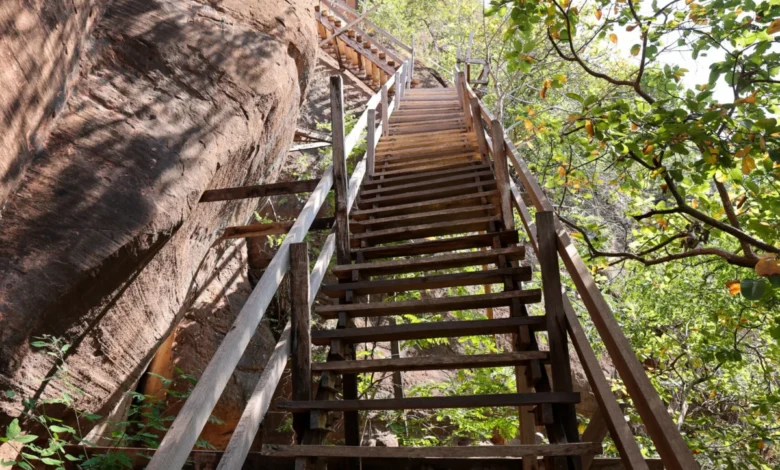
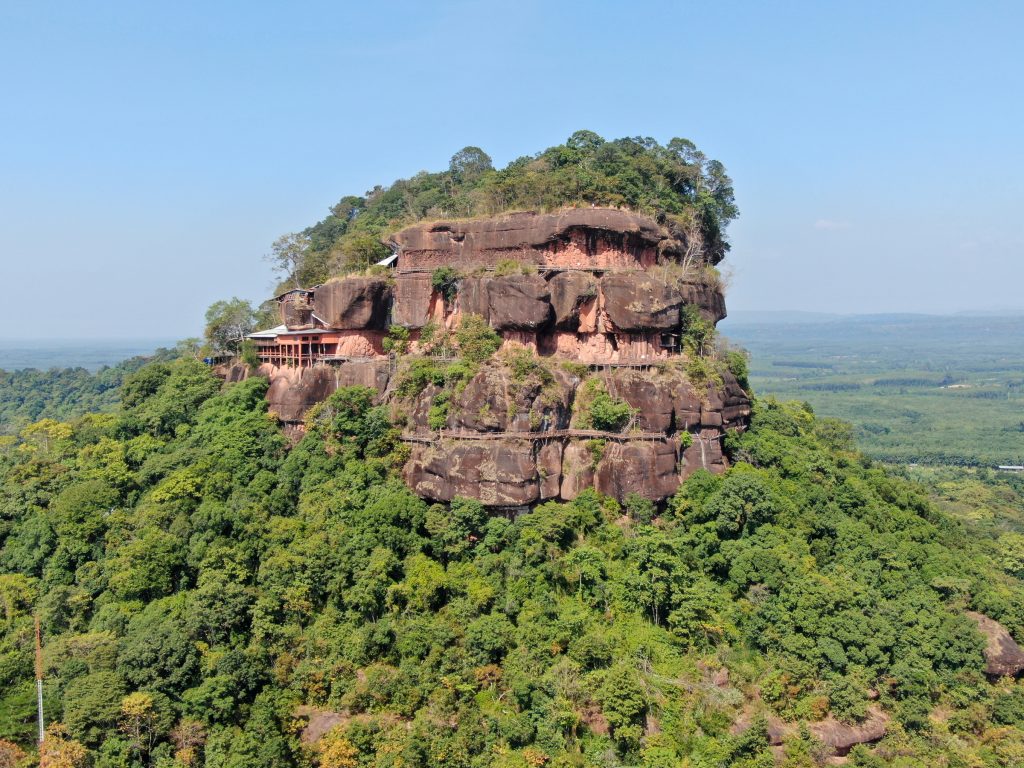
Rising dramatically from the flat, agrarian landscape of Thailand’s northeastern Isan region, the isolated sandstone monolith known as Wat Phu Tok stands as one of Southeast Asia’s most unorthodox architectural achievements. Officially designated as Wat Jetiyakhiri, this remote mountain temple complex in Bueng Kan province challenges visitors with a complex vertical labyrinth of cantilevered wooden walkways, sheer cliffside stairs, and deep spiritual symbolism. For travelers seeking alternatives to Thailand’s heavily commercialized southern beaches and central urban hubs, the site offers an immersive journey into off-the-beaten-path exploration, combining architectural ingenuity with Buddhist ascetic tradition.
Geographical and Historical Context
Located approximately 30 minutes from downtown Bueng Kan, the mountain formation commands attention due to its stark geological isolation. Geologists and travelers frequently compare its solitary rise to a smaller-scale version of Sigiriya in Sri Lanka. Standing at an elevation of 359 meters, the site derives its local Isan moniker, "Phu Tok," directly from its geographical reality, translating simply to "Lonely Mountain."

The history of the temple is deeply rooted in the traditions of Thai forest-tradition Buddhism. Historically, the rugged terrain, dense surrounding flora, and prevalence of indigenous wildlife—particularly venomous snake populations—rendered the mountain largely inhospitable. However, these very elements made the remote peak an ideal sanctuary for ascetic monks seeking solitude, seclusion, and an environment conducive to deep meditation.
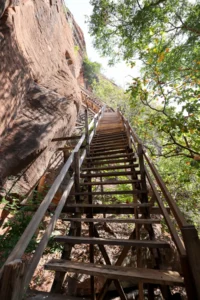
The physical transformation of the mountain began under the direction of the revered monk Luang Pu Juan. Recognizing the spiritual potential of the rugged terrain, Luang Pu Juan spearheaded an ambitious community-driven engineering effort. Monks, novices, and local villagers collaborated to construct a network of wooden staircases, vertical ladders, and suspended

walkways. These pathways were meticulously designed to link various natural caves, hidden shrines, and secluded meditation platforms scattered across the steep rock faces.
The Architecture of the Seven Levels

The structural layout of Wat Phu Tok is not merely functional; it is deeply symbolic. The temple’s ascent is deliberately engineered across seven distinct levels, a direct architectural representation of the seven stages of Buddhist enlightenment and mindfulness.
The journey begins at the base of the mountain, where a large monastic complex, a serene lake, and landscaped parklands welcome visitors. The ascent starts via a series of relatively stable wooden staircases that gradually grow steeper as they wind toward the upper tiers.

By the time visitors reach the fifth level, the terrain transitions into a more expansive plateau. This tier serves as the primary administrative and ceremonial hub of the mountain complex, housing the principal ordination hall alongside numerous smaller shrines and resting pavilions. Detours along this level lead adventurous hikers to hidden rock temples perched precariously on secondary outcroppings, connected by narrow wooden suspension bridges that offer panoramic vistas of the surrounding Mekong River basin.
The sixth level represents the structural and psychological pinnacle of the Wat Phu Tok experience. Approximately half of the pathway on this tier consists of wooden planks anchored directly into the vertical rock face of the cliff. These cantilevered walkways provide unobstructed, sweeping views of the verdant Bueng Kan province below. While engineers and maintenance crews ensure the structural integrity of the timber framework, the narrow paths, natural sway of the wood, and sheer vertical drops induce a palpable sense of vertigo, requiring strict vigilance from all who traverse them.

The final stage of the climb, the seventh level, marks the summit of the mountain. Unlike the bustling infrastructure of the lower and middle tiers, the seventh level offers no man-made walkways, elaborate shrines, or tourist amenities. Historically documented as a natural habitat for indigenous wildlife, including venomous snakes, access to this uppermost plateau is undertaken strictly at the visitor’s own risk. It serves primarily as a quiet, undisturbed vantage point for those completing the symbolic ascent.
Socio-Economic Implications and Tourism Impact

The ongoing preservation of Wat Phu Tok carries significant implications for the local economy of Bueng Kan, one of Thailand’s newest provinces established officially in 2011. Historically reliant on rubber cultivation and cross-border trade with Laos, the region has seen a gradual influx of domestic and international travelers drawn to its natural and cultural assets.
Tourism authorities and regional planners view sites like Wat Phu Tok as vital components in sustainable tourism diversification strategies. By drawing visitors away from saturated urban centers like Bangkok or Chiang Mai and toward the Isan region, regional stakeholders aim to stimulate rural hospitality sectors, small-scale transport services, and local culinary enterprises.

At the same time, managing visitor flow at a site defined by delicate wooden infrastructure presents unique challenges. Temple administrators and local maintenance teams continually balance the demands of public accessibility with structural preservation. Routine safety inspections of the timber walkways, anchoring bolts, and ladder systems are paramount, particularly given the tropical weather patterns characterized by heavy monsoon rains and high winds that accelerate timber degradation.
Visitor Guidelines and Practical Safety Measures

Navigating Wat Phu Tok requires careful preparation and physical endurance. Tourism officials and experienced travelers emphasize several essential guidelines for those planning an excursion to the remote site:
- Physical Readiness: The climb involves steep vertical ascents, narrow ledges, and uneven footing. Individuals with severe vertigo, mobility impairments, or cardiovascular conditions are strongly advised against attempting the upper tiers.
- Appropriate Attire: As an active Buddhist temple, visitors must adhere to modest dress codes, covering their shoulders and knees. Sturdy, closed-toe footwear with reliable grip is mandatory for navigating the wooden boardwalks.
- Weather Considerations: Ascents should be avoided during heavy rainfall, as the wooden planks and natural rock surfaces become exceptionally slick, significantly increasing the risk of accidents.
- Environmental Respect: Given the remote and ecologically sensitive nature of the mountain, visitors are expected to pack out all waste, maintain a respectful quietude suitable for a meditation ground, and avoid disturbing local fauna.
Through its striking synthesis of daring civil engineering, deep religious symbolism, and raw natural beauty, Wat Phu Tok remains a defining landmark of northeastern Thailand. It continues to challenge the limits of structural design while offering a profound sanctuary of peace and reflection high above the Isan plains.