Conquering Wat Phu Tok: Thailand’s Architectural Wonder and Cliffside Spiritual Journey in Bueng Kan

Nestled in the remote and verdant expanse of Thailand’s northeastern Isan region, the province of Bueng Kan remains one of the country’s best-kept secrets for travelers seeking solitude, expansive natural landscapes, and off-the-beaten-path destinations. Rising dramatically from this flat, rural terrain is an isolated red sandstone monolith known scientifically as an inselberg, upon which sits Wat Jetiyakhiri, more universally recognized by locals as Wat Phu Tok. Derived from the local Isan dialect, "Phu Tok" translates directly to "lonely mountain," an apt descriptor for the 359-meter-high formation that stands in striking geographical isolation, drawing comparisons to a smaller-scale version of Sri Lanka’s famed Sigiriya.
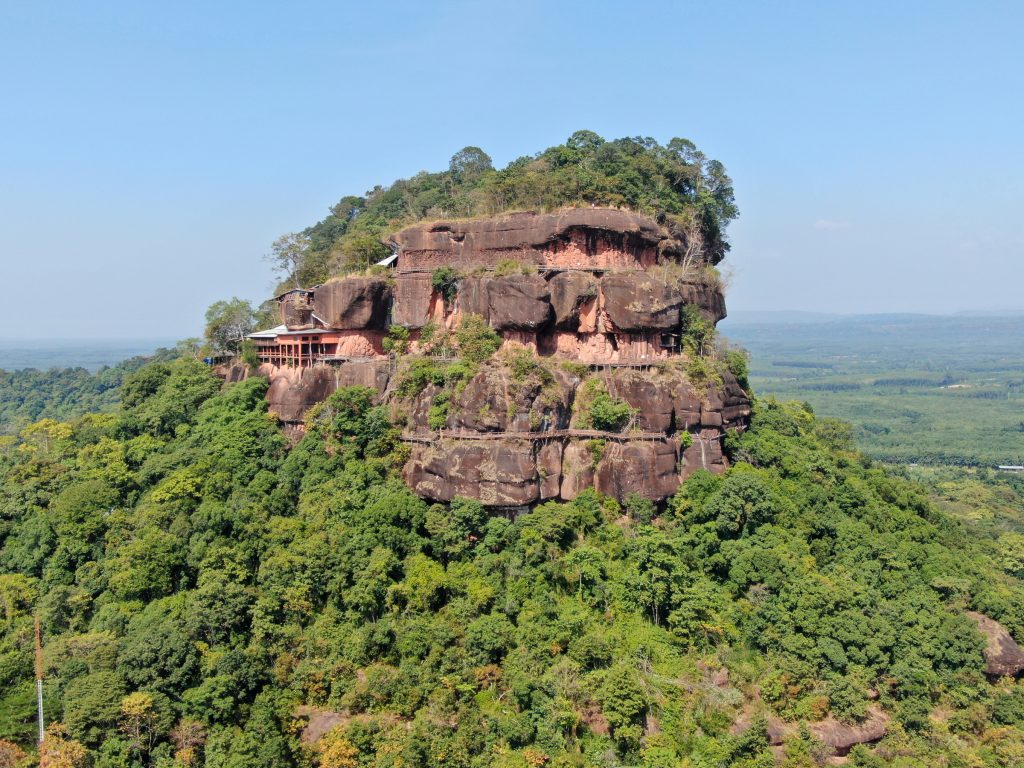
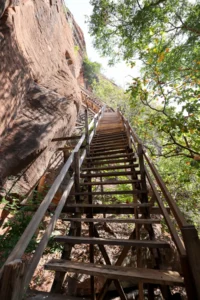
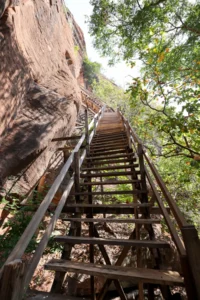
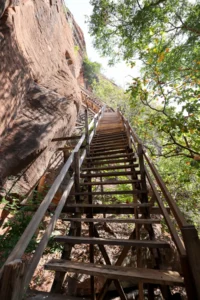
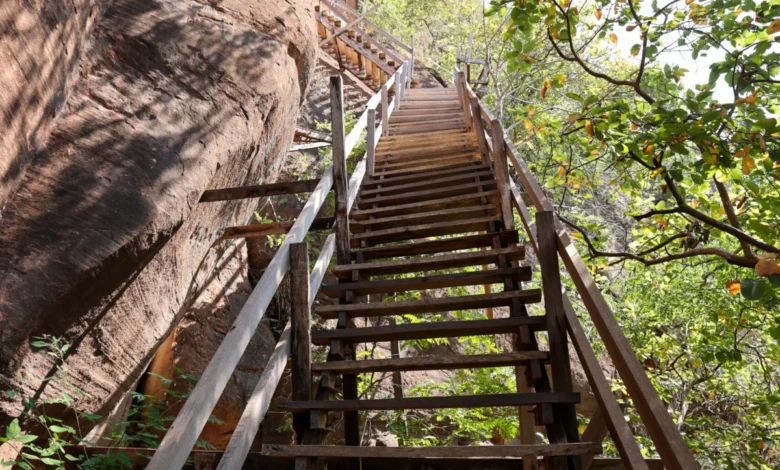
The temple is far more than an arresting visual landmark; it is a masterclass in vernacular engineering, religious devotion, and architectural daring. Designed as a physical manifestation of the spiritual path toward Buddhist enlightenment, Wat Phu Tok features an intricate system of wooden staircases, suspended ladders, and cliff-anchored walkways winding across seven distinct tiers. For travelers and pilgrims alike, ascending the mountain offers an experience that blends profound architectural ambition with a palpable sense of physical peril, making it one of the most uniquely challenging cultural heritage sites in Southeast Asia.
Historical Origins and Architectural Conception

The origins of Wat Phu Tok are deeply rooted in the ascetic traditions of Thai Buddhism. Historically, the rugged terrain, dense surrounding flora, and remote location of the inselberg made it a natural habitat for diverse wildlife, most notably populations of venomous snakes. Rather than deterring visitors, these challenging environmental factors made the mountain an ideal sanctuary for meditation. In Buddhist monastic practice, physical isolation and the overcoming of primal fears are viewed as vital catalysts for spiritual introspection and mental clarity.
The monumental task of transforming the sheer rock face into a functional monastery was spearheaded by the revered monk Luang Pu Juan. Under his guidance, construction began on the intricate network of wooden pathways designed to connect various meditation cells, shrines, and sacred spaces scattered across the cliffside. The master plan was deliberately conceived with seven distinct levels, a direct architectural metaphor for the seven stages of spiritual awakening and mental purification outlined in Buddhist theology.

The construction methodology relied heavily on manual labor, traditional carpentry, and sheer ingenuity. Workers anchored wooden beams directly into the vertical sandstone precipices, fashioning cantilevered walkways that hugged the contours of the mountain. While Luang Pu Juan tragically lost his life in a subsequent aircraft accident before the site’s complete evolution, his disciples and local conservationists have maintained the infrastructure meticulously. Today, the site stands as both a monument to his spiritual vision and a triumph of rural Thai craftsmanship.
Geographical Context and Arrival Logistics

Located approximately 30 minutes by road from the burgeoning urban center of Bueng Kan city, the temple complex is easily accessible by private vehicle or local transport, though it remains largely insulated from mass tourism due to its geographic isolation. Upon arrival, visitors are greeted by a sprawling infrastructure at the base of the mountain, featuring a serene lake, a spacious park, and ample parking facilities designed to accommodate the steady trickle of intrepid tourists and devout pilgrims.
The ascent begins modestly near the main temple gate at the base. Initial pathways consist of standard paved trails that quickly transition into sturdy wooden staircases. As visitors progress past the preliminary levels, the gradient steepens noticeably. The stairs evolve into near-vertical wooden ladders, testing the physical endurance and resolve of climbers. Despite the alarming visual angle and the natural elasticity of aged timber underfoot, the structural integrity of the walkways is routinely inspected and reinforced by local temple authorities to ensure public safety.

Navigating the Seven Levels of Enlightenment
The architectural and spatial organization of Wat Phu Tok is strictly stratified across its seven levels, each offering distinct topographical features and religious significance.

The lower levels, spanning tiers one through four, primarily serve as transitional zones. While occasional small shrines and meditation platforms are carved into the rock, these tiers are largely functional, serving to channel foot traffic upward and acclimatize climbers to the increasing altitude and exposure.
Upon reaching the fifth level, the spatial dynamic shifts dramatically. This tier widens considerably, moving away from narrow cliffside trails to ground-level paths that weave through shaded forest floors and rock formations. The fifth level functions as the administrative and communal heart of the monastic complex, housing the largest ordination hall and numerous auxiliary shrines. It is also the departure point for several worthwhile detours, including a secluded rock temple situated on a minor outcropping connected by a narrow wooden bridge. This architectural appendage offers an intimate glimpse into the contemplative life of the resident monks, far removed from the primary tourist route.

The sixth level represents the structural and experiential climax of the entire complex. Accounting for roughly half of the mountain’s circumference, the pathway on this level consists entirely of cantilevered wooden planks bolted directly into the sheer vertical rock face, suspended high above the jungle canopy. Walking the sixth level requires a balance of composure and vigilance; while handrails and stabilizing beams are robust, the sheer drop-off below demands absolute concentration. From this elevated vantage point, visitors are rewarded with panoramic, unobstructed vistas of the sprawling Mekong River basin and the dense, undulating green canopy of Bueng Kan province. The combination of high-altitude exposure, sweeping mountain breezes, and architectural audacity creates an atmosphere that is simultaneously exhilarating and deeply humbling.
The final frontier, the seventh level, marks the summit of the mountain. According to local advisories, access to the seventh tier is undertaken strictly at the visitor’s own risk, owing to the historical presence of venomous snakes and the complete absence of engineered infrastructure. Unlike the meticulously crafted walkways of the lower tiers, the summit is an untamed natural space devoid of shrines or artificial pathways. While it offers secluded vantage points for those who navigate the final scramble, most experts and seasoned travelers agree that the architectural and visual zenith of Wat Phu Tok resides firmly on the sixth level.

Socio-Economic and Tourism Implications
As Bueng Kan continues to develop its regional tourism infrastructure following its official establishment as Thailand’s 77th province in 2011, sites like Wat Phu Tok play a pivotal role in regional economic diversification. Tourism boards across the Isan region have increasingly emphasized off-the-beaten-path destinations to alleviate the economic pressures of over-tourism concentrated in traditional hotspots like Bangkok, Chiang Mai, and Phuket.

The influx of eco-tourists and adventure travelers to Wat Phu Tok stimulates local micro-economies, benefiting nearby hospitality providers, transportation services, and food vendors. However, this growth necessitates careful balancing acts between commercial promotion and heritage preservation. Conservationists emphasize that the delicate wooden infrastructure anchored into the fragile sandstone cliffs requires continuous financial investment and rigorous safety standards to withstand both environmental weathering and increasing foot traffic.
Furthermore, the site serves as a vital cultural touchstone for Theravada Buddhism in northeastern Thailand, preserving ancient traditions of forest monasticism that prioritize asceticism, communion with nature, and physical endurance as pathways to spiritual liberation.

Practical Guidance for Prospective Visitors
For travelers planning an excursion to Wat Phu Tok, preparation is paramount. Officials recommend scheduling visits during the early morning hours to beat the intense tropical heat of the Isan region and to experience the mountain during its most tranquil periods. Proper footwear with high-traction soles is mandatory, as wooden surfaces can become slick during the monsoon season or early morning condensation.

Visitors are also reminded that Wat Phu Tok remains an active, sacred place of worship. Appropriate modest attire—covering shoulders and knees—is strictly required throughout the temple grounds, and respectful decorum is expected of all guests. By respecting both the physical hazards of the cliffside architecture and the spiritual sanctity of the monastic community, visitors can ensure a safe and profoundly memorable journey to one of Thailand’s most extraordinary architectural achievements.