The Vertiginous Path to Enlightenment: A Comprehensive Guide to Wat Phu Tok in Bueng Kan Province

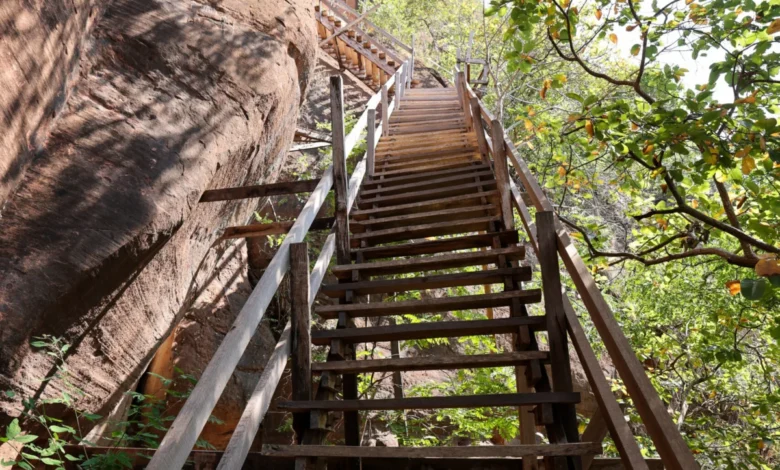
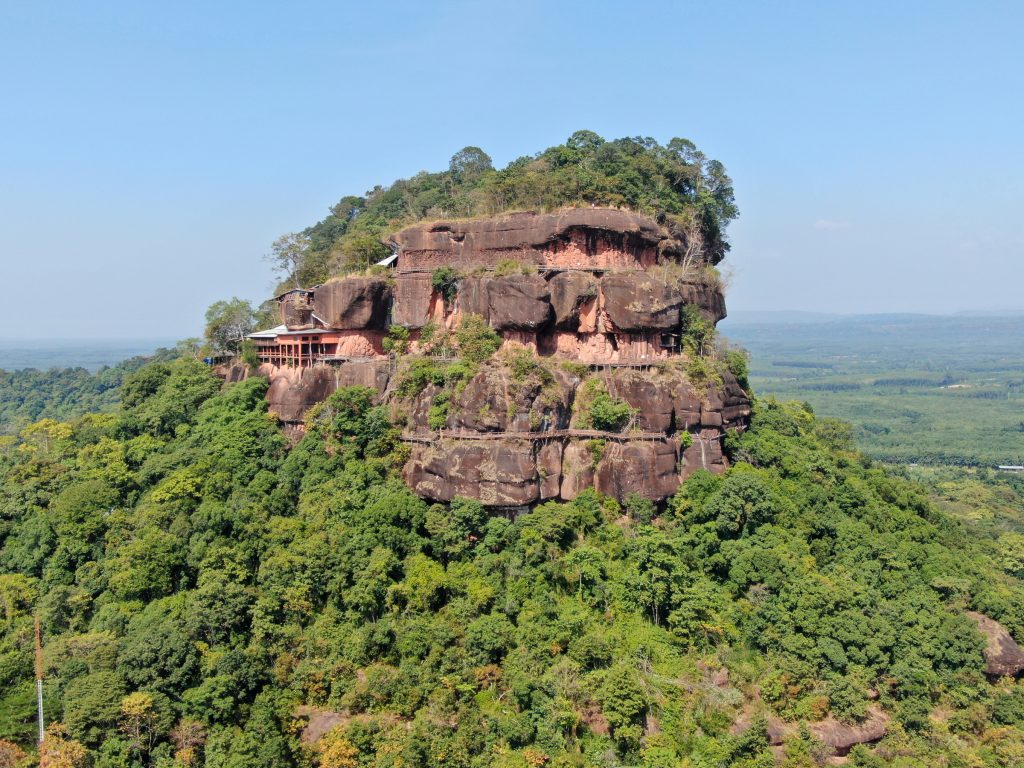
Wat Phu Tok, officially known as Wat Jetiyakhiri, stands as a testament to both architectural ingenuity and spiritual devotion, situated in the remote Bueng Kan province of Thailand’s northeastern Isan region. This sandstone outcrop, which rises 359 meters above the surrounding plains, has earned a reputation as one of the most adventurous and psychologically challenging religious sites in Southeast Asia. Characterized by a series of wooden staircases and boardwalks that cling to the sheer faces of a red rock mountain, the temple serves as a physical metaphor for the seven stages of Buddhist enlightenment. Located approximately 30 kilometers from the city of Bueng Kan and roughly 185 kilometers from the regional hub of Udon Thani, the site offers a stark contrast to the gilded urban temples of Bangkok, emphasizing the "forest monk" tradition of meditation, seclusion, and the overcoming of earthly fears.
Historical Foundation and the Vision of Luang Pu Juan
The transformation of the "lonely mountain"—the literal translation of Phu Tok—into a site of national religious significance began with the late Monk Luang Pu Juan. A prominent figure in the Thai Forest Tradition (Kammaṭṭhāna), Luang Pu Juan sought out the mountain in the mid-20th century specifically for its isolation and its reputation for being inhabited by venomous snakes and wild animals. In the Buddhist forest tradition, such environments are considered ideal for meditation because they force the practitioner to confront the reality of mortality and develop a heightened state of mindfulness.
Construction of the wooden infrastructure began in 1969. Remarkably, the intricate system of stairs and walkways was built without the aid of heavy machinery or modern engineering equipment. Instead, the monks and local volunteers utilized manual labor, anchoring wooden beams directly into the sandstone crevices. The project took five years to reach a state of completion that allowed for a full ascent.

The history of the temple is also marked by tragedy. In April 1980, Luang Pu Juan was one of several high-ranking monks who died in a Thai Airways flight crash near Bangkok. Despite the loss of its founder, the temple has been meticulously maintained by the resident monastic community and the local government of Bueng Kan, which was established as Thailand’s 77th province in 2011. Today, Wat Phu Tok serves as the province’s primary cultural landmark and a symbol of the region’s spiritual resilience.
Architectural and Spiritual Chronology: The Seven Levels
The ascent of Wat Phu Tok is structured into seven distinct levels, each corresponding to a stage of the Satta Bojjhanga (the Seven Factors of Enlightenment) in Buddhist philosophy. This progression is designed to be both a physical journey and a meditative exercise.

The Lower Tiers: Preparation and Entry
The first and second levels consist of ground-level paths and initial wooden stairs that lead visitors through dense tropical foliage at the base of the mountain. These levels represent the preliminary stages of mindfulness. At the trailhead, visitors pass through a formal gate where they are expected to adhere to a strict code of conduct, including modest dress and silence. The terrain here is relatively gentle, though the humidity of the Isan region provides the first physical challenge of the trek.
The Middle Tiers: The Transition to the Cliffside
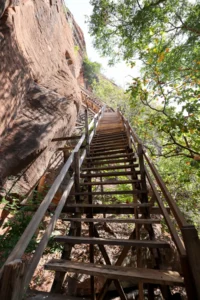
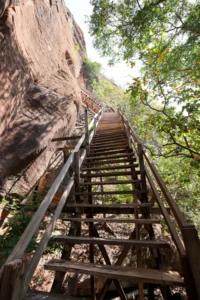
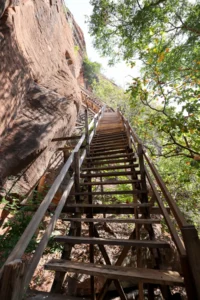
As climbers reach the third and fourth levels, the incline increases sharply. The staircases transition from earth-bound steps to suspended wooden structures. These levels begin to offer glimpses of the surrounding Khorat Plateau. From a spiritual perspective, these tiers represent the effort and joy required to sustain spiritual practice. The craftsmanship of the wooden planks becomes more apparent here; despite their weathered appearance, the structures are regularly reinforced to ensure the safety of the hundreds of pilgrims who visit weekly.

The Fifth Level: The Heart of the Temple
The fifth level serves as the primary hub for religious activity. It features a large ordination hall (Ubosot) nestled against the rock face, along with various shrines and grottoes used for meditation. One of the most striking features of this level is a natural rock bridge that leads to a detached sandstone spire, often referred to as the "Wihan." This area provides a panoramic view of the mountain’s unique geology, characterized by deep red iron-oxide staining and wind-eroded crevices.
The Sixth Level: The Path of Fear and Beauty
The sixth level is widely considered the architectural highlight of Wat Phu Tok. It consists of a 400-meter wooden boardwalk that encircles the mountain, bolted directly into the vertical cliff face. To the left of the walker is the solid rock wall; to the right is a sheer drop of hundreds of meters with only a modest wooden handrail for security.

This level is intended to test the "equanimity" of the practitioner. The panoramic views from the sixth level extend across the Mekong River basin and, on clear days, into the Bolikhamsai Province of neighboring Laos. The experience of walking on the creaking planks, suspended high above the forest floor, is designed to induce a state of "heightened awareness," a core goal of Buddhist meditation.
The Seventh Level: The Summit and the Wilderness
The final level is accessed by a steep, ladder-like staircase. Unlike the lower levels, the seventh level is largely undeveloped and overgrown with forest. It represents the final stage of enlightenment—total liberation. Access to this level is sometimes restricted due to the presence of wildlife, including snakes, which the monks protect as part of the mountain’s natural ecosystem. There are no shrines or boardwalks at the very top, emphasizing the Buddhist concept that the ultimate destination is a return to nature and a state of emptiness.

Technical Specifications and Environmental Context
Geologically, Phu Tok is a classic example of the sandstone buttes found throughout the Isan region. The mountain is composed of sedimentary rock layers that date back to the Cretaceous period. The red hue is a result of high iron content in the sandstone, which has oxidized over millions of years.
The wooden walkways are primarily constructed from local hardwoods, chosen for their resistance to rot and termites. However, the extreme weather conditions of northeastern Thailand—characterized by a harsh monsoon season and intense summer heat—require a continuous cycle of maintenance. The temple’s resident monks, often assisted by local engineers, conduct daily inspections of the boardwalks.

In terms of logistics, the climb to the sixth level typically takes between 45 minutes to an hour, depending on the visitor’s fitness level. There is no entrance fee, although donations are vital for the upkeep of the wooden structures. The temple is generally closed during the peak of the rainy season (specifically during the Songkran festival in April) to prevent accidents on slippery surfaces.
Regional Economic and Tourism Impact
The rise of Wat Phu Tok as a tourist destination has played a significant role in the economic development of Bueng Kan. As Thailand’s newest province, Bueng Kan has sought to distinguish itself from more established tourist hubs like Chiang Mai or Phuket by promoting "Green and Cultural Tourism."

Data from the Ministry of Tourism and Sports indicates that while Isan remains the least visited region by international tourists, domestic "merit-making" travel is on the rise. Wat Phu Tok acts as an anchor attraction, drawing visitors who then frequent local homestays, restaurants, and markets. The provincial government has recently invested in improving the road infrastructure leading to the temple to accommodate tour buses while attempting to maintain the site’s "off-the-beaten-path" appeal.
However, the increase in tourism presents a challenge for the monastic community. The influx of "adventure seekers" who visit for the "thrill" of the walkways sometimes clashes with the meditative silence required by the resident monks. To manage this, the temple has implemented strict visiting hours and zoning, ensuring that certain areas remain reserved exclusively for meditation.

Cultural Etiquette and Safety Analysis
For the international traveler, Wat Phu Tok requires a level of cultural sensitivity and physical preparation not typically associated with leisure tourism.
- Dress Code: As a sacred site, shoulders and knees must be covered. Footwear must be removed before entering any of the shrines on the fifth level.
- Physical Demands: The climb is strenuous and not recommended for those with vertigo, heart conditions, or mobility issues.
- Safety Philosophy: Unlike Western tourist attractions, there are no safety harnesses or high-tech netting. The safety of the visitor is predicated on personal responsibility and mindfulness—a reflection of the temple’s spiritual teachings.
From a journalistic perspective, Wat Phu Tok represents a unique intersection of religious devotion and environmental adaptation. It is a site where the architecture does not merely house the faith but is itself an instrument of the faith. The "scary" nature of the walkways is not a flaw in design but a deliberate psychological tool intended to strip away the distractions of the ego.

Implications for the Future
As Bueng Kan continues to develop, Wat Phu Tok faces the delicate task of balancing its role as a provincial icon with its primary function as a secluded monastery. The preservation of the wooden walkways remains a constant financial and logistical hurdle. Furthermore, as global travel trends shift toward "authentic" and "transformative" experiences, the temple is likely to see a continued increase in international interest.
The legacy of Monk Luang Pu Juan lives on in the creaking timber and the silent vistas of Phu Tok. By transforming a "lonely mountain" into a ladder to the heavens, the founders created a landmark that challenges the body as much as it inspires the spirit. Whether viewed as an engineering marvel, a grueling hike, or a profound religious pilgrimage, Wat Phu Tok remains one of the most significant and evocative sites in the Kingdom of Thailand.