Conquering Thailand’s Vertical Labyrinth: A Comprehensive Guide to Wat Phu Tok in Bueng Kan Province

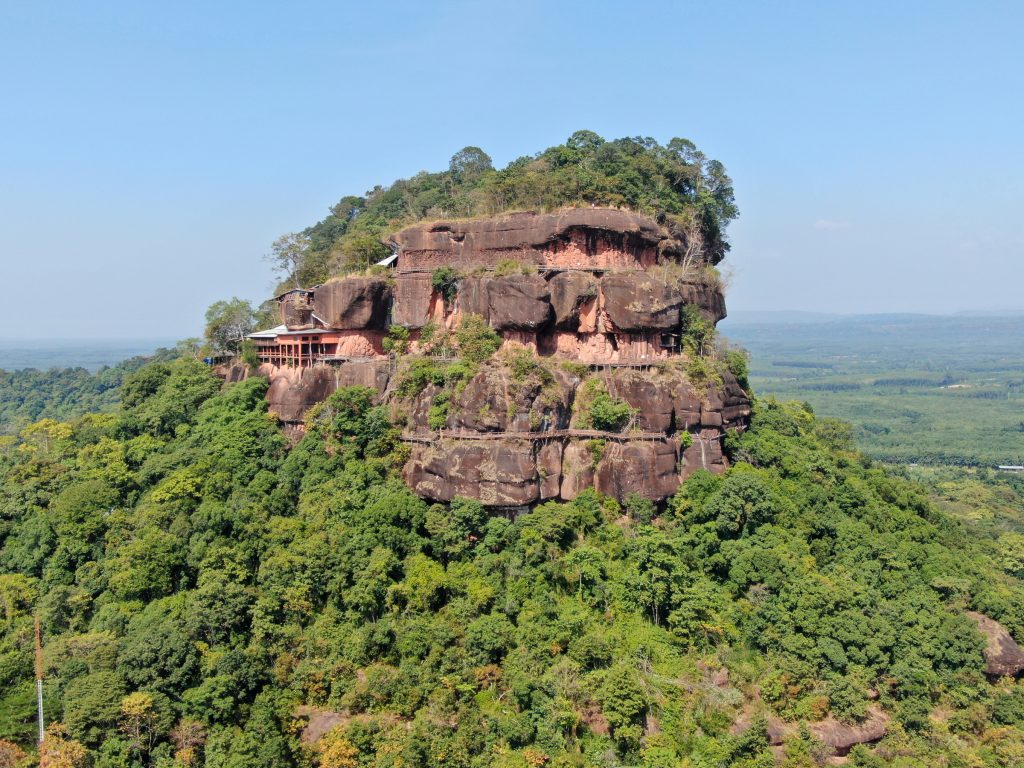
Rising sharply from the flat, agrarian landscapes of northeastern Thailand, Wat Phu Tok—officially designated as Wat Jetiyakhiri—stands as one of the most architectural and engineering marvels in Southeast Asia. Located in the remote Bueng Kan province within the Isan region, this striking sandstone inselberg has long captured the attention of intrepid travelers, spiritual seekers, and architectural historians alike. Translating locally from the Isan dialect as the "lonely mountain," Phu Tok reaches an elevation of 359 meters, dominating the surrounding terrain and offering a unique synthesis of Buddhist spirituality and death-defying engineering.
The Genesis and Vision of Luang Pu Juan
The history of Wat Phu Tok is inextricably linked to the austere traditions of Thai forest Buddhism. For generations, the mountain’s rugged, densely forested slopes and treacherous terrain remained largely untouched, save for the indigenous wildlife, which notoriously included populations of venomous snakes. This isolation, however, made the site an ideal environment for monks seeking solitude and deep meditation. The physical and psychological challenges posed by the harsh natural elements were viewed as spiritual obstacles to be overcome on the path to enlightenment.

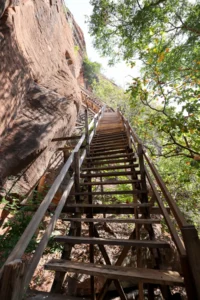
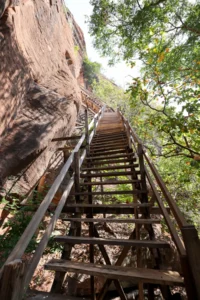
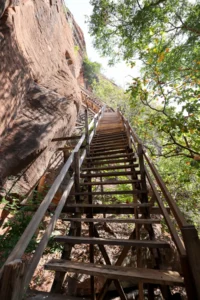
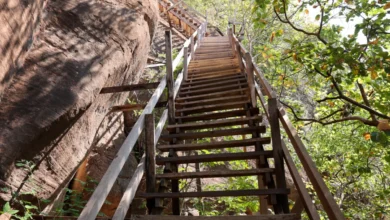
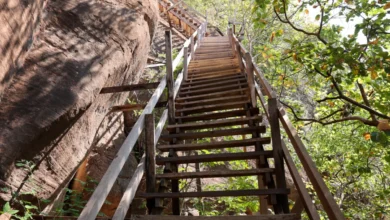
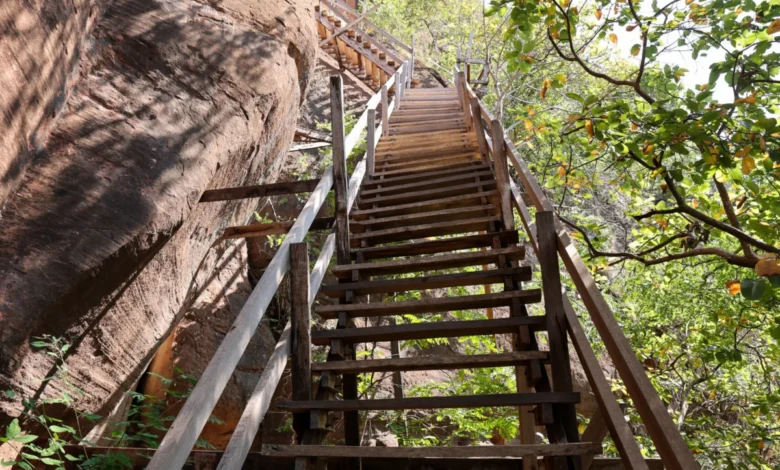
In the mid-20th century, the revered monk Luang Pu Juan arrived at the mountain with the vision of establishing a permanent meditation retreat. Recognizing the need for infrastructure that could allow practitioners to navigate the sheer vertical cliffs without destroying the natural habitat, Luang Pu Juan orchestrated the construction of an intricate system of wooden staircases, suspended ladders, and cantilevered walkways. Initiated in the late 1960s or early 1970s—with local monastic records placing the intensive construction phase across more than a decade—this massive undertaking was carried out largely by hand using primitive tools and local timber.
The overarching design of the temple complex was intentionally conceptualized around Buddhist cosmology. The mountain was divided into seven distinct vertical levels, directly correlating to the seven stages of spiritual awakening and meditation required to achieve liberation in Buddhist philosophy. Tragically, Luang Pu Juan did not live to see the completion of his life’s work; he perished in a heavily publicized royal Thai Air Force plane crash in 1980 alongside several other senior meditation masters. Despite this profound loss, the monastic community and local volunteers have continuously maintained and restored the wooden infrastructure, preserving the site as a functioning monastery and a monumental feat of vernacular engineering.

Architectural Layout and the Seven Levels of Ascension
Visitors arriving at the base of Wat Phu Tok find a sprawling complex featuring a large lake, a central park, and a traditional lower temple. From this entry point, the journey upward begins via a paved path that rapidly transitions into the signature wooden architecture that defines the site.

The ascent through the seven levels is a graduated physical and psychological experience:
Levels One through Four: These initial tiers serve as the transition zone from the base of the mountain. The pathways here are relatively wide, consisting of dirt trails interspersed with low-angle wooden steps. Shrines, small resting areas, and natural rock formations begin to appear, though the landscape remains heavily dominated by the dense secondary forest characteristic of the Isan region. The wooden planks on these levels are securely anchored, providing a stable footing for climbers.

The Fifth Level: Serving as the administrative and communal heart of the mountain monastery, the fifth level features a substantial flattening of the terrain. Here, visitors encounter the primary ordination hall (Ubosot), along with numerous residential quarters for resident monks, auxiliary shrines, and meditation pavilions. Unlike the precarious cliffside trails of the upper tiers, the fifth level largely consists of ground-level earth paths winding through shaded clearings. It is also from this level that travelers can take a notable detour along an elevated rock walkway leading to an isolated cliffside shrine—a minor architectural marvel featuring a suspended wooden bridge traversing a natural chasm.
The Sixth Level: Universally recognized by visitors as both the architectural highlight and the most harrowing section of Wat Phu Tok, the sixth level is defined by its sheer cliffside exposure. Approximately half of this level’s circumference is composed of narrow wooden plank walkways bolted directly into vertical sandstone faces via steel anchors. The planks occasionally flex underfoot, providing a tactile reminder of the void inches away. While civil engineering assessments indicate that the structure is regularly inspected and reinforced, the psychological toll of traversing a thirty-centimeter-wide ledge hundreds of feet in the air remains significant. The reward for this ascent is an uninterrupted panoramic view of the Mekong River basin, the borderlands of neighboring Laos, and the vast agricultural expanses of Bueng Kan province.

The Seventh Level: The final tier marks the physical summit of the mountain. Accessible via a final, steep series of wooden ladders, the seventh level is entirely devoid of the intricate wooden walkways found below. Historical records and local monastic warnings emphasize that this zone is heavily populated by venomous snakes, particularly vipers, which thrive in the undisturbed brush of the summit. Consequently, access to the seventh level is officially discouraged for casual tourists and is reserved primarily for dedicated monastics and experienced guides. The summit offers additional vantage points, though most visitors agree that the architectural and visual pinnacle of the experience occurs on the sixth level.
Regional Impact and Tourism Demographics

Bueng Kan was officially established as Thailand’s 77th province in March 2011, having been separated from Nong Khai province to improve administrative efficiency and boost regional development. Since its establishment, the provincial government has sought to promote sustainable, low-impact tourism to leverage its natural assets, which include the famous Red Lotus Lake, Hin Sam Wan (Three Whale Rock), and Wat Phu Tok.
Unlike the heavily commercialized tourist centers of Phuket, Chiang Mai, or central Bangkok, Bueng Kan remains largely off the conventional international tourism trail. Data from the Tourism Authority of Thailand (TAT) indicates that the vast majority of visitors to Wat Phu Tok are domestic travelers, regional day-trippers from neighboring Isan provinces, and specialized adventure or religious tourists from Western nations. This relative isolation has preserved the tranquil, meditative atmosphere of the temple, allowing it to function primarily as an active monastic community rather than a mass-tourism attraction.

Economic analyses of the region suggest that sites like Wat Phu Tok serve as crucial anchors for the local economy, driving small-scale hospitality, homestay networks, and transport services in an otherwise agrarian-dominated province. However, regional authorities maintain a delicate balancing act between promoting accessibility and preserving the delicate ecosystem of the Phu Tok forest reserve.
Safety Protocols and Visitor Guidelines

Due to the inherent risks associated with high-altitude vertical climbs and aging wooden infrastructure, safety at Wat Phu Tok is a primary concern for site managers. Unlike modern tourist attractions in urban centers, Wat Phu Tok lacks extensive modern safety netting, harness systems, or standardized handrails on its most exposed sections.
Tourists visiting the site are strongly advised to adhere to a strict set of safety protocols:

- Footwear: Sturdy walking shoes or hiking boots with high-traction rubber soles are mandatory; flip-flops and smooth-soled shoes drastically increase the risk of slipping on wooden planks that may be slick from morning dew or tropical rainfall.
- Weather Conditions: Ascents are strongly discouraged during heavy downpours or thunderstorms, as the wooden pathways become slippery and lightning strikes on the exposed sandstone summit present a severe hazard.
- Health and Fitness: Individuals with severe vertigo, cardiovascular conditions, or mobility impairments should avoid the upper levels, particularly the sixth-tier cliff walkways.
- Environmental and Cultural Etiquette: Because Wat Phu Tok remains an active Buddhist monastery, visitors must dress conservatively—covering shoulders and knees—and maintain silence or low speaking volumes to respect the monks engaged in meditation.
Implications and Future Preservation
The long-term preservation of Wat Phu Tok presents a unique engineering and ecological challenge. The wooden walkways, exposed to the intense tropical sun, monsoon rains, and high humidity of northeastern Thailand, require continuous, labor-intensive maintenance. Local authorities, in coordination with the resident monastic community, rely on periodic donations and regional development grants to replace deteriorating timber and reinforce structural anchor points.

As global interest in Isan’s off-the-beaten-path destinations grows through digital media and travel documentation, Wat Phu Tok faces the dual challenge of accommodating increased foot traffic while maintaining its spiritual integrity and structural safety. For now, the "lonely mountain" remains a testament to human ingenuity, religious devotion, and the pursuit of transcendence amidst the unforgiving cliffs of the Mekong basin.