The Ultimate Guide to Europe’s Premier Culinary Schools for International Students

Choosing where to study the culinary arts is a critical juncture for aspiring chefs, hospitality entrepreneurs, and baking specialists alike. The decision is rarely just about learning how to chop, sear, or bake; rather, it is a strategic investment in a global career. For international students, enrolling in a European institution means stepping directly into historic food cultures, sourcing regional ingredients, and gaining access to a network of Michelin-starred restaurants and luxury hotels.
However, the modern culinary landscape is as diverse as the cuisines it celebrates. A high school graduate seeking a comprehensive four-year bachelor’s degree requires an entirely different academic environment than a career-changer looking for an intensive six-month diploma, or a working chef hoping to master advanced pastry arts. Balancing institutional prestige with hands-on training, lifestyle considerations, and strict financial realities is paramount before committing to any program across the continent.
The Global Appeal of European Culinary Education
Europe has long been viewed as the epicenter of culinary excellence. Countries like France, Italy, Spain, and Switzerland have cultivated food traditions over centuries, transforming eating from a basic survival necessity into a high art form. For international applicants, moving to Europe offers an immersive cultural education. Markets in Lyon, Florence, San Sebastián, and Lisbon become daily extensions of the classroom, while local agriculture provides a direct connection to the farm-to-table philosophy long before it became a modern buzzword.
Data gathered from industry studies underscores the value of formal education in high-end kitchens. According to comprehensive research by Chef’s Pencil regarding the educational backgrounds of Michelin-starred chefs, formal training remains a prominent, though not exclusive, pathway. For instance, roughly 61% of Michelin-starred chefs examined in France and the United States completed formal culinary or hospitality programs. In the United Kingdom, that figure sits at around 46%. While these statistics demonstrate that success is achievable through rigorous work-based apprenticeships as well, they highlight why tens of thousands of international students continue to apply to European institutions annually.
France: The Cradle of Haute Cuisine
Few nations command the gastronomic reverence of France. As the birthplace of classical haute cuisine and home to legendary figures like Paul Bocuse and Alain Ducasse, France remains a global benchmark for technical precision.
In Agde, situated in the sun-drenched south of France, the Gastronomicom International Culinary Academy offers intensive English-taught programs in cooking and pastry. Catering to international students who may not yet speak fluent French, Gastronomicom bridges the gap by offering combined culinary and language courses, culminating in professional restaurant internships. Programs range from two-month intensives to comprehensive year-long courses, with tuition spanning from approximately €5,100 to €19,000.
In Paris—a city boasting one of the highest densities of Michelin-starred dining establishments globally—FERRANDI Paris stands as an elite institution. FERRANDI’s pedigree is well-documented; empirical studies tracking Michelin-starred chefs in France reveal that FERRANDI alumni outnumber those of any other competing French institution. Offering a three-year Bachelor in Culinary Arts and Entrepreneurship alongside shorter professional tracks, FERRANDI charges roughly €15,000 annually for its bachelor’s programs, attracting students eager to merge classical technique with modern business acumen.
Further south, in the gastronomic capital of Lyon, Institut Lyfe (formerly known as Institut Paul Bocuse) focuses on the intersection of culinary mastery and executive leadership. Its three-year Bachelor in International Culinary Arts Management costs approximately €13,905 per year and requires students to spend half of their curriculum operating real training restaurants for paying guests.
Meanwhile, Le Cordon Bleu maintains its status as perhaps the most globally recognized culinary name. Founded in Paris in 1895, its dual footprints in Paris and London accommodate thousands of international students. The London campus, heavily favored by non-French-speaking students seeking English instruction, offers professional diplomas where tuition alone for a standard pastry program exceeds £24,000, with the nine-year Grand Diplôme scaling toward £49,500.
United Kingdom: Bridging Vocational Training and Fine Dining
The United Kingdom presents a fascinating dichotomy in culinary training. While private academies like Le Cordon Bleu draw elite international crowds, UK research highlights that a significant portion of Britain’s top chefs rise through rigorous vocational colleges and structured national apprenticeships.
Capital City College’s Westminster campus in central London stands out as a historic powerhouse of British culinary education. Boasting alumni such as Jamie Oliver and Ainsley Harriott, the college has also produced more UK Michelin-starred chefs than any other single institution in targeted industry analyses. Operating on local vocational funding structures rather than exorbitant private international tuition fees, it offers accessible routes into professional cookery.
Similarly, University College Birmingham and its affiliated Birmingham College of Food offer robust pathways, including a four-year Culinary Arts Management BA that integrates extended industrial placement years. These institutions demonstrate that practical, government-backed vocational training can be just as effective as expensive private academies for entering the demanding British hospitality sector.
Italy: Tradition, Regionalism, and the Art of Simplicity
Italian cuisine’s global ubiquity belies the profound regional complexity found across the peninsula. From the slow-cooked braises of the north to the sun-ripened tomatoes and seafood of the south, studying in Italy is an exercise in respecting raw ingredients.
ALMA: The School of Italian Culinary Arts, located in the Ducal Palace of Colorno near Parma, places students directly inside Italy’s famed "Food Valley." Surrounded by the cultural homes of Parmigiano Reggiano and Prosciutto di Parma, ALMA’s 11.5-month International Culinary Program costs approximately €30,200 and mandates rigorous hands-on training paired with mandatory internships.
In Florence, the Apicius International School of Hospitality embeds students within the Renaissance backdrop of Tuscany. Apicius distinguishes itself through experiential learning, operating commercial venues like the Ganzo restaurant and the Fedora pastry shop, where students interact directly with the public. Annual tuition fees for its two-year programs range from roughly €16,775 to €20,900.
In northern Italy’s Lombardy region, the CAST Italian Institute of Culinary Arts & Hospitality in Brescia provides technical specialization alongside a three-year Bachelor in Culinary Arts & Hospitality Management taught in English, with tuition fees ranging from €8,925 to €12,750 annually.
Spain: Avant-Garde Innovation and the Mediterranean Coast
Spain’s contribution to modern gastronomy cannot be overstated. Following the trail blazed by elBulli, Spanish kitchens have continually pushed the boundaries of culinary science and artistic presentation.
The Basque Culinary Center in Donostia–San Sebastián has emerged as a premier global hub for culinary research and education. Operating within a city renowned for its Michelin density and vibrant pintxos culture, the center offers a four-year bachelor’s degree in Gastronomy and Culinary Arts for roughly €11,900 per year through Mondragon University. While primarily taught in Spanish, it attracts a deeply international student body.
On the Mediterranean coast, GASMA (CEU Cardenal Herrera University) in Castellón de la Plana marries culinary techniques with food science and business management, offering English-taught tracks in its inaugural year. In Barcelona, the Culinary Institute of Barcelona (CIB) champions a creative, non-dogmatic approach to cooking, charging approximately €29,282 for its intensive 14-month Haute Cuisine certificate.
Switzerland: Luxury, Hospitality, and Immersive Internships
Switzerland occupies a unique niche, fusing world-class culinary training with the upper echelons of the luxury hotel and resort industry. Swiss schools are characterized by structured educational blocks interspersed with high-paying international internships.
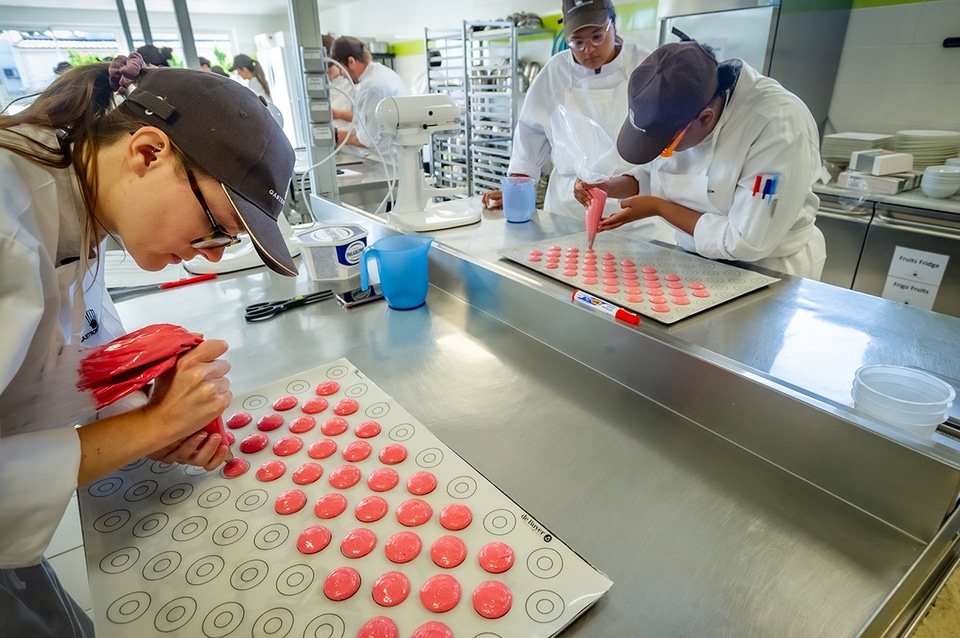
Institutions like BHMS in Lucerne structure their programs around alternating six-month study periods and paid industrial placements, charging roughly 30,100 CHF per year for a three-year BA in Culinary Arts. Similarly, the Culinary Arts Academy Switzerland, operating campuses in Le Bouveret and Brig, offers a three-year Bachelor of Arts featuring dual internships. While tuition hovers around 23,200 CHF annually, total costs rise past 40,000 CHF when accommodation, meals, and administrative fees are factored in, reflecting Switzerland’s notoriously high cost of living.
Portugal: Emerging Destinations and Economic Value
For students seeking high-quality European culinary education without the prohibitive costs associated with Switzerland or the UK, Portugal has emerged as a premier alternative.
The network of Escolas de Hotelaria e Turismo, overseen by Turismo de Portugal, offers technical specialization programs in culinary arts for roughly €1,500 in annual tuition. Combining traditional Portuguese seafood and baking traditions with modern food safety and kitchen management, these schools—with select English-language availability in Lisbon, Estoril, and Porto—provide an affordable gateway into the European culinary market.
Financial Realities and Strategic Decision-Making
Before enrolling in any culinary program, experts advise prospective students to conduct a rigorous financial and professional audit.
- Calculate the Total Cost: Tuition is only part of the equation. Uniforms, knives, ingredients, housing, transport, and insurance can inflate the baseline cost by tens of thousands of dollars.
- Evaluate Debt vs. Return: Starting salaries for entry-level line cooks are notoriously modest, even within fine-dining establishments. Students taking on substantial loans must realistically assess whether an entry-level kitchen salary can service that debt.
- Scrutinize the Curriculum: Prospective students must request detailed syllabi to determine the exact ratio of practical kitchen hours versus passive classroom lectures.
- Clarify Internship Guarantees: A school stating it "facilitates" placements is vastly different from one guaranteeing a paid, structured industrial internship.
Ultimately, the best culinary school is not necessarily the most expensive or the one with the flashiest marketing brochure. It is the institution that provides a solid technical foundation, transparent operational costs, and a manageable bridge into a punishing yet deeply rewarding global industry.