
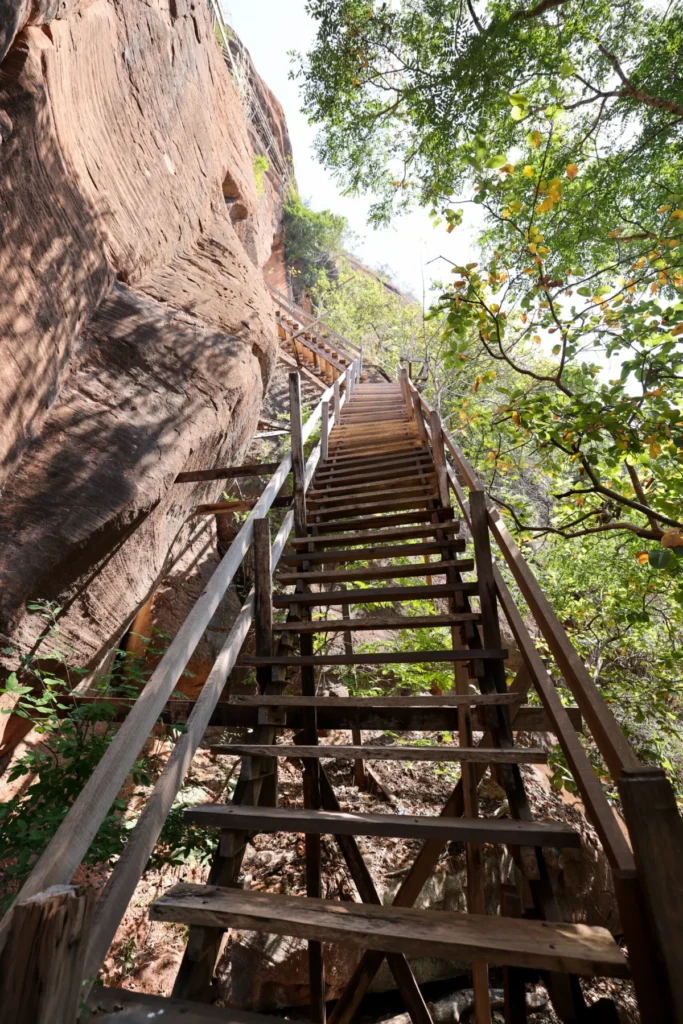
Nestled deep within the verdant and often overlooked landscapes of Thailand’s northeastern Isan region, the remote province of Bueng Kan houses one of the kingdom’s most architectural and geographical anomalies: Wat Jetiyakhiri, universally known as Wat Phu Tok. Rising sharply from the flat surrounding plains, this isolated sandstone monolith challenges visitors with a network of precarious wooden stairs, ladders, and cantilevered walkways clinging directly to vertical rock faces. Far removed from the bustling tourist corridors of Bangkok, Chiang Mai, or the southern islands, Wat Phu Tok offers an expedition that blends profound Buddhist spirituality with a high-stakes physical ascent.
Geographical and Architectural Overview
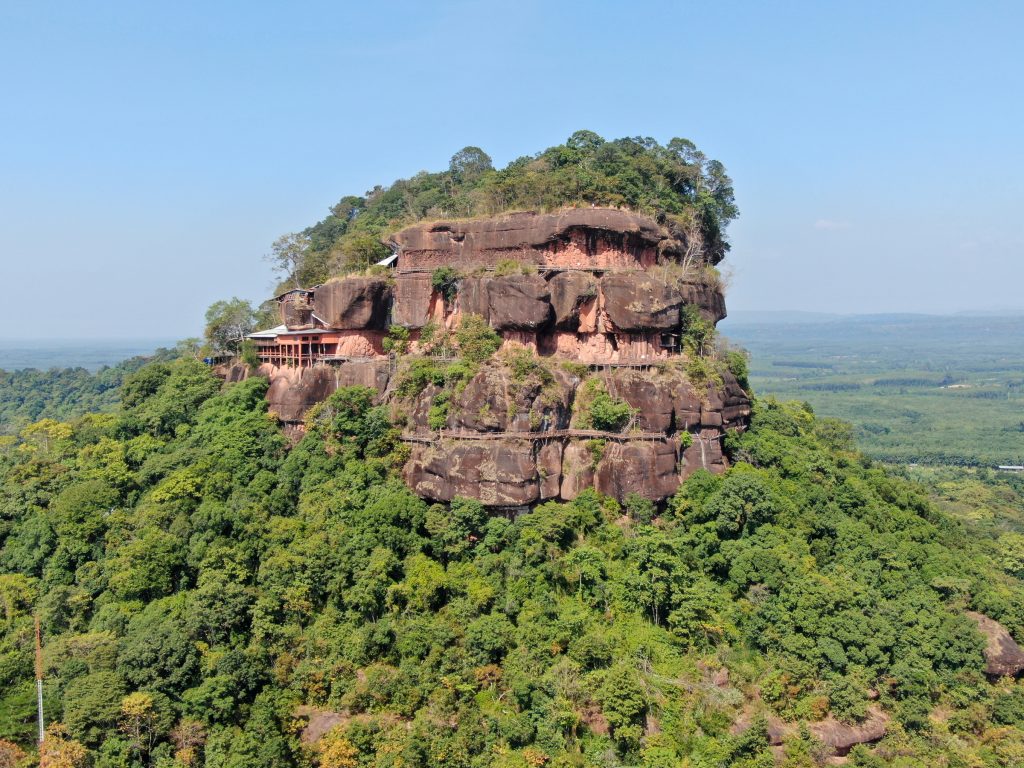
Formally designated as Wat Jetiyakhiri, the site derives its colloquial moniker from the local Isan dialect, where "Phu Tok" translates directly to "lonely mountain." Standing at an elevation of 359 meters, the solitary red rock formation bears a striking visual resemblance to smaller iterations of global marvels like Sigiriya in Sri Lanka. Located approximately a 30-minute drive from Bueng Kan city, the temple grounds occupy a serene footprint featuring a large entrance lake, expansive parklands, and administrative structures at the base.

The primary feature that distinguishes Wat Phu Tok from other monastic sites across Southeast Asia is its vertical labyrinth. Built entirely to facilitate meditative seclusion, the complex is engineered across seven distinct tiers. These levels are not merely physical floors of a building, but rather an architectural representation of the seven stages of Buddhist enlightenment, requiring practitioners to navigate increasingly difficult terrain to achieve mental and physical transcendence.
Historical Foundations and Monastic Vision

The genesis of Wat Phu Tok is inextricably linked to the late revered forest monk Luang Pu Juan. Recognizing the inherent solitude, rugged topography, and untamed nature of the isolated mountain, the monk chose the site as an ideal environment for ascetic Buddhist meditation. Historically, the dense wilderness surrounding the mountain was heavily populated by wildlife, most notably a high concentration of venomous snakes. This environmental hazard served a dual purpose: providing a sanctuary free from worldly distractions while enforcing heightened mindfulness upon those who sought spiritual refuge.
Under the guidance of Luang Pu Juan, monks and local volunteers initiated the monumental task of constructing a pathway system. Without modern industrial equipment, laborers meticulously anchored wooden planks, beams, and ladders into the sheer sandstone cliffs. This network was designed to connect disparate meditation caves, shrines, and monastic quarters scattered across the vertical gradients of the mountain. Although the visionary founder tragically lost his life in a commercial aviation accident years later, the monastic community and local authorities have continuously maintained the infrastructure, preserving the structural integrity of the mountain walkways for posterity.

Navigating the Seven Levels of Enlightenment
The journey through Wat Phu Tok begins at the base of the mountain, where visitors transition from conventional ground paths to a series of escalating wooden staircases. The initial ascent starts gently before accelerating into steep inclinations that closely resemble vertical ladders. While the construction utilizes native timber that occasionally yields underfoot, engineers and visitors alike note that the structural framing remains remarkably secure and anchored.

Levels One through Four: The Preliminary Ascent
The lower tiers serve as an introduction to the mountain’s topography. Visitors traverse early staircases and encounter sporadic shrines nestled within natural rock shelters. These initial stages are characterized by dense forest canopy and ground-level trails, allowing climbers to acclimate to the rising gradient and the humid Isan climate before encountering more formidable architectural challenges.
Level Five: The Administrative and Sacred Core
Upon reaching the fifth level, the spatial dynamics of the mountain shift dramatically. Unlike the narrow cliffside paths, the fifth tier opens into a relatively expansive ground-level plateau. This level functions as the primary administrative and ceremonial hub of Wat Phu Tok, housing the main ordination hall and numerous secondary shrines. It is also the access point for notable architectural detours, including an elevated rock walkway leading to an isolated subsidiary temple nestled against a secondary cliff face. This detour requires crossing a narrow wooden bridge suspended over a minor chasm, offering both architectural appreciation and expansive vistas of the surrounding terrain.

Level Six: The Suspended Cliff Walkway
Widely regarded as the architectural climax of the complex, the sixth level consists of a continuous path divided between ground-level terrain and cantilevered wooden walkways. Approximately half of the circumference of this tier is anchored directly into the vertical granite and sandstone cliff faces. As visitors traverse these suspended planks, they are exposed to unobstructed panoramic views of the sprawling Mekong River basin and the unbroken canopy of Bueng Kan’s green lowlands. While the sheer drop-offs induce vertigo for unprepared travelers, the spatial openness and cool mountain breezes render it the most heavily photographed and discussed section of the temple. Safety guidelines strictly mandate continuous concentration, as the narrow path leaves no margin for error.
Level Seven: The Summit and Ecological Realities
The final tier, the seventh level, represents the culmination of the physical and spiritual journey. Accessing the apex requires navigating an unpaved, steep final ascent. Unlike the meticulously engineered sixth level, the seventh tier features no permanent architectural structures, shrines, or wooden pathways. Instead, it marks the forested summit of the mountain. Local authorities and monastic caretakers explicitly warn visitors that the seventh level maintains a dense population of venomous serpents, categorizing the final push as an undertaking executed strictly at one’s own risk. Consequently, most travelers conclude their exploration at the architectural marvel of the sixth tier before beginning the descent.

Socio-Economic Implications and Tourism Impact
The ongoing preservation and promotion of Wat Phu Tok hold significant implications for the economic development of Bueng Kan province. Established formally as Thailand’s 77th province in 2011 by partitioning from Nong Khai, Bueng Kan has historically sought sustainable tourism models to bolster its economy without sacrificing its ecological and cultural identity.

Destinations like Wat Phu Tok act as anchor attractions for "off-the-beaten-path" tourism initiatives promoted by the Tourism Authority of Thailand (TAT). By drawing adventurous travelers interested in eco-tourism, religious history, and rural exploration, the site helps distribute tourism revenue away from saturated hubs like Phuket, Chiang Mai, and Ayutthaya. Regional analysts note that sustainable management of such fragile ecosystems is paramount; balancing increased visitor numbers with the preservation of a sacred monastic site requires strict adherence to safety regulations, waste management protocols, and structural maintenance of the aging timber infrastructure.
Practical Considerations for Visitors

For travelers planning an expedition to Wat Phu Tok, regional tourism boards recommend adhering to several foundational guidelines to ensure safety and cultural sensitivity:
- Timing: Early morning ascents are strongly advised to avoid the intense tropical heat of the Isan afternoon and to experience the mountain during its most peaceful hours.
- Attire: As an active Buddhist temple, visitors must adhere to modest dress codes, covering shoulders and knees.
- Physical Preparedness: Individuals with severe vertigo, limited mobility, or cardiovascular concerns should exercise extreme caution before attempting the upper tiers, particularly the cantilevered walkways of the sixth level.
- Safety Precautions: Sturdy footwear with reliable traction is essential, and vigilance must be maintained at all times due to the lack of secondary safety netting along high-altitude cliff paths.
Through its unique blend of daring engineering, ascetic Buddhist history, and untamed geographical isolation, Wat Phu Tok remains a testament to human determination and spiritual devotion, cementing its status as one of Thailand’s most compelling architectural achievements.







0 Komentar
Sampaikan opini dan diskusi yang membangun dengan bahasa yang santun.
No Comments Yet
Be the first to share your thoughts on this story.