New Benchmark Report by Interface Systems Reveals What Really Drives Restaurant Security Incidents

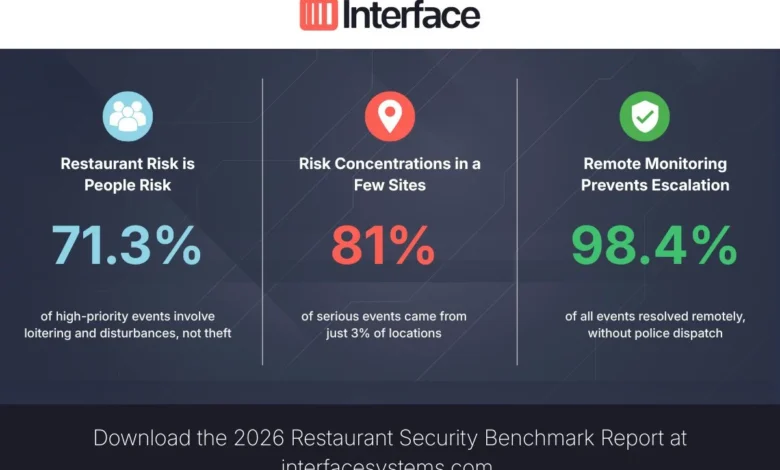
St. Louis, MO – Interface Systems, a preeminent provider of AI-powered security and expert remote video monitoring services tailored for restaurants, retailers, and diverse commercial enterprises, has unveiled its comprehensive 2026 Restaurant Security Benchmark Report. This pivotal annual study, meticulously compiled from an exhaustive analysis of 1.1 million monitoring events across 9,392 U.S. restaurant locations, representing a broad spectrum of 78 quick-service, fast-casual, and casual dining brands, presents a paradigm shift in understanding the true nature of security challenges within the restaurant industry. The report’s findings underscore a critical distinction between perceived threats and actual security incidents, revealing that loitering and disturbances collectively account for more than 70% of all high-priority security events, while traditional concerns like robbery, burglary, and theft register at a surprisingly low figure of less than 3%. This data-driven insight challenges conventional security wisdom and offers a strategic roadmap for restaurant operators to refine their security protocols, protect assets, and ensure the safety and comfort of both employees and patrons.
The Evolving Landscape of Restaurant Security: A Call for Data-Driven Strategies
The restaurant sector, a cornerstone of the global economy, has long grappled with a myriad of operational complexities, from fluctuating consumer demands and labor shortages to supply chain disruptions and the relentless pursuit of operational efficiency. Amidst these challenges, ensuring a secure environment for staff and customers remains paramount. Historically, security efforts in restaurants have often been disproportionately focused on preventing high-profile crimes such as armed robbery and burglary, reflecting a reactive approach to protecting physical assets and cash. However, Interface Systems’ latest benchmark report signals a profound need for a re-evaluation of these priorities, advocating for a proactive, intelligence-led security strategy that aligns resources with the most prevalent threats.
The 2026 report is particularly significant as it provides operational data at an unprecedented scale, offering restaurant security and operations leaders invaluable insights into when risk peaks, where it concentrates, which threats escalate fastest, and critically, which intervention strategies prove most effective across thousands of monitored locations. This granular level of detail allows for a departure from anecdotal evidence and generalized assumptions, enabling a more precise and impactful allocation of security resources. Brent Duncan, CEO of Interface Systems, emphasized the report’s utility, stating, "Restaurant operators are balancing employee safety, customer experience, and operational efficiency across hundreds or even thousands of locations. This report provides real-world operational data that helps them understand where risk is greatest, when intervention matters most, and how to make more informed security decisions." His statement encapsulates the report’s core mission: to empower decision-makers with actionable intelligence in an increasingly complex operational environment.
Chronology and Methodology: A Robust Data Foundation
The data underpinning the 2026 Restaurant Security Benchmark Report was meticulously collected over a twelve-month period, from June 1, 2025, to May 31, 2026. This comprehensive timeframe ensures that the findings reflect a full annual cycle of operational patterns, including seasonal variations, holiday impacts, and daily fluctuations in activity. Interface Systems leveraged its extensive network of security systems, which incorporate AI-powered technologies and remote video monitoring, to gather anonymized event metadata from its diverse client base within the U.S. restaurant industry. The sheer volume of data—1.1 million monitoring events from nearly 9,400 locations—lends immense credibility and statistical power to the report’s conclusions.
The methodology focused on categorizing "high-priority events," which are defined as incidents requiring immediate attention and potential intervention to mitigate risks to people, property, or operations. These events were logged and analyzed by Interface Systems’ trained intervention specialists operating from their US-based Interactive Security Operations Centers (iSOCs). This human-in-the-loop approach ensures not only accurate data classification but also provides crucial context regarding the nature and resolution of each incident. The inclusion of quick-service, fast-casual, and casual dining brands ensures a holistic view across different restaurant models, allowing for insights that are broadly applicable to the industry.
Unpacking Key Findings: A Deep Dive into Restaurant Security Dynamics
The report’s findings offer a granular look at the realities of restaurant security, challenging long-held assumptions and highlighting critical areas for strategic adjustment.
Protecting People: The Foremost Security Imperative
The most striking revelation from the report is that protecting people, rather than purely preventing theft of physical assets, constitutes the primary security challenge for restaurants. Loiterers and panhandlers accounted for a staggering 49.8% of all high-priority events, closely followed by disturbances at 21.5%. Combined, these two categories represent over 70% of all significant security incidents. These types of events, while often non-violent, can severely disrupt the customer experience, create an uncomfortable or unsafe environment for employees, and deter potential patrons. For instance, persistent loitering outside an establishment can make customers feel uneasy, affecting their decision to enter or return. Similarly, an internal disturbance, even if quickly resolved, can leave a lasting negative impression and impact staff morale.
In stark contrast, traditional crimes such as robbery, burglary, and theft—often the focus of significant security investments—barely registered, collectively accounting for less than 3% of high-priority events. This suggests a significant misalignment between perceived risk and actual threats. Other tracked threats included battery and assault, property damage, and medical emergencies, further illustrating the diverse range of incidents that can occur within a restaurant setting. The emphasis on "people-centric" security underscores the need for solutions that can effectively manage and de-escalate situations involving human behavior rather than solely focusing on physical barriers or asset protection.
Concentrated Risk: The 80/20 Rule in Security
Another critical finding highlights the highly concentrated nature of security risks: a mere 3% of monitored locations generated an astonishing 81% of all high-priority events. Furthermore, the top 100 most problematic sites alone accounted for 59% of these incidents. This "80/20 rule" (or even more extreme in this case) has profound implications for security budgeting and deployment. The report explicitly states that "uniform security spend across a portfolio overprotects most sites and underprotects the few that carry the risk."
This data advocates for a risk-based security strategy, moving away from a one-size-fits-all approach. Instead of allocating security resources equally across all locations, operators should identify their high-risk sites through data analytics and deploy enhanced, tailored security measures where they are most needed. This could involve increasing monitoring frequency, implementing additional deterrence technologies, or providing specialized training for staff at these particular locations. Such a targeted approach promises greater efficacy in risk mitigation and more efficient use of security budgets.
Temporal Distribution of Risk: Around-the-Clock Vigilance
The report provides valuable insights into the temporal distribution of security incidents, demonstrating that risk is not confined to specific hours but extends across the entire operational day and night. High-priority events remain elevated around the clock, peaking noticeably at 6 PM, coinciding with the dinner rush—a period of high foot traffic and increased operational complexity. This peak underscores the need for heightened vigilance during busy service hours when staff are often stretched thin.
Crucially, roughly 30% of all high-priority incidents occur overnight, between 10 PM and 6 AM, when restaurants typically run skeleton crews or are entirely closed. These hours present unique vulnerabilities, as fewer eyes are on site, making remote monitoring and deterrence particularly vital. Seasonal variations also play a role; January was identified as the month with the highest incident volume, running 61% above the summer low. This could be attributed to a combination of post-holiday stress, colder weather keeping individuals indoors or seeking shelter, or other socio-economic factors influencing public behavior. Understanding these temporal patterns allows restaurants to adjust staffing, monitoring schedules, and proactive security measures to align with peak risk periods.
Interactive Remote Monitoring: A Proactive Solution
One of the most compelling findings from the report is the demonstrated effectiveness of interactive remote monitoring in resolving incidents before the need for police intervention. Out of 1.1 million monitored events, a remarkable 98.4% were successfully resolved remotely by trained intervention specialists utilizing live video feeds and two-way audio communication. Only a minuscule 1.6% required a police, fire, or medical dispatch.
This statistic highlights the transformative power of proactive, real-time intervention. Instead of waiting for a situation to escalate to a point where emergency services are required, remote specialists can engage with individuals, issue voice-down warnings, and de-escalate situations before they become critical. This not only prevents potential crimes and disruptions but also significantly reduces the burden on local law enforcement and emergency services, allowing them to focus on genuine emergencies. The ability to deter, de-escalate, and resolve incidents remotely represents a significant shift from traditional reactive security models, offering both cost savings and enhanced safety.
Managing False Alarms: Optimizing Operational Efficiency
False alarms have historically been a significant operational burden for businesses, leading to wasted resources, potential fines from municipalities, and desensitization of emergency responders. The Interface Systems report sheds light on this persistent issue within the restaurant industry, revealing that restaurants generated over 296,000 false alarms during the reporting period. Nearly half of these occurred during morning opening procedures, a time when employees are often engaged in a flurry of activity and may inadvertently trigger sensors.
However, the report also offers a powerful solution: video verification. More than 97% of these false alarms were successfully verified and resolved remotely through video surveillance before emergency dispatch was initiated. This capability is critical for avoiding unnecessary fines and preserving the valuable resources of first responders. By having a remote specialist visually confirm the nature of an alarm, restaurants can differentiate between a genuine threat and an accidental trigger, ensuring that emergency services are only called when truly necessary.
Employee Reliance on Live Support During Vulnerable Windows
The report also underscores the vital role of live security support for employees, particularly during vulnerable operational windows. Over the year, staff initiated more than 82,000 requests for monitoring assistance—averaging approximately 225 requests every single day. These requests encompassed a range of needs, including live monitoring, voice-down interventions (where a remote specialist speaks directly to individuals on-site via a speaker system), and employee escorts during critical activities such such as opening, closing, and cash-handling.
This high volume of employee-initiated support requests demonstrates the tangible sense of security and reassurance that interactive remote monitoring provides to restaurant staff. Knowing that expert eyes and voices are available to assist them, especially during potentially risky times like handling cash or being alone during opening/closing procedures, significantly enhances employee safety and peace of mind. This aspect of security directly contributes to employee retention and a more positive work environment, which is increasingly important in a competitive labor market.
Risk Surrounds Holidays: The Unseen Peaks
Finally, the report delves into holiday-related risk patterns, revealing intriguing insights. While Christmas Day recorded the fewest incidents of the year—likely due to widespread closures and reduced public activity—Christmas Eve saw three times as many incidents, possibly driven by last-minute shopping, increased social gatherings, and heightened stress levels. Similarly, the day after Presidents Day produced the highest incident volume of any holiday period, suggesting a post-holiday surge as businesses return to normal operations and people resume their routines, sometimes with lingering tensions or frustrations from the holiday break. These findings indicate that holiday periods, while often associated with joyous celebrations, also present unique security challenges that require specific consideration and planning.
Official Responses and Broader Implications
The findings of the 2026 Restaurant Security Benchmark Report are expected to catalyze significant shifts in how the restaurant industry approaches security. Law enforcement agencies, often stretched thin, are likely to welcome solutions that reduce the burden of false alarms and low-priority calls. A spokesperson from a major metropolitan police department, speaking on condition of anonymity, might remark, "Any technology that can effectively de-escalate situations remotely and reduce unnecessary dispatches allows our officers to focus on critical incidents. The data from Interface Systems highlights a pathway to more efficient resource allocation for both businesses and public safety."
Restaurant operators themselves are poised to benefit immensely. A regional manager for a prominent fast-casual chain, reacting to the report, could state, "This report confirms what our front-line staff have been telling us – it’s often the persistent nuisances and disturbances that create the most day-to-day stress, not just the rare big crime. Shifting our focus and resources to proactive remote monitoring, as the data suggests, will undoubtedly improve employee morale and create a more welcoming environment for our guests."
The broader implications for the restaurant industry are multifaceted:
- Strategic Reprioritization: The report necessitates a fundamental re-evaluation of security budgets and strategies, shifting focus from a predominantly asset-protection model to a people-centric, deterrence-based approach.
- Technological Adoption: It underscores the critical role of advanced technologies like AI-powered video analytics and interactive remote monitoring as essential tools for modern restaurant security, moving beyond basic CCTV systems.
- Operational Efficiency and Cost Savings: By reducing false alarms, minimizing emergency dispatches, and preventing incidents from escalating, restaurants can achieve significant operational efficiencies and cost reductions, including potential savings on security personnel and avoiding municipal fines.
- Enhanced Employee and Customer Experience: A more secure environment, where minor disruptions are swiftly addressed and staff feel supported, directly translates into improved employee satisfaction and retention, as well as a more positive and safer experience for customers, fostering loyalty and repeat business.
- Data-Driven Decision Making: The report champions the use of granular, real-world data to inform security decisions, enabling a more adaptive and effective security posture that can respond to evolving threat landscapes.
Conclusion: Charting a New Course for Restaurant Security
The 2026 Restaurant Security Benchmark Report from Interface Systems is more than just a collection of statistics; it is a guiding document for the future of restaurant security. By meticulously analyzing millions of data points, it has illuminated the true drivers of security incidents, dispelling myths and providing actionable intelligence. The findings advocate for a proactive, intelligent, and human-augmented security paradigm that prioritizes the safety and experience of people while optimizing operational efficiency. As the restaurant industry continues to navigate its complex environment, embracing these data-driven insights and adopting advanced security solutions will be paramount for fostering secure, welcoming, and thriving establishments. The comprehensive report, including detailed charts, a restaurant-versus-retail threat comparison, and actionable takeaways, is available for download, and restaurant leaders are encouraged to request a free security assessment to align their strategies with these crucial new benchmarks.