Amedeo Avogadro At 250: Culinary Science Meets Chemistry With The Launch Of A Parametric Waffle Generator

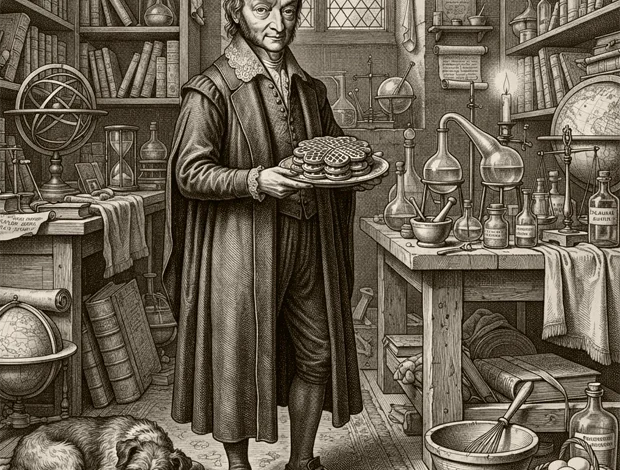
The intersection of molecular science and culinary arts has reached a new frontier with the official debut of Avogadro, a parametric waffle recipe generator that bridges historical tribute and digital food technology. Launched to coincide with the 250th birth anniversary of physicist and chemist Amedeo Avogadro, the application allows culinary enthusiasts and professional chefs alike to dynamically engineer bespoke waffle batters using mathematical parameters rather than static recipe books.
The tool, hosted by the food science publication Khymos, marks the realization of a concept first conceptualized in 2014. After more than a decade of sporadic development—moving from primitive spreadsheet models to a fully functional digital interface—the platform went live on August 9, 2026, exactly two and a half centuries after Avogadro’s birth in Turin, Italy.
The Architecture of the Generator
Unlike conventional digital recipe repositories that rely on databases of static entries, Avogadro operates entirely on the fly. Users select a foundational suite of ingredients categorized by liquids, dairy, fats, eggs, starches, and sweeteners. From there, they manipulate a series of interactive sliders that control core batter properties, including sweetness, richness, and tanginess.
The application instantly computes a precise, gram-scaled batter formulation adjusted automatically to the number of eggs designated by the user. Accompanying the live ingredient calculations is a visual "waffle heart quality indicator." This metric serves a dual purpose: it verifies whether the generated ratios will result in a structurally sound batter and measures how closely the formulation aligns with traditional, real-world waffle compositions. Interestingly, the tool’s developer notes that several commercially successful, pre-packaged waffle mixes sit surprisingly far outside the conventional compositional norm, proving that unconventional ingredient ratios can still yield commercially viable products.
The platform offers two distinct user tiers. Standard mode provides a streamlined interface with a curated ingredient list and simplified sliders designed to guarantee workable outcomes. Expert mode, tailored for seasoned practitioners and food science hobbyists, unlocks the complete catalogue of ingredients, all eight control sliders, and advanced presets capable of generating unconventional culinary combinations.

Historical Context and the Mathematics of $10^27$ Recipes
The naming convention and launch date of the tool pay direct homage to Amedeo Avogadro, best known for Avogadro’s constant ($6.022 times 10^23$), which defines the number of constituent particles, such as atoms or molecules, in a mole.
The parallel between chemistry and baking forms the conceptual backbone of the project. By calculating every possible permutation of ingredient selections and slider positions, the generator spans approximately $10^27$ distinct control settings. This astronomical figure equates to roughly 1,660 moles worth of theoretical waffle batters—a playful nod to the scientist who established that equal volumes of all gases, at the same temperature and pressure, contain the same number of molecules.
Food science historians note that historical baking traditions frequently relied on unwritten empirical knowledge. Older Scandinavian cookbooks, for instance, rarely specified exact measurements, instead instructing bakers to "add flour until the batter has the right consistency." This reliance on tacit knowledge forms the central research question behind the Avogadro project: defining the exact mathematical boundaries where a liquid mixture transitions from a generic batter into a functional waffle mixture.
Data Realism and Engineering Caveats
While the theoretical ceiling of $10^27$ control settings suggests an infinite culinary landscape, the developer has introduced realistic caveats regarding the output. System rounding algorithms and the pruning of trace ingredients mean that numerous distinct control positions ultimately resolve to identical batter compositions. Furthermore, extreme slider configurations can occasionally push the formula outside the realm of physical utility, a phenomenon visually flagged by the absence of lobes on the interface’s quality indicator.
Despite these limitations, the sheer volume of unique, untested recipes ensures that users experimenting with the platform will frequently encounter formulations that have never before been documented in culinary history.

Development Chronology: From 2014 Mockups to 2026 Launch
The journey toward the Avogadro generator spans twelve years of iterative design:
- 2014: The initial concept is conceived, resulting in early user-interface mockups and a rudimentary Microsoft Excel model designed to test variable scaling.
- 2014–2025: The project remains largely dormant while the developer compiles a corpus of approximately 1,000 traditional Norwegian and Scandinavian waffle recipes to study baseline structural ratios.
- August 2026: Development accelerates to meet the August 9 deadline for the 250th anniversary of Avogadro’s birth.
- August 9, 2026: Avogadro officially launches in both standard and expert modes, introducing live parametric calculation to the public.
Implications for Culinary Education and Gastronomy
The introduction of parametric recipe generators signals a broader shift in how home cooks and researchers interact with food formulation. By treating cooking as a variable-driven equation rather than a rigid set of instructions, tools like Avogadro democratize food science.
Culinary educators have increasingly emphasized the importance of understanding ratios over rote memorization of recipes—a philosophy championed by culinary theorist Michael Ruhlman in works like Ratio: The Simple Codes Behind the Craft of Everyday Cooking. Avogadro takes this pedagogical approach into the digital age, allowing users to visualize the immediate impact of altering fat-to-flour ratios or liquid-to-starch balances in real time.
Furthermore, the crowdsourcing aspect of the launch invites the global cooking community to act as a distributed testing network. Because no individual can physically test $10^27$ variations, the project relies on user feedback to refine the model’s underlying assumptions about what constitutes "right consistency" in batter mechanics. Users encountering edge-case errors or discovering unexpectedly exceptional flavor profiles are encouraged to submit direct URLs of their generated recipes for peer review and algorithmic calibration.
As celebrations for Amedeo Avogadro’s quarter-millennial anniversary take place across scientific and academic institutions worldwide, the culinary sector now has its own unique monument to his legacy—one measured not in moles of gas, but in grams of flour, butter, and sugar.