The Physics and Chemistry of Coffee Extraction: Exploring Pour-Over Complexity, Equipment Design, and the Pursuit of the Ideal Brew

The global pursuit of the optimal cup of coffee has long bridged culinary arts and empirical science. At the intersection of fluid dynamics, thermal physics, and organic chemistry lies the pour-over brewing method—a technique celebrated by specialty baristas and home enthusiasts alike for its capacity to offer precise control over extraction. However, beneath the deceptive simplicity of pouring hot water over ground coffee rests an immensely complex ecosystem of interdependent variables. Recent analyses by coffee chemists and equipment designers shed light on why minor alterations in brewing geometry, particle size distribution, and thermal retention can drastically transform the final beverage, while also highlighting the inherent trade-offs between complex percolation methods and robust immersion techniques.
The Chemical Reality of Extraction
To understand the mechanics of manual brewing, one must first examine the chemical composition of roasted coffee. The soluble compounds present in a roasted bean span multiple orders of magnitude in concentration, each possessing a distinct solubility profile and extraction rate.
If the primary objective of a coffee extraction were to mirror the complete soluble content of the bean precisely, a brewer would theoretically employ ultra-fine grinds and prolonged steep times—approaching methods seen in traditional Turkish coffee preparation without sugar or spices. Such a process yields extraction rates approaching 30 percent, producing a potent, highly concentrated cup.
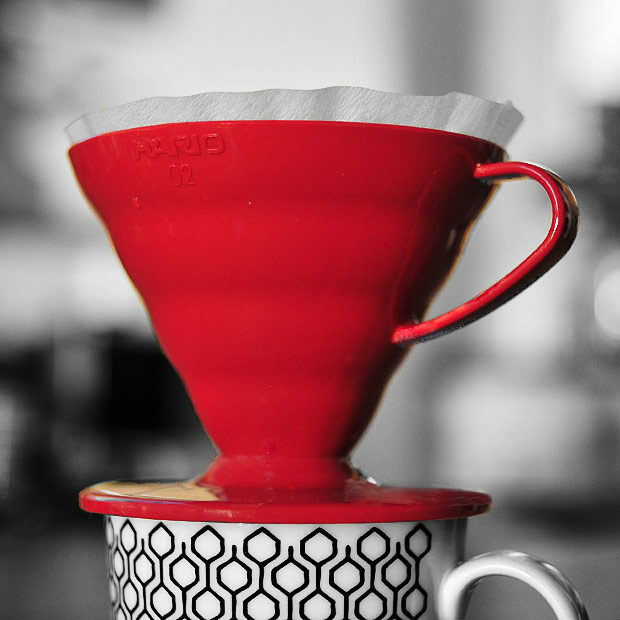
However, maximum extraction does not equate to optimal flavor. Specialty coffee brewing relies on selective extraction rather than uniform extraction. From a chemical perspective, achieving a superior cup requires an uneven extraction where individual flavor and aromatic compounds are extracted to varying degrees. The pour-over, or percolation, technique has historically served as the primary instrument for this selective extraction, allowing water to cascade through a stratified bed of coffee grounds via gravity filtration.
Variables and Interdependencies in Percolation Brewing
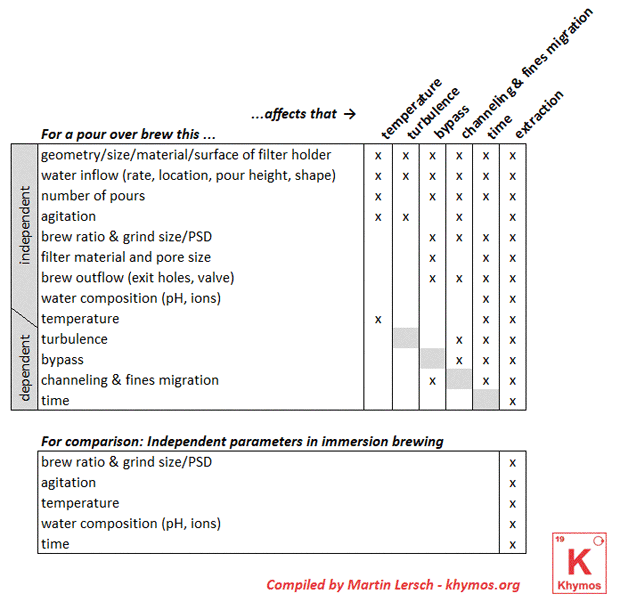
Pour-over brewing appears deceptively straightforward: hot water is introduced to a bed of coffee, filtering downward into a vessel. Yet, the physical parameters governing this process are numerous and heavily correlated. Independent variables—such as brew ratio, nominal grind size, water chemistry, pouring temperature, and filter composition—directly influence dependent outcomes like flow rate, contact time, thermal loss, and extraction yield.
Grind size and particle size distribution (PSD) serve as prime examples of this complexity. Finer particles increase the total surface area available for water interaction, which accelerates the dissolution of chemical compounds. Simultaneously, however, finer grounds pack more densely, restricting water flow and prolonging contact time. This restriction introduces the risk of filter clogging and fluid channeling.
Water, governed by physical laws, invariably follows the path of least resistance. When a fine grind or a restrictive filter slows percolation, standing water above the coffee bed frequently bypasses the dense grounds entirely, flowing instead through the periphery of the filter holder. This phenomenon, known as bypass, dilutes the final brew with unextracted or underextracted water, rendering the process susceptible to unintended and random variations.
Historical Evolution of Drip and Pour-Over Equipment
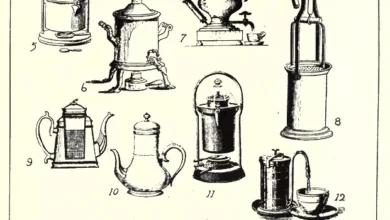
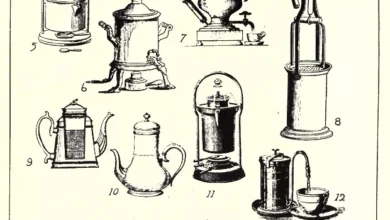
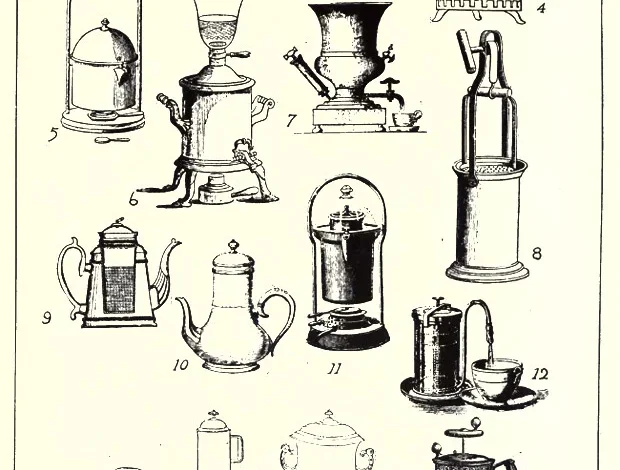
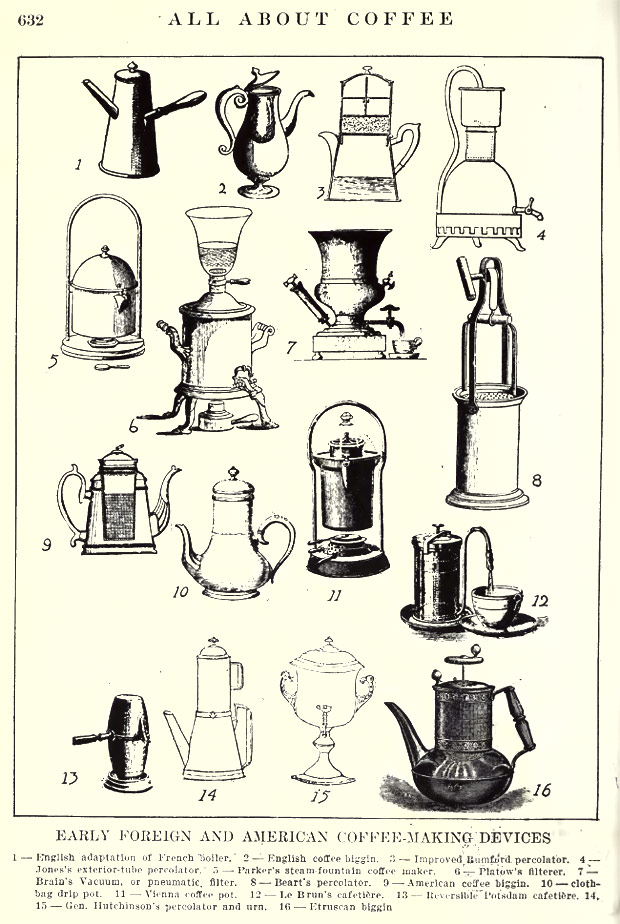
The challenge of optimizing percolation has driven centuries of innovation in coffee maker design. Historical documentation, such as W. A. Ukers’ foundational 1922 publication "All about coffee," demonstrates that inventors have spent generations attempting to solve the mechanical equations of coffee extraction. Modern equipment catalogs feature dozens of distinct filter holders, each engineered to address specific hydrodynamic and thermal constraints.
Equipment design generally balances several core engineering factors:
- Material and Thermal Insulation: Metal components conduct heat rapidly, risking thermal loss unless vacuum-insulated (such as double-walled stainless steel drippers) or possessing significant thermal mass. While glass offers aesthetic appeal, its fragility during frequent handling makes ceramic and food-grade plastics pragmatic alternatives for consistent heat retention and durability.
- Geometry and Bed Shape: Cone-shaped drippers, trapezoidal Melitta-style holders, and flat-bottom brewers (like the Kalita Wave) dictate the shape of the coffee bed. Cylindrical, narrow beds maximize contact time but slow flow, whereas flat beds expedite drainage but heighten the risk of channeling.
- Wall Surface and Bypass Control: Smooth-walled drippers allow wet filter paper to adhere directly to the surface, effectively sealing off peripheral bypass. Conversely, internal ridges, fluted filter papers, or patterned structures facilitate lateral water flow to prevent clogging, though this often increases uncontrolled bypass.
- Inflow and Outflow Regulation: Specialized gooseneck kettles, water distribution screens (such as the Melodrip or Gabi Dripmaster), and mechanical stop-valves allow brewers to decouple contact time from grind size, offering tighter control over the extraction phase.
Comparative Analysis of Brewing Equipment
To benchmark contemporary apparatuses, industry analysts routinely categorize equipment based on material composition, thermal properties, geometry, filter type, and flow control mechanisms. Below is a comparative overview of prominent commercial and specialty coffee brewing devices:
| Filter Holder | Material | Insulation | Shape | Structure | Filter Type | Bottom Configuration | Bypass Potential | Inflow Control | Outflow Control |
|---|---|---|---|---|---|---|---|---|---|
| Aeropress | Plastic | Material | Straight | None | Plain | Perforated (97 holes) | No | No | Pressure |
| April Pour Over | Ceramic | Material | Tapered | Ridge | Folded | Open / Ridge | Yes | No | None |
| Chemex | Glass | Material | Tapered | None | Plain | Cone | No | No | None |
| Clever Dripper | Plastic | Material | Tapered | Ridge | Plain | Trapezoid (1 hole) | Yes | No | Stop Valve |
| Hario V60 (Plastic/Ceramic) | Plastic/Ceramic | Material | Tapered | Ridge | Plain | Cone | Yes | No | None |
| Kalita Wave | Metal/Glass/Ceramic | Material | Tapered | None | Folded | Flat (3 holes) | Yes | No | None |
| Stagg X/XF | Metal | Vacuum | Tapered | None | Folded | Flat (10 holes) | Yes | No | None |
| Tricolate | Plastic | Material | Straight | None | Plain | Perforated (51 holes) | No | Yes | None |
Immersion Brewing as a Reproducible Alternative
Given the myriad variables and potential for human error inherent in pour-over percolation, many scientists and professional baristas advocate for immersion brewing methods as a more reliable and repeatable alternative.
In immersion systems—typified by the French Press or the standard immersion dripper—coffee grounds are steeped directly in a fixed volume of water for a predetermined duration. Initial agitation eliminates trapped carbon dioxide bubbles, after which the slurry extracts uniformly until approaching chemical equilibrium. Because extraction approaches an equilibrium plateau, minor variations in timing or agitation have a less drastic impact on the final cup profile than in percolation systems.
Furthermore, immersion brewing divorces contact time from grind size when paired with pressure filtration. However, traditional immersion devices utilizing coarse wire mesh filters (such as the standard French Press) permit microscopic coffee fines to pass into the final beverage. These suspended solids contribute body and tactile texture while also leaving a visible sediment at the base of the cup. While these fines enhance mouthfeel, prolonged extraction of unseparated sediment can introduce secondary bitterness, prompting some practitioners to incorporate secondary paper filtration for enhanced clarity.
Broader Implications and Industry Outlook
The ongoing dissection of coffee extraction physics illustrates why standardized recipes frequently fail when replicated across different kitchens. Because popular recipes often omit critical parameters such as water mineral composition, precise particle size distribution curves, pouring turbulence, and thermal drift, identical instructions yield divergent results.
Ultimately, the quest for the ultimate extraction remains an active frontier. While complex pour-over devices offer unmatched potential for flavor nuance, robust immersion methods provide accessibility and repeatability. As research into hydrodynamics and extraction kinetics continues to evolve, the coffee industry moves steadily closer to reconciling the art of manual brewing with empirical precision, ensuring that the pursuit of the ideal cup remains grounded in measurable science.