The Chemical Symphony Inside Your Morning Cup: What Really Makes Up a Brewed Coffee


The daily ritual of brewing coffee is often viewed through a lens of simplicity: hot water meets roasted beans, gravity does its work, and a dark, invigorating beverage fills the cup. Yet, beneath this seemingly straightforward culinary process lies an extraordinarily complex chemical matrix. While a standard cup of black coffee is overwhelmingly composed of water—accounting for more than 98.5% of the liquid—the remaining fraction is a dense, highly sophisticated composition of dissolved solids that dictates everything from color and aroma to mouthfeel and flavor profiles. Understanding this intricate balance requires moving beyond traditional brewing metrics and examining the molecular architecture of coffee extraction.
The Composition of Total Dissolved Solids
To appreciate what is actually in a cup of coffee, food scientists and coffee researchers look closely at Total Dissolved Solids, commonly abbreviated as TDS. In a typical cup of brewed coffee, the TDS ranges from 1.2% to 1.5%. This means that in a single liter of coffee, approximately 12 to 15 grams of solid matter have been successfully extracted from roughly 60 grams of roasted coffee grounds.
These extracted compounds are responsible for the distinct visual and sensory characteristics of the beverage. When analyzed using advanced chromatographic techniques capable of separating individual chemical components, coffee reveals the presence of hundreds—if not thousands—of distinct molecules. While many of these compounds have been thoroughly identified and characterized by flavor chemists, a significant number remain entirely unknown.
Historical research underscores this chemical mystery. An Aroma Extract Dilution Analysis (AEDA) conducted in 2002 revealed that out of 40 key odorants identified in coffee, 13 were entirely unknown. Such gaps in scientific knowledge persist for two primary reasons: either the compounds are present in concentrations so infinitesimally small that obtaining a sample large enough for structural elucidation is exceedingly difficult, or the molecules are exceptionally large, complicating the process of mapping their exact molecular structures.
Volatiles, Non-Volatiles, and the Illusion of Synthetic Coffee
The vast array of compounds found in coffee can be broadly categorized into two distinct groups: volatile and non-volatile compounds. Volatile compounds are responsible for the complex aromas that travel to the olfactory receptors in the nose, while non-volatiles primarily dictate how the beverage feels and tastes on the tongue, contributing sensations of bitterness, sweetness, acidity, and astringency. Non-volatile components, including various oils and insoluble micro-particles, also dictate the body and texture of the brew.
Attempts to replicate this complex sensory experience artificially have yielded limited success. A notable 1996 study demonstrated that based on 22 key volatile compounds found in coffee, researchers could synthetically construct two model coffees designed to mimic Arabica and Robusta varieties. While human assessors described these model formulas as clearly coffee-like, the consensus was clear: 22 compounds are vastly insufficient to replicate the nuance, depth, and richness of real coffee. The presence of countless unidentified molecules ensures that authentic, agriculturally derived coffee remains unmatched by synthetic alternatives.
The Role of Concentration and Odor Thresholds
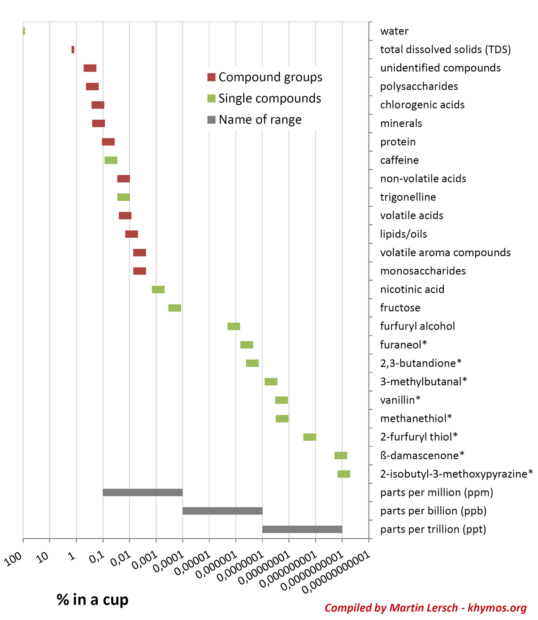
When examining the concentration ranges of coffee compounds on a logarithmic scale, researchers observe a span covering more than nine orders of magnitude. This scale encompasses everything from major components like water and carbohydrates down to trace elements measured in parts per million (ppm), parts per billion (ppb), and even parts per trillion (ppt).
A common misconception in flavor science is that a lower concentration implies a lower impact on the overall sensory experience. While concentration matters within linear ranges for individual compounds, it does not hold true when comparing entirely different substances. This discrepancy is driven by human olfactory sensitivity, as every chemical compound possesses a unique odor threshold. Consequently, a compound present in concentrations as minute as 0.0000000001% can exert just as much influence over the overall flavor profile as a compound present at a much higher concentration of 0.01%.
This phenomenon is mathematically captured by the Odor Activity Value (OAV), defined as a compound’s concentration divided by its specific odor threshold. A prime example is beta-damascenone, a potent aromatic compound belonging to the rose ketone family. First discovered in rose oil during the 1960s and later utilized prominently in luxury perfumery—such as Dior’s iconic Poison fragrance—beta-damascenone is also present in coffee. Even though it appears in coffee at concentrations as low as 1 part per trillion, its exceptionally low odor threshold allows it to function as one of the top key odorants in the beverage, profoundly shaping the final cup’s aromatic profile.
Polar Versus Non-Polar Extraction Dynamics
Another critical factor in coffee chemistry is the polarity of the compounds involved. Compounds can be divided into polar categories—such as acids, minerals, proteins, and carbohydrates—which share a high solubility in water. Because water acts as an effective polar solvent, it successfully extracts more than 75% of these polar compounds during a standard brew cycle.
Conversely, non-polar compounds, including essential lipids and various aromatic volatiles, have very low water solubility. As a result, standard water-based brewing extracts only about 10% to 30% of these non-polar components. This fundamental chemical reality suggests that exploring alternative solvents, such as ethanol, could unlock entirely new dimensions of coffee extraction and flavor exploration.
Limitations of Traditional Brewing Metrics
For decades, measuring Total Dissolved Solids has served as the industry standard for evaluating coffee strength. However, the reliance on TDS metrics has notable limitations. Because TDS measures overall mass rather than specific molecular makeup, it fails to account for the vast differences in extraction rates between polar and non-polar compounds. Furthermore, many critical flavor-and-aroma-driving compounds exist in quantities too small to register a meaningful change in TDS measurements.
Ultimately, while TDS remains a reliable indicator of brew strength, it is a poor predictor of actual aroma and flavor complexity. As coffee science continues to evolve, analytical chemistry sheds light on the microscopic wonders hidden within each bean, yet the human nose remains the ultimate, irreplaceable instrument for assessing the true quality of a well-brewed cup of coffee.