The enduring legacy of Southern California’s coastal dive bars serves as a vital anchor in an era of rapid regional transformation.

Los Angeles and its surrounding counties have long functioned as the primary artistic and financial engine of Southern California, yet this identity is currently undergoing a period of profound instability. The region is grappling with a confluence of socio-economic and environmental pressures that threaten to erode the character of its communities. Since the late 1990s, the exodus of film and television production—a cornerstone of the local economy—has significantly altered the fiscal landscape. Concurrently, environmental data from UCLA researchers indicates that high-severity wildfires now burn 30 times more area than they did four decades ago, signaling a permanent shift in the regional climate. These physical and economic stressors are exacerbated by the socio-political climate, where frequent immigration enforcement actions continue to impact the stability of the region’s diverse population. Amidst these changes, even the long-standing cultural shorthand of the “dry heat” has been challenged by rising humidity levels, leaving residents to navigate a city that feels increasingly unrecognizable.
The Institutional Role of the Coastal Dive Bar
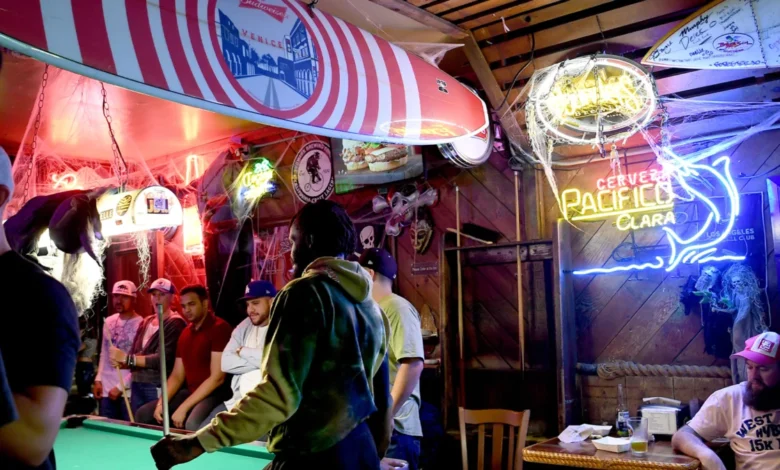
Despite these broad demographic and environmental shifts, one segment of Southern California’s cultural infrastructure remains surprisingly resilient: the coastal dive bar. These establishments, stretching from the northern reaches of Santa Barbara County down to the Imperial Beach border at Tijuana, serve as historical touchstones. While often colloquially referred to as "beach bars," these venues are rarely situated directly on the sand. Escalating coastal land values have pushed many of these institutions a few blocks inland, though they retain a sensory connection to the Pacific Ocean. They function as a democratic space where economic background is secondary to the shared experience of the locale.
These bars are characterized by a specific aesthetic: nautical motifs, tiki-adjacent decor—a design language with roots in mid-century Hollywood—and, in the most authentic cases, interiors constructed of aged wood that evoke the feeling of a ship’s cabin. While the rise of digital point-of-sale systems has modernized the industry, a small subset of these bars continues to operate as cash-only businesses, preserving an operational model that has largely vanished from the broader hospitality sector.
Historical Evolution and Economic Context
The lineage of these establishments often extends back to the early 20th century, predating the modern, high-density development of the California coastline. The survival of these venues is particularly notable given the extreme gentrification of beachside municipalities.
A primary example is Ercole’s in Manhattan Beach. Established in the 1920s, the venue has transitioned through various iterations—including an ice cream and sandwich parlor during the Prohibition era, an Italian restaurant, and a Dutch-Indonesian eatery in the 1950s—before settling into its current identity as a staple burger-and-beer dive in the 1970s. Its persistence is an anomaly in Manhattan Beach, a city that has evolved from a sleepy seaside town into one of the most affluent residential enclaves in the United States.
Similarly, the Beach Ball in Newport Beach has maintained a consistent operational model since 1969. By providing a public-service-style schedule—remaining open from 6:00 a.m. to 2:00 a.m. daily—it serves as a community hub that transcends the transient nature of modern tourism. Its architectural layout, which transitions from a street-level bar to a basement-level pool hall, mirrors the mid-century design preferences of the era in which it was founded.
Clustering and Urban Preservation
Playa del Rey, a coastal neighborhood hemmed in by Los Angeles International Airport (LAX), the Marina del Rey harbor, and protected wetlands, represents a unique case study in architectural and cultural preservation. Because of its relative isolation, the area has retained a high concentration of historic bars within a two-tenths-of-a-mile radius on Culver Boulevard.
Prince O’ Whales, which opened in 1955 under the name The Bowspirit, remains a focal point of this cluster. The establishment’s longevity is matched by the Harbor Room, founded in 1978, which maintains a reputation for high-proof service and limited physical capacity, often cited as one of the smallest bars in Los Angeles. The Shack, another fixture of the 1970s, continues to provide a culinary link to the past, serving a specialized burger that incorporates regional influences, such as the Louisiana hot link.
Broader Sociological Implications
The persistence of these venues invites analysis into the concept of "third places"—social environments separate from the two usual social environments of home and the workplace. Sociologists have long argued that such spaces are essential for the maintenance of community ties. In Southern California, these dive bars act as a bridge between generations. They are spaces where "delirious day drunks" and long-term residents coexist, creating a form of social continuity that is frequently disrupted by the rapid turnover of commercial real estate in the city.
The historical significance of these bars is comparable to the preservation efforts directed toward Googie-style architecture—the mid-century modern aesthetic that defined Southern California diners and coffee shops. While the aesthetic is different, the function is identical: these buildings serve as physical manifestations of a regional history that is constantly under threat of erasure.
Economic and Regulatory Challenges
The survival of these bars is not guaranteed. They face ongoing pressure from rising property taxes, shifting public health regulations, and the increasing demand for high-end hospitality concepts that maximize square-footage revenue. However, their continued existence suggests that there is a significant market demand for authentic, unpretentious space.
Industry analysts note that while these bars may not yield the high margins of modern, stylized cocktail lounges, they benefit from low overhead and extreme customer loyalty. Furthermore, their role as "anchor tenants" in older buildings often shields them from the most aggressive redevelopment cycles, as their presence is frequently integrated into the historical narrative of the neighborhoods they occupy.
Conclusion
As Los Angeles moves into a new phase of urban development, the role of the coastal dive bar remains a subject of both nostalgia and academic interest. These venues are not merely businesses; they are repositories of local lore and social history. Whether through the preservation of mid-century interior design or the maintenance of long-standing culinary traditions like the "beach burger," these institutions provide a vital link to the past. They remind the public that despite the environmental and economic volatility of the 21st century, the fundamental human need for a consistent, accessible communal space remains unchanged. For those seeking to understand the enduring identity of Southern California, a seat at one of these weathered bars offers as much insight as any official historical record.
Related posts: