Conquering Wat Phu Tok: Thailand’s Architectural Wonder and the Seven Levels of the Lonely Mountain

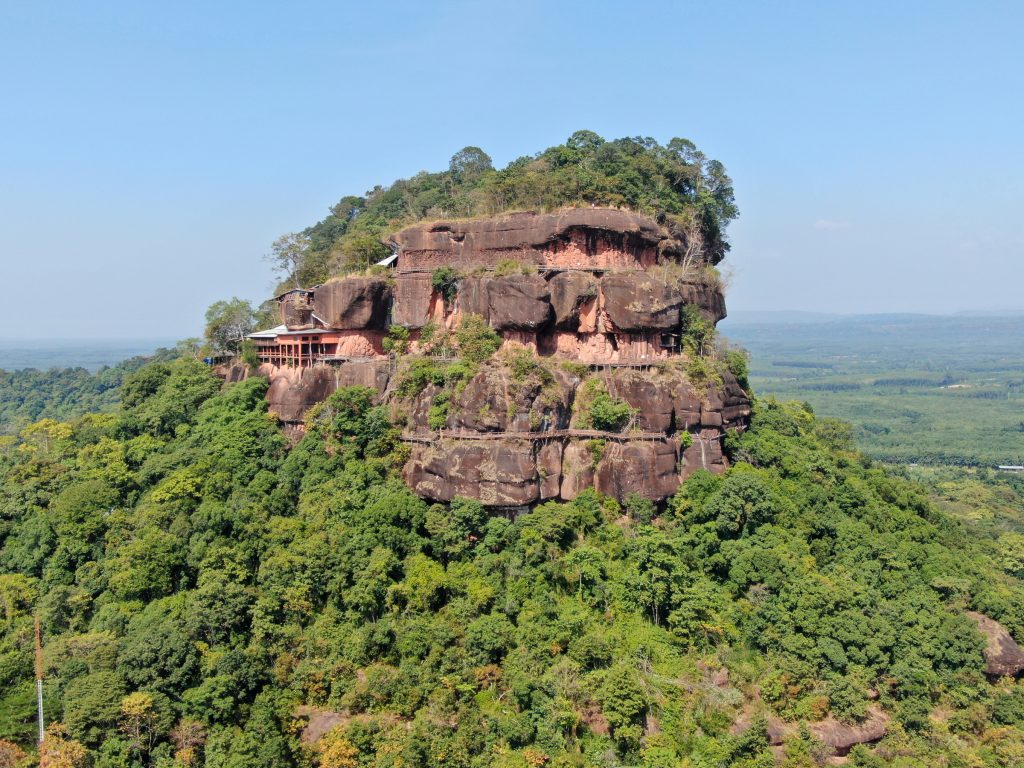
Perched in the remote northeastern corner of Thailand’s Isan region, the temple of Wat Jetiyakhiri—universally known as Wat Phu Tok—stands as one of the most remarkable architectural and spiritual feats in Southeast Asia. Located in Bueng Kan province, far from the heavily touristed beaches of the south and the bustling metropolis of Bangkok, this isolated mountain sanctuary offers a unique intersection of Buddhist philosophy, audacious engineering, and rugged natural beauty. Translating locally from the Isan dialect as "lonely mountain," Phu Tok is a solitary sandstone monolith that rises 359 meters above the surrounding flat plains, drawing intrepid travelers, pilgrims, and architecture enthusiasts willing to test their nerves against its dizzying heights.
Main Facts and Geographical Overview
Wat Phu Tok is situated approximately 359 meters above sea level in Bueng Kan province, an area celebrated for its vast, undisturbed landscapes, tranquil atmosphere, and proximity to the Mekong River basin. The geological formation of the mountain itself is striking, bearing a distinct resemblance to a smaller-scale version of Sri Lanka’s famous Sigiriya rock fortress.

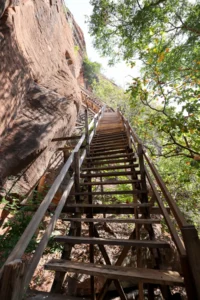
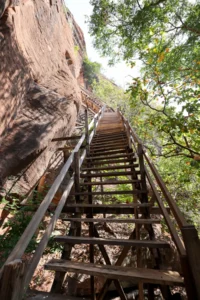
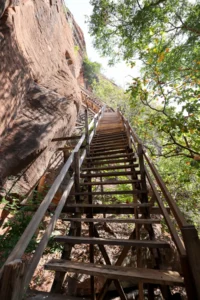
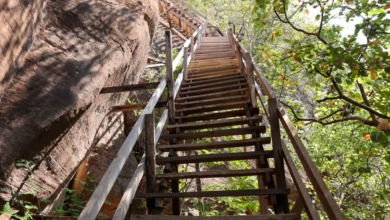
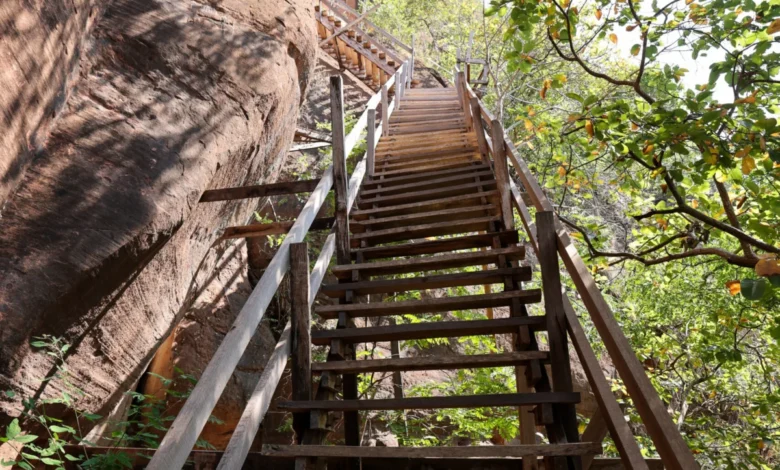
The primary attraction of the site is its intricate, multi-tiered system of wooden staircases, ladders, and cantilevered walkways. These structures are anchored directly into the vertical faces of the red sandstone cliffs, wrapping around the circumference of the mountain. Built entirely by hand, the walkways provide access to seven distinct levels, a deliberate architectural choice mirroring the seven stages of enlightenment in Buddhist meditation. The site covers a vast area, beginning with a expansive park and a large lake at the base, before transitioning abruptly into the dense, snake-populated forest that blankets the lower slopes of the mountain.
Historical Chronology and Origins

The history of Wat Phu Tok is deeply intertwined with the life and vision of its founder, the revered forest monk Luang Pu Juan. Historically, the rugged terrain, dense vegetation, and remote geographical location of the mountain made it a formidable wilderness teeming with wildlife, particularly venomous snakes. Rather than viewing these perils as deterrents, ascetic monks recognized the isolated, challenging environment as an ideal setting for solitary meditation and spiritual endurance.
In the decades following its establishment, Luang Pu Juan spearheaded the monumental construction effort to make the upper reaches of the mountain accessible. Monks, novices, and local volunteers labored to construct a network of wooden stairs, ladders, and suspended walkways that connected natural caves, meditation platforms, and shrines.

The creation of the seven levels followed a strict theological blueprint, designed to test the mental discipline and focus of those ascending them. The progression from the earthy, ground-level shrines up to the precipitous heights of the sixth and seventh tiers represents the psychological and spiritual shedding of worldly attachments. Although the visionary founder, Luang Pu Juan, tragically perished in a commercial airplane crash years after the completion of the core structures, his disciples and local authorities have continued to maintain the complex, ensuring its preservation as both a functioning monastery and a historical landmark.
Structural Breakdown: Navigating the Seven Levels

A visit to Wat Phu Tok is fundamentally defined by the physical ascent through its seven tiers, each offering a distinct environment and set of structural characteristics.
The lower levels (Levels One through Four) serve as the transitional zone from the base of the mountain. The trail begins near the main entrance gate, gradually shifting from packed earth paths to wooden plank staircases. As visitors climb higher, the staircases become significantly steeper, occasionally transitioning into vertical ladders. Despite the daunting angle and the occasional flex of the aging wooden planks, the engineering remains remarkably sturdy. These initial tiers feature intermittent shrines and resting areas, though most visitors bypass them to reach the upper sections.

The fifth level marks a major turning point in the ascent. Unlike the narrow cliffside paths below, the fifth tier flattens out significantly, providing substantial ground-based walking space. This level functions as the administrative and ceremonial heart of the complex, housing the largest ordination hall (ubosot) on the mountain, alongside numerous smaller shrines, meditation cells, and assembly areas. Additionally, the fifth level features a worthwhile detour leading to a small, secluded rock temple situated on an isolated spur of the mountain, accessible via an elevated rock walkway and a suspension bridge.
The sixth level is universally acknowledged as the structural and experiential pinnacle of Wat Phu Tok. Approximately half of this level’s circumference consists of wooden walkways cantilevered directly into the sheer vertical rock face, suspended hundreds of feet above the forest canopy. While the design provides an undeniably thrilling—and for some, terrifying—traversal, the maintenance standards remain high, utilizing thick timber and secure steel anchors. Navigating this narrow ledge requires absolute concentration, as a single misstep presents significant hazards. Walkers are rewarded with unobstructed, panoramic vistas of the Mekong River basin, the surrounding agricultural fields, and the dense tropical canopy of Bueng Kan province.

The seventh level represents the ultimate physical summit of the mountain. Accessible via a final, steep vertical ascent from the sixth tier, the top of the mountain is largely unadorned by artificial structures. Historically avoided and discouraged due to a high concentration of venomous snakes, the seventh level features no wooden walkways or shrines. It is primarily a forested plateau at the peak of the monolith. While it offers additional vantage points for those who reach the summit, most architectural and travel analysts emphasize that the sixth level remains the core attraction for visitors.
Logistics and Visitor Information

For travelers planning an excursion to Wat Phu Tok, the journey typically begins in Bueng Kan city, located approximately a 30-minute drive away. The site features extensive infrastructure at the base, including a large parking lot, a scenic lake, and park facilities designed to accommodate both domestic pilgrims and international tourists.
Admission to the temple grounds is free, though donations for the upkeep of the wooden structures are welcomed. Authorities recommend visiting during the dry season—typically between November and February—when weather conditions are cooler and the risk of slick, hazardous wooden planks is minimized. Visitors are strongly advised to wear sturdy footwear with reliable traction, adhere strictly to posted safety guidelines, and maintain moderate physical fitness, as the vertical climbs and exposed heights demand sustained physical exertion.

Broader Implications and Tourism Impact
The ongoing accessibility of Wat Phu Tok highlights a broader initiative by regional authorities in northeastern Thailand to promote sustainable, off-the-beaten-path tourism. As traditional tourist hotspots across the country grapple with overtourism and environmental degradation, remote provinces like Bueng Kan offer an alternative economic model rooted in nature conservation, cultural heritage, and low-impact travel.

At the same time, the management of Wat Phu Tok presents a unique engineering and safety challenge. Maintaining miles of wooden infrastructure exposed to tropical monsoons, intense ultraviolet radiation, and high humidity requires continuous financial investment and manual labor. Regional tourism boards and temple administrators maintain a delicate balance between preserving the raw, adventurous authenticity of the site and implementing modern safety enhancements to protect the thousands of domestic and international visitors who make the pilgrimage to the lonely mountain each year.