The industrial town of Donora, Pennsylvania, stands today as a haunting reminder of the devastating human cost of unchecked air pollution, marking a critical turning point in modern environmental history. Exactly 78 years ago, an apocalyptic yellow-tinted toxic fog descended upon the Monongahela River valley, trapping industrial emissions and plunging the community into a multi-day health crisis. This catastrophe resulted in thousands of sudden illnesses and multiple fatalities, ultimately catalyzing national environmental reform in the United States and serving as a foundational case study within the CNBC Insight historical archives.
For decades, Donora had thrived as a quintessential American mill town. Nestled in a picturesque river valley approximately 30 miles south of Pittsburgh, the municipality of roughly 14,000 residents was economically dependent on heavy industry. The skyline was dominated by massive operations, notably the Donora Zinc Works and the American Steel & Wire Company, both subsidiaries of United States Steel Corporation. These industrial giants provided steady employment, a sense of civic pride, and a high standard of living for the local working class. However, the very mills that fueled the town’s prosperity also pumped an unremitting stream of sulfur dioxide, carbon monoxide, zinc dust, and metal particulates into the local atmosphere.
The Deadly Trap: Geography and Meteorology Combine
The disaster of late October 1948 was not caused solely by the sheer volume of industrial emissions, but rather by a lethal convergence of unfavorable geography and unusual meteorological phenomena. Donora is situated in a deep, horseshoe-shaped basin carved by the Monongahela River, flanked by steep hills rising several hundred feet on either side.
On Tuesday, October 26, 1948, a high-pressure weather system stalled over the eastern United States. This atmospheric stagnation created a severe temperature inversion. Normally, warm air near the Earth’s surface rises, carrying pollutants away into the upper atmosphere. During a temperature inversion, however, a layer of warm air traps a layer of dense, cold air against the valley floor.
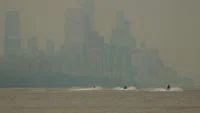
In Donora, this meteorological lid sealed the basin shut. The smoke, gases, and particulate matter pouring from the Zinc Works and the steel mills could not rise or disperse. Instead, the pollutants accumulated relentlessly near the ground, mixing with natural moisture to form a thick, sulfurous, yellowish-green inversion fog. Day by day, the concentration of atmospheric toxins grew thicker, turning afternoon skies into a twilight gloom and reducing visibility to near zero.
Chronology of a Catastrophe: Day by Day
The unfolding crisis followed a rapid and terrifying trajectory, catching local residents and health officials entirely unprepared.
Tuesday, October 26, 1948: The inversion settled over the Monongahela valley. Residents began noticing a strange, metallic smell and a distinct haze clinging to the streets. Initially, complaints were muted, as periodic smoke from the mills was an accepted part of daily life in an industrial economy.
Wednesday, October 27, 1948: The fog thickened perceptibly. Citizens reported a sharp, acrid taste in their mouths and a burning sensation in their eyes and throats. Individuals with pre-existing respiratory conditions, such as asthma and bronchitis, began experiencing severe breathing difficulties. Local doctors’ offices experienced a sudden influx of patients gasping for air.
Thursday, October 28, 1948: Panic began to set in as the smog intensified. The fog was now so dense that motorists had to creep along with headlights on in broad daylight, and pedestrians lost their bearings on familiar streets. The town’s emergency services were overwhelmed. The local telephone switchboard was jammed with calls from panicked relatives seeking medical help. Makeshift triage centers were established, and hospitals in Donora and neighboring communities filled to absolute capacity.
Friday, October 29, 1948: The first fatalities occurred. Within a span of hours, vulnerable residents—primarily the elderly and those with chronic heart and lung ailments—succumbed to asphyxiation and acute systemic toxicity. Municipal authorities realized they were facing an unprecedented public health emergency. Loudspeakers blared warnings through the streets, advising residents with respiratory ailments to evacuate the valley immediately.
Saturday, October 30, 1948: The death toll mounted as medical personnel fought valiantly to save suffocating patients with limited supplies of oxygen. Mill management and local government officials held emergency conferences, debating whether to shut down the industrial plants. However, because the emissions were already trapped, shutting down the furnaces offered no immediate relief without a change in the weather.
Sunday, October 31, 1948: Relief finally arrived from the skies. By Sunday afternoon, a long-awaited cold front broke the temperature inversion, bringing steady rain that washed the toxic particulates out of the air and cleared the valley.
Casualties and the Medical Toll
When the skies finally cleared, the true magnitude of the disaster became horrifyingly apparent. Statistical evaluations conducted in the aftermath revealed that approximately 5,900 residents—representing an astounding 43 percent of Donora’s total population—fell seriously ill during the five-day ordeal. An additional 1,400 residents suffered milder symptoms, meaning nearly half the town was physically incapacitated.
Initial reports confirmed 20 immediate fatalities directly attributed to the toxic exposure. However, historical and medical re-evaluations suggest the death toll was likely higher. Many elderly citizens who survived the acute phase of the crisis died in the subsequent weeks and months from lingering respiratory and cardiovascular damage. Autopsies and medical analyses of the victims revealed lungs severely congested with soot, metal oxides, and chemical irritants, causing pulmonary edema and heart failure.
Local medical professionals played heroic roles during the crisis. Dr. William Rongaus, one of the frontline physicians who treated the victims, later reflected on the sheer narrowness of their survival. In interviews with historical researchers, including documentation preserved by the Smithsonian Magazine, Dr. Rongaus emphasized that the death toll could have been catastrophically higher if natural weather patterns had not intervened. "The number of casualties would have reached 1,000, not 20," Dr. Rongaus noted, reflecting on how close the entire community came to complete annihilation.
In addition to human suffering, the ecosystem of the valley was devastated. Livestock dropped dead in pastures, household pets perished, and vegetation across the hillsides turned brown and withered overnight as if scorched by acid. Paint on houses peeled, and metal fixtures tarnished prematurely from chemical exposure.
Official Responses and the Corporate Stance
In the immediate aftermath of the disaster, finger-pointing and denial characterized the official response. Executives at the United States Steel Corporation and the management of the Donora Zinc Works initially deflected responsibility, arguing that the fog was a natural act of God exacerbated by an unusual weather pattern, rather than a direct consequence of their manufacturing processes. Local officials, fearful of alienating the primary economic engine of the region, were hesitant to apportion blame.
Nevertheless, public outrage could not be easily suppressed. The federal government stepped in as the scale of the tragedy drew national media attention. President Harry S. Truman, recognizing the unprecedented nature of the crisis, intervened by ordering federal agencies to investigate the disaster thoroughly. The U.S. Public Health Service launched a comprehensive epidemiological and environmental study, which ultimately produced a landmark report linking the deaths directly to the accumulation of industrial sulfur dioxide and particulate matter reacting with meteorological inversion conditions.
Broader Impact and Implications for Environmental Policy
The tragedy at Donora sent shockwaves through the American political and scientific establishments, permanently altering public perception regarding industrial pollution. Prior to 1948, heavy smoke and foul air were widely accepted as unavoidable symbols of economic progress and industrial might—the literal scent of money and employment. Donora shattered this illusion, proving that air pollution could be a silent, swift assassin.
The lessons learned from the Donora smog disaster served as the direct intellectual and legislative precursor to modern environmental regulation in the United States. The event heavily influenced the drafting of the Air Pollution Control Act of 1955, the nation’s first major piece of federal legislation regarding air quality. More importantly, it laid the essential groundwork for the landmark Clean Air Act of 1970, which established strict national ambient air quality standards and empowered federal regulators to hold industrial polluters accountable.
Furthermore, the Donora disaster predated and parallels the infamous Great Smog of London in 1952, which claimed thousands of lives under strikingly similar meteorological and industrial conditions. Both events galvanized international awareness, proving that urban and industrial centers required stringent monitoring and emission controls to protect public health.
Conclusion: A Legacy Carved in Clean Air
Seventy-eight years later, the Donora smog disaster remains a vital case study in industrial toxicology, meteorology, and public policy. While the mills that once defined Donora have long since closed and the town has transitioned into a quiet residential community, the ghosts of October 1948 linger in the collective memory of the region.
The sacrifice of the 20 initial victims—and the suffering of the thousands who fell ill—was not in vain. Their ordeal exposed the deadly limits of atmospheric assimilation and forced a nation to recognize that the air we breathe is a finite, shared resource requiring vigilant protection. Today, every time modern environmental regulations force factories to scrub their emissions or issue smog alerts to protect vulnerable citizens, the legacy of Donora’s tragic autumn continues to save lives.