When Pragmatism Overcame Pride: The Diplomatic Pilgrimage of Lee Kuan Yew to Kalibata Cemetery

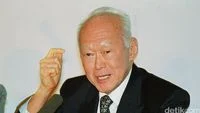
The intricate architecture of modern Southeast Asian geopolitics was forged not merely through grand treaties and economic pacts, but frequently through agonizing gestures of political pragmatism. Among the most striking examples in the annals of ASEAN diplomacy occurred in May 1973, when Singaporean Prime Minister Lee Kuan Yew stepped onto the solemn grounds of the Kalibata Heroes Cemetery in Jakarta. Executing an action that would spark intense domestic criticism back home, the founding father of Singapore walked purposefully toward the graves of two Indonesian marines—KKO Usman bin Haji Muhammad and Harun bin Said—whom he had ordered hanged five years prior. This profound and controversial diplomatic pilgrimage remains a masterclass in statecraft, illustrating how a visionary leader chose to swallow political pride to secure the survival and economic prosperity of a vulnerable, newly independent island-nation.
To understand the immense weight of Lee Kuan Yew’s gesture in 1973, one must examine the geopolitical crucible from which Singapore emerged. Expelled from its turbulent merger with Malaysia on August 9, 1965, Singapore found itself cast adrift as a tiny, resource-scarce sovereign state with a population of less than two million, surrounded by larger, potentially hostile neighbors. The regional atmosphere was heavily charged, lingering in the shadow of the Indonesia-Malaysia Konfrontasi (Confrontation)—a violent, undeclared campaign waged by President Sukarno from 1963 to 1966 to crush the formation of the Malaysian federation, of which Singapore had been a constituent part.
During the height of this volatile campaign, on March 10, 1965, a civilian building in the heart of Singapore, the MacDonald House, was targeted in a devastating bomb attack. The explosive device, planted by Indonesian saboteurs, detonated with catastrophic force, claiming the lives of three innocent civilians—MacDonald House employees Elizabeth Suzie Choo and Juliet Goh, and Bank of China driver Mohamed Yasin bin Kesit—while injuring 33 others. The perpetrators, members of Indonesia’s Korps Komando Operasi (KKO, now the Indonesian Marine Corps), were swiftly apprehended by local authorities. Usman and Harun were subsequently tried, convicted of capital murder, and sentenced to hang under Singaporean jurisdiction.
Despite intense diplomatic pressure, appeals for clemency from Jakarta, and violent protests that rattled the region, the judicial process was allowed to run its course. Under the administration of Lee Kuan Yew, the Singaporean government refused to commute the sentences, projecting an uncompromising stance on national sovereignty and the rule of law. On October 17, 1968, Usman and Harun were executed by hanging at Changi Prison. The executions sent shockwaves through the Indonesian archipelago, triggering an immediate and severe diplomatic rupture. Official diplomatic missions were downscaled, and staff members at the Indonesian embassy in Singapore were largely repatriated, leaving behind only a skeleton crew of defense attaches and essential personnel. Bilateral relations plunged to their absolute nadir, casting a long, icy shadow over maritime Southeast Asia.
The geopolitical landscape of Indonesia, however, underwent a seismic shift with the rise of General Soeharto and the establishment of the New Order regime. Transitioning away from Sukarno’s fiery, anti-imperialist confrontation policies, Soeharto prioritized national economic rehabilitation, regional stability, and open engagement with the West and its Southeast Asian neighbors. This strategic pivot did not go unnoticed by Lee Kuan Yew, who astutely recognized that Singapore’s long-term economic viability depended entirely on fostering peaceful, cooperative ties with Jakarta, its largest and most populous neighbor.
Recognizing the mutual strategic benefits of rapprochement, Lee sought to thaw the diplomatic frost by proposing an official visit to Indonesia in May 1973. Yet, President Soeharto, a master of Javanese political subtlety and cultural etiquette, laid down a non-negotiable precondition. For Jakarta to truly turn the page on the bitter legacy of the Konfrontasi and the executions, the Singaporean Prime Minister had to personally acknowledge the sacrifice of the two executed marines in a manner that satisfied traditional Indonesian notions of honor, penitence, and spiritual closure.
According to historical accounts, notably documented by diplomat Abdul Rachman Ramly in the 2011 publication Pak Harto: The Untold Stories, Soeharto stipulated that Lee must physically scatter flowers directly upon the graves of Usman and Harun at the Kalibata Heroes Cemetery. This was a deliberate departure from standard protocol, which usually required visiting foreign dignitaries to lay ceremonial wreaths at the main memorial monument rather than at specific, politically sensitive gravesites. It was a litmus test of Lee’s sincerity and a measure of his willingness to humble himself for the greater good of bilateral relations.
Lee Kuan Yew’s decision to accept Soeharto’s stringent condition was fraught with domestic political risk. In Singapore, the hanging of Usman and Harun had been legally and publicly framed as a defense against terrorism and unlawful violence. For the Prime Minister to personally honor these same men at their final resting place risked alienating domestic constituencies, infuriating families of the MacDonald House bombing victims, and inviting fierce criticism from political opponents who might view the act as an unprincipled capitulation.
Nevertheless, Lee’s calculated pragmatism prevailed over political optics. In his memoirs, From Third World to First (2000), Lee provided a candid window into his strategic calculus, analyzing the situation through the lens of Javanese sociology and psychology. He noted that to build an authentic, enduring friendship with President Soeharto and the broader Indonesian military elite, the lingering trauma of the 1968 executions needed to be formally put to rest through a symbolic gesture that accommodated Javanese beliefs regarding a clean conscience and spiritual harmony.
"If I wanted to build a genuine relationship with President Soeharto, the episode surrounding the hanging of the two marines had to be closed with a diplomatic gesture that accommodated Javanese beliefs about a clean soul and conscience," Lee reflected in his memoirs. Understanding that the Indonesian military leadership deeply valued personal honor and symbolic deference, Lee chose to prioritize geopolitical stability over short-term domestic popularity.
In May 1973, Lee Kuan Yew arrived in Jakarta and fulfilled the precise terms of the agreement. Accompanied by Indonesian officials, the Singaporean Prime Minister walked to the shaded paths of the Kalibata Heroes Cemetery, knelt before the graves of Usman and Harun, and scattered fresh flowers upon the earth. This quiet, profoundly symbolic act reverberated across the region, instantly dismantling the diplomatic wall that had separated the two nations for half a decade.
The gesture stunned observers internationally and shocked domestic audiences in both countries, but its immediate efficacy was undeniable. The symbolic laying of flowers served as a psychological catharsis, allowing Jakarta to officially close a painful chapter of national history without losing face. President Soeharto accepted the gesture as a profound mark of respect, signaling a personal rapport that would form the bedrock of bilateral diplomacy for decades to come.
Beyond the pilgrimage to Kalibata, Lee demonstrated an extraordinary commitment to bridging the cultural and linguistic divide between Singapore and Indonesia. Recognizing that personal chemistry and direct communication were vital in dealing with Soeharto and his inner circle of generals, Lee took the deliberate step of studying the Indonesian language. By mastering conversational Indonesian, he was able to engage in private, unmediated dialogues with Soeharto, bypassing translators and establishing a level of trust and intimacy rare among international heads of state.
The long-term implications of Lee Kuan Yew’s 1973 diplomatic gamble cannot be overstated. The successful thaw at Kalibata paved the way for a sweeping normalization of political, economic, and security ties between Singapore and Indonesia. Within a few years, bilateral trade surged, maritime boundaries began to be systematically negotiated, and both nations emerged as co-founders of the Association of Southeast Asian Nations (ASEAN), cementing a regional framework for peace and economic cooperation that endures to this day.
Furthermore, the reconciliation laid the groundwork for deep-seated defense cooperation, including joint military exercises, airspace management agreements, and intelligence sharing—partnerships that were once entirely unthinkable in the volatile climate of the 1960s. Analysts frequently cite the 1973 visit as a textbook case of transformative diplomacy, proving that ideological rigidity and historical grievances can be successfully navigated when leaders prioritize long-term strategic stability over transient emotional pride.
Decades later, the legacy of Lee Kuan Yew’s visit to the Kalibata Heroes Cemetery continues to resonate as a defining moment in modern Southeast Asian history. It stands as a powerful reminder that statecraft often requires leaders to make agonizing choices, stepping beyond comfort zones and risking political capital to build bridges where enmity once reigned. By placing flowers on the graves of men he had legally sent to the gallows, Lee Kuan Yew transformed a site of historical tragedy into the foundation for enduring regional partnership, permanently altering the geopolitical destiny of Singapore and Indonesia.
Related posts: