The Legacy of Mbah Maridjan and the Cataclysmic 2010 Eruption of Mount Merapi: A Historical Reflection on Duty, Disaster, and Volcanology

Mount Merapi, straddling the border between Central Java and the Special Region of Yogyakarta, has long held a paradoxical position in Indonesian culture: it is simultaneously a source of imminent, lethal danger and a sacred, life-giving pillar of local civilization. For centuries, the mountain’s periodic eruptions have displaced communities, destroyed infrastructure, and claimed countless lives. Yet, its volcanic ash continually enriches the surrounding agricultural soil, sustaining millions of farmers who farm its steep slopes. This complex dynamic of reverence and resilience found its ultimate embodiment in the figure of Mas Penewu Surakso Hargo, universally known as Mbah Maridjan, the spiritual gatekeeper (juru kunci) appointed by the Yogyakarta Sultanate. His steadfast refusal to evacuate during the catastrophic eruption cycles of the 21st century transformed him into a cultural symbol of unwavering duty, even as his fateful choice became inextricably linked to one of the most violent volcanic events in modern Indonesian history.
The Unshakable Oath of the Juru Kunci
When seismic instruments and visual observations began registering alarming anomalies at Mount Merapi in late October 2010, disaster management agencies and regional authorities immediately initiated emergency protocols. Hundreds of residents living within the designated danger zones were urged to pack their belongings and move to temporary evacuation shelters. Among them, however, a lone figure stood resolute against the tide of fleeing villagers. Mbah Maridjan, then aged 83, firmly rejected the directives of disaster mitigation officials and even spurned a direct personal plea from Sri Sultan Hamengkubuwona X, the Governor of Yogyakarta and monarch of the Yogyakarta Sultanate, urging him to leave his home in Kinahrejo on the southern slopes of the mountain.
Mbah Maridjan’s decision was not rooted in mere stubbornness or skepticism of modern science, but in a profound, lifelong commitment to an oath he had sworn to the late Sultan Hamengkubuwana IX, the father of Hamengkubuwana X. Appointed as the spiritual custodian of the mountain, Mbah Maridjan viewed his post as a sacred mandate. In traditional Javanese cosmology, the spirit of the mountain must be respected through rituals, prayers, and physical presence, acting as a spiritual buffer between the volatile forces of nature and the human settlements below. For the aging juru kunci, abandoning the slopes of Merapi meant abandoning his spiritual duty to the Sultanate and the community.
Furthermore, Mbah Maridjan perceived the mountain through a philosophical lens that transcended Western vulcanological definitions of destruction. He frequently encapsulated this worldview in the Javanese aphorism "Merapi kuwi mbangun," which translates to "Merapi is building." In his understanding, the volcanic cycles were not merely destructive catastrophes, but a continuous process of renewal and creation by the earth. This deeply embedded worldview rendered him impervious to official warnings. Four years prior, during the 2006 eruptive phase, his refusal to evacuate had also made headlines. On that occasion, fate favored his conviction; a shift in wind direction diverted scorching pyroclastic flows away from his residence, allowing him to survive and cementing his reputation among locals as a man shielded by mystical protection.
The Turning Point: The Cataclysm of October 26, 2010
Nature, however, does not negotiate with myth. On October 26, 2010, Mount Merapi erupted with an unprecedented level of violence that shattered previous assumptions about the volcano’s behavior. The eruption unleashed a series of massive pyroclastic flows—locally known as wedhus gembel, or "gandering sheep" due to their appearance—racing down the southern ravines at hurricane speeds with temperatures exceeding several hundred degrees Celsius.
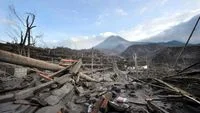
Kinahrejo, Mbah Maridjan’s hamlet located just a few kilometers from the peak, bore the full brunt of the searing gas and ash avalanche. The infrastructure of the village was instantaneously obliterated, and the surrounding flora was reduced to charred timber. In the aftermath of the disaster, rescue teams searching the devastated landscape discovered Mbah Maridjan’s lifeless body. He was found inside his ruined home in a traditional prayer prostration (sujud), facing Mecca. His death marked a tragic, symbolic end to an era of traditional guardianship, shocking the nation and signaling that the impending eruption was of a magnitude far exceeding anything witnessed in living memory.
Escalation and the Peak of the 2010 Eruption
While the death of Mbah Maridjan dominated national headlines and plunged the cultural community into mourning, vulcanologists and disaster management officials were grappling with an even more alarming reality: the eruption had not yet reached its zenith. Following the initial late-October explosions, Mount Merapi entered a vastly more aggressive and explosive phase characterized by rapid magma ascent, the destabilization of newly formed lava domes, and continuous pyroclastic emissions.
The crisis reached its apocalyptic peak during the night of November 4 to the early morning hours of November 5, 2010. During this window, the volcano produced its most powerful paroxysmal explosion of the century. A colossal column of ash and volcanic gas surged approximately 17 kilometers high into the stratosphere, heavily disrupting regional aviation. Simultaneously, massive volumes of pyroclastic material cascaded down the Gendol River valley, traveling an unprecedented distance of 15 to 16 kilometers from the summit. This lateral reach far exceeded historical averages for Merapi eruptions, threatening densely populated areas that had previously been considered safe zones.
Recognizing the escalating catastrophe, the National Disaster Management Agency (BNPB), in coordination with the Center for Volcanological and Geological Hazard Mitigation (PVMBG), drastically expanded the evacuation radius to 20 kilometers from the peak. This enforced perimeter displacement affected hundreds of thousands of residents across the Sleman, Klaten, Boyolali, and Magelang regencies. Temporary shelters filled rapidly as families fled into schools, mosques, and government buildings, creating one of the largest internal displacement crises in Indonesia’s modern disaster history.
Socioeconomic Toll and Casualties
The 2010 eruption sequence is officially recorded in Indonesian history as the most destructive volcanic event at Mount Merapi in over a century. The sheer destructive power of the pyroclastic currents, combined with subsequent cold lahar floods (lahar dingin) triggered by heavy seasonal rains washing volcanic debris down the riverbeds, resulted in staggering human and economic losses.
According to final official reports compiled by the BNPB in its 2010 disaster documentation, the human toll was devastating:
- 341 fatalities directly resulting from thermal injuries, asphyxiation, and secondary hazards.
- 368 individuals severely injured and admitted to regional hospitals for intensive medical treatment.
- 61,154 people forcibly displaced from their homes into emergency evacuation camps.
The economic fallout was equally crippling. The BNPB estimated the total material and structural losses at approximately Rp4.23 trillion. This financial figure encompassed widespread damage to agricultural lands, livestock losses, critical infrastructure destruction, and the complete leveling or structural compromise of 3,307 residential and public buildings within the affected districts. The local economy in the Special Region of Yogyakarta and Central Java suffered a severe contraction, requiring years of concerted governmental intervention for rehabilitation and reconstruction.
Post-2010 Volcanic Behavior and Ongoing Monitoring
The monumental eruption of 2010 fundamentally altered the internal plumbing and physical structure of Mount Merapi, leaving a massive horseshoe-shaped crater and re-shaping the summit topography. Far from returning to a dormant state, the volcano entered a new era of persistent, complex activity that continues to demand unremitting vigilance from scientific and civil authorities.
On August 11, 2018, Merapi initiated a new magmatic eruption cycle that persisted through September 2019, characterized by intermittent ash explosions and lava dome growth. This was followed by a series of high-intensity explosive events throughout 2020. By January 2021, the mountain transitioned into an efusive eruption phase defined by the continuous extrusion of new lava domes, accompanied by frequent lava avalanches and dangerous pyroclastic density currents (PDCs) cascading down its slopes.
Although none of these subsequent episodes have reached the catastrophic scale of the 2010 event, Mount Merapi remains classified as one of the most active and closely monitored volcanoes in the world. Modern vulcanology relies on advanced satellite radar interferometry, real-time seismic networks, tiltmeters, and continuous gas emission monitoring to track magma migration beneath the surface. These technological advancements enable early warning systems that give local communities critical lead time to evacuate, significantly mitigating the risk of mass casualties.
Implications for Disaster Risk Reduction in Indonesia
The historical legacy of Mbah Maridjan and the seismic trauma of the 2010 eruption offer profound lessons for contemporary disaster management, particularly in a nation as geologically volatile as Indonesia. Straddling the Pacific Ring of Fire, Indonesia must continuously balance the socio-cultural realities of indigenous communities living in close proximity to natural hazards with the imperatives of modern scientific risk reduction.
The tragic fate of the revered juru kunci underscores the deep psychological and cultural bonds that tie traditional populations to ancestral lands and active geological features. Modern disaster policy in Indonesia has increasingly recognized that effective mitigation cannot rely solely on enforcement and physical barriers; it must incorporate culturally sensitive communication and community-based disaster preparedness. Engaging local leaders, traditional authorities, and spiritual figures as partners in safety education has become a vital strategy in bridging the gap between empirical science and local belief systems.
Ultimately, the story of Mbah Maridjan and the 2010 eruption of Mount Merapi serves as a dual historical marker. It stands as a solemn memorial to the destructive power of nature and the vulnerability of human settlement in the face of tectonic fury, while simultaneously honoring the unbreakable human spirit of resilience, duty, and cultural identity that defines the communities living in the shadow of Java’s most formidable peak.