Menjaga Warisan Lewat Benang Kasab: Kisah Asra dan Peran PNM Mekaar dalam Melestarikan Sulaman Tradisional Aceh di Tengah Arus Modernisasi

Jakarta, CNBC Indonesia – In an era defined by rapid industrial modernization and mass-produced consumer goods, traditional handicrafts face an existential crisis. The painstaking nature of heritage artisanal work—requiring meticulous attention to detail, specialized generational skills, and weeks or even months of labor—clashes with the fast-paced demands of contemporary markets. Consequently, fewer younger artisans are willing to inherit these labor-intensive traditions, threatening centuries of cultural heritage with obscurity.
Yet, for a dedicated few, the preservation of traditional crafts transcends mere economic survival. It is an act of cultural stewardship, safeguarding local heritage, ancestral techniques, and regional identity for future generations. This resilience is vividly embodied by Asra, a 63-year-old artisan from Kuala Baru, Aceh. Since 1990, she has devoted more than three decades of her life to mastering and sustaining sulam kasab, a traditional Acechani embroidery craft renowned for its intricate designs and demand for extraordinary patience.
The Evolution of a Lifelong Craft
Asra’s journey into the world of traditional embroidery began out of necessity and cultural immersion. Growing up in Aceh, the intricate art of kasab thread embroidery was deeply embedded in the local social fabric. However, as modern alternatives flooded the market, the landscape of traditional craftsmanship began to shift.
"Initially, this business stemmed from the kasab thread embroidery culture that has long been a tradition in our region. Because the manufacturing process takes quite a long time and requires high precision, gradually many residents preferred to buy kasab bead embroidery rather than making it themselves," Asra recounted in a written statement.
Recognizing this evolving consumer preference, Asra adapted. She transitioned from traditional thread embroidery to intricate beadwork kasab, initially offering her craftsmanship through word-of-mouth orders from house to house. What started as a modest sideline activity conducted alongside her duties as a housewife steadily blossomed into a formidable micro-enterprise that significantly bolstered her family’s financial stability. Over the decades, her reputation for meticulous quality expanded beyond her immediate neighborhood, allowing her creations to be marketed across various regions throughout Aceh.
The Labor-Intensive Artistry of Kasab Beadwork
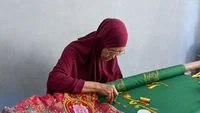
The production of kasab bead embroidery is far from simple. Every single piece is entirely handmade, requiring specialized techniques passed down through generations. The tension of the thread must be meticulously controlled with every single stitch to ensure the resulting geometric or floral patterns remain immaculate, uniform, and structurally sound.
The work cannot be rushed. Patience and unwavering focus are fundamental pillars of the craft, as a single misaligned bead or misplaced stitch can compromise the aesthetic integrity of the entire piece.
"The uniqueness of this business lies in its rather complicated manufacturing process. Every pull of the thread requires extra precision and patience. It cannot be rushed because every part must be made carefully so that the final result is neat and beautiful," Asra explained.
Overcoming Financial Hurdles: The Turning Point in 2020
Despite the artistic success and cultural value of her work, Asra’s enterprise, like many micro-enterprises across the Indonesian archipelago, encountered significant structural obstacles—most notably, limited access to working capital. By 2020, as demand for her kasab beadwork grew, her production capacity was severely constrained by a lack of funds to purchase raw materials in bulk.
Seeking a viable solution to scale her operations, Asra joined PT Permodalan Nasional Madani (PNM) Mekaar, an institution specializing in empowering women-led ultra-micro businesses. Through her participation as a client, she secured crucial additional capital designed specifically to support small-scale entrepreneurs.
This injection of capital proved to be a transformative milestone for her business. Asra utilized the financing to directly address her production bottlenecks, procuring larger quantities of beads, threads, and base fabrics. With adequate financial backing, she was not only able to sustain continuous operations but also significantly expand her production capacity to fulfill a rising volume of orders.
"Alhamdulillah, this additional capital helped me to keep running the business and meet production needs," Asra stated gratefully.
In addition to financial infusion, Asra received comprehensive non-financial support. She participated in specialized capacity-building programs and mentoring workshops regarding kasab thread and bead techniques held directly in Kuala Baru. These structured training sessions enriched her technical repertoire and enhanced her entrepreneurial acumen, providing her with modern business management tools while honoring traditional techniques.
Economic Ripples and Community Empowerment
As Asra’s production capacity multiplied, the positive economic impact cascaded outward, directly benefiting the surrounding community in Kuala Baru. No longer operating as a solitary home-based crafter, Asra began creating employment opportunities for local residents, particularly women.
By engaging neighbors in the production process, she enabled them to earn supplemental household income. This collaborative production model transformed her enterprise from a solitary family-sustaining venture into an engine of local economic vitality. Concurrently, the proliferation of active perajin (artisans) in the village ensures that the specialized knowledge of Acehnese embroidery remains dynamic and active within the community, rather than locked away as a fading historical memory.
The Broader Ecosystem: Ultra Micro Holding (UMi) and Financial Inclusion
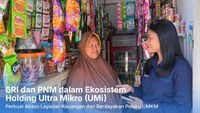
Asra’s narrative serves as a micro-cosm of a much larger national financial inclusion strategy spearheaded by Indonesia’s Ultra Micro Holding (Holding UMi). Established in 2021, the holding integrates the extensive grassroots reach of PT Bank Rakyat Indonesia (Persero) Tbk (BRI) as the parent entity, alongside PT Pegadaian and PT Permodalan Nasional Madani (PNM).
The primary mandate of Holding UMi is to broaden and deepen financial access for the ultra-micro segment—a demographic historically underserved by traditional commercial banking systems. By constructing an integrated ecosystem that seamlessly combines accessible financing, savings mechanisms, transactional services, and structured business mentoring, Holding UMi aims to elevate grassroots entrepreneurs out of subsistence-level operations into sustainable, scalable enterprises.
Corporate Secretary of BRI, Dhanny, emphasized that capacity building and empowerment constitute the bedrock of building a sustainable ultra-micro ecosystem in Indonesia. According to Dhanny, financial access must never be viewed as an isolated transaction, but rather as a gateway to holistic community development.
"Through the Ultra Micro Holding, we want to ensure that financial access becomes the entry point toward broader empowerment. Business actors like Ibu Asra demonstrate that when financial access is combined with mentoring and the spirit to keep developing, ultra-micro businesses can provide benefits that far exceed the business owners themselves," Dhanny asserted.
The integration of BRI’s financial prowess, Pegadaian’s pawn-backed liquidity solutions, and PNM’s group-based lending and mentoring model (Mekaar) creates a robust safety net and growth ladder for millions of informal workers across Indonesia. For artisans operating in remote coastal and rural areas like Kuala Baru, this institutional backing bridges the chasm between traditional heritage crafts and modern economic sustainability.
Preserving Heritage for the Next Generation
For Asra, the institutional support from PNM Mekaar and Holding UMi represents a vital chapter in her three-decade-long mission. As the modern world marches forward with automated production lines and digital consumerism, her hands continue to move with deliberate slowness, weaving beads and threads into timeless expressions of Acehnese identity.
In an era where intangible cultural heritage is increasingly vulnerable to globalization, Asra’s workshop stands as a testament to the power of resilient individuals backed by robust financial infrastructure. Every piece of sulam kasab that emerges from her hands is more than just a marketable commodity; it is a vital lifeline for her family, a source of shared prosperity for her neighbors, and a living museum piece that ensures the intricate embroidery traditions of Aceh will endure to captivate and inspire future generations.