Indonesia Officially Enters a New Era of Naval Power with the Arrival of Its First Aircraft Carrier KRI Sriwijaya ex ITS Giuseppe Garibaldi

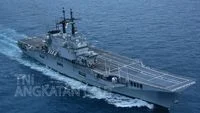
Jakarta — In a historic milestone that fundamentally shifts the geopolitical and strategic balance of Southeast Asia, the Indonesian Navy officially welcomed its first-ever aircraft carrier to the archipelago on Friday morning, September 18, 2026. The formidable vessel, formerly known as the Italian Navy’s ITS Giuseppe Garibaldi (C 551), docked gracefully at the Tanjung Priok port in North Jakarta following an arduous and symbolic 25-day transcontinental voyage that commenced from an Italian naval base on August 24, 2026.
This acquisition represents far more than a routine addition of military hardware; it marks the realization of a decades-long strategic ambition for Indonesia to project power, safeguard its sprawling maritime sovereignty, and secure critical sea lanes of communication across the Indo-Pacific. As the vessel transitions into Indonesian service, it has officially been rechristened as KRI Sriwijaya, honoring the glorious ancient maritime empire that once dominated Southeast Asian waters and commanded vast economic and naval networks across the region.
The inclusion of an aircraft carrier within the arsenal of the Tentara Nasional Indonesia Angkatan Laut (TNI AL)—the Indonesian Navy—serves as the centerpiece of a broader, aggressive modernization initiative. This endeavor is designed to address mounting security challenges, protect abundant natural resources within the country’s Exclusive Economic Zone (EEZ), and project a credible, outward-looking defense posture capable of deterring potential regional aggressors.
A Historical Interlude: Tracing the Legacy of Giuseppe Garibaldi
To understand the weight of the name originally borne by Indonesia’s new flagship, one must look deep into the annals of 19th-century European history. The vessel’s namesake, Giuseppe Garibaldi, stands as one of the most celebrated figures in the turbulent and complex process of modern nation-building. Born in the Mediterranean port city of Nice on July 4, 1807, Garibaldi entered a world where the Italian Peninsula was not a unified nation-state, but rather a fragmented mosaic of regional kingdoms, duchies, and foreign-controlled territories.
During his formative years, Garibaldi became deeply immersed in the radical ideals of the French Revolution, particularly the concepts of liberty, equality, and fraternity. These philosophies ignited within him an unyielding vision for a unified Italy. This intellectual awakening led him to join "Young Italy" (Giovine Italia), a political movement founded by the visionary nationalist Giuseppe Mazzini in 1831. Mazzini’s clandestine organization sought to create a united, free, and republican Italy through popular insurrection.
As Italian scholar Giuliana Limiti observed in her seminal 2008 work, "Garibaldi and Mazzini: Thought and Action," the relationship between the two revolutionaries laid the philosophical groundwork for modern Italian statehood: "From Mazzini, Garibaldi obtained new ideas about unity and republicanism; the political and social essence useful to achieving freedom and justice; the idea of brotherhood between society and workers; and the concept of the relationship between institutional and social frameworks."
However, Garibaldi’s fiery commitment to revolution came with severe personal and political costs. Following his involvement in failed uprisings and insurrectionary plots in Piedmont, he was hunted by royal authorities and ultimately condemned to death in absentia. Facing the gallows, Garibaldi fled into exile in South America, a chapter of his life that would unexpectedly forge his legendary military prowess.
The Crucible of the Americas and the Hero of Two Worlds
Garibaldi’s years in South America, spanning from the late 1830s to the mid-1840s, served as a grueling military laboratory. Living and fighting in Brazil and Uruguay, he immersed himself in the irregular warfare of the continent, participating in the Ragamuffin War and the Uruguayan Civil War. It was during these tumultuous campaigns that Garibaldi mastered the intricacies of guerrilla tactics, cavalry maneuvering, and the command of multidisciplinary volunteer forces.
This hard-earned tactical expertise proved decisive when the winds of revolution finally summoned him back to Europe. In 1860, amid the sweeping revolutionary waves of the Risorgimento—the ideological and political movement that unified the different states of the Italian peninsula—Garibaldi orchestrated his most famous military feat. Known as the Expedition of the Thousand (Expedition of theredi Mille), Garibaldi gathered a ragtag volunteer force of roughly 1,000 red-shirted patriots, sailing from Genoa to the island of Sicily.
Despite being vastly outnumbered by the professional armies of the Bourbon-ruled Kingdom of the Two Sicilies, Garibaldi’s tactical brilliance and inspirational leadership carried the day. His forces captured Palermo, crossed the Strait of Messina, and marched triumphantly into Naples, systematically dismantling the southern monarchy. In a moment of supreme political selflessness that cemented his status as a national icon, Garibaldi chose national unity over personal power. He handed his conquests over to King Victor Emmanuel II of the House of Savoy, paving the way for the official proclamation of the Kingdom of Italy on March 17, 1861.
When Garibaldi passed away on June 2, 1882, his legacy spanned hemispheres. Having fought for liberty on both sides of the Atlantic, history rightfully enshrined him with the timeless moniker: "The Hero of Two Worlds."
Chronology of a Strategic Acquisition: From Italian Service to Indonesian Flagship
The path toward Indonesia acquiring its first aircraft carrier has been meticulously charted over several years, reflecting Jakarta’s quiet determination to upgrade its blue-water naval capabilities.
- Early 2020s: As regional tensions escalated in the South China Sea and the broader Indo-Pacific, Indonesian defense planners intensified discussions regarding the acquisition of a transformative power-projection platform. While traditional submarine and frigate procurements remained active, the Ministry of Defense recognized a critical gap in airborne early warning, anti-submarine warfare, and vertical envelopment capabilities at extended ranges.
- Late 2024 to 2025: Negotiations between the Indonesian Ministry of Defense and Italian naval authorities gained momentum. The Italian Navy’s ITS Giuseppe Garibaldi, having served with distinction since 1985 as a light aircraft carrier and command ship before being gradually supplemented by the larger ITS Cavour and newer Trieste-class amphibious assault ships, was identified as an ideal candidate for transfer. Refurbishment terms, technology transfer agreements, and crew training programs were finalized.
- August 24, 2026: Following comprehensive maintenance, systems upgrades, and integration preparations conducted with Indonesian technical oversight, the vessel formally departed from an Italian port, embarking on its historic repositioning voyage toward Southeast Asia.
- September 18, 2026 (Morning): Amidst a high-security maritime escort and a ceremonial welcoming committee, the ship arrived at Tanjung Priok, Jakarta. High-ranking Indonesian defense officials, naval commanders, and dignitaries gathered at the harbor to witness the vessel officially enter Indonesian territorial waters and receive its new designation: KRI Sriwijaya.
Strategic Implications and Defense Analysis
Military analysts and defense economists have weighed in heavily on the arrival of KRI Sriwijaya, noting that the vessel fundamentally alters Indonesia’s military posture. As an archipelagic nation comprising over 17,000 islands, Indonesia has historically struggled with the logistical nightmare of defending its vast maritime frontiers using land-based air cover alone.
By integrating an aircraft carrier capable of operating rotary-wing aircraft, vertical/short take-off and landing (V/STOL) jets, and advanced command-and-control systems, the TNI AL can now establish floating airbases anywhere within its jurisdiction. This capability is exceptionally vital for patrolling the Natuna Sea, securing eastern Indonesian waters, and responding swiftly to humanitarian disasters and natural calamities—a frequent necessity in the world’s most active seismic and meteorological zone.
Furthermore, defense experts point out that the commissioning of KRI Sriwijaya signals a maturation of Indonesia’s "Minimum Essential Force" (MEF) doctrine into a more assertive, outward-looking deterrence strategy. While Indonesia continues to champion regional diplomacy and ASEAN centrality, the possession of a blue-water flagship ensures that Jakarta speaks from a position of undeniable military substance.
Official Responses and Domestic Reception
The Indonesian Ministry of Defense, alongside the Headquarters of the Indonesian National Armed Forces (TNI), has emphasized that the acquisition of KRI Sriwijaya aligns strictly with the nation’s constitutional mandate to protect every inch of the motherland while maintaining a defensive, non-aggressive posture.
In an impromptu press briefing at Tanjung Priok following the ship’s arrival, military spokespersons highlighted that the integration of the vessel will be accompanied by an extensive training regimen for Indonesian sailors, aviators, and technical specialists. This ensures that the operation and maintenance of the ship meet the highest international naval standards.
Public and political reaction across the capital has been overwhelmingly enthusiastic. Lawmakers from the House of Representatives (DPR RI) commission overseeing defense affairs praised the strategic vision behind the acquisition, noting that reviving the historical name of Sriwijaya—an empire that once successfully policed the vital trade choke points of the Malacca and Sunda Straits—serves as a powerful reminder of Indonesia’s inherent maritime destiny.
Conclusion: A New Horizon for the Indonesian Navy
As KRI Sriwijaya rests at anchor in Tanjung Priok, flying the red and white flag of the Republic of Indonesia, a new chapter in modern military history begins to unfold. The spirit of Giuseppe Garibaldi—built on revolutionary zeal, tactical adaptability, and an unyielding commitment to unity—now finds a unique parallel in the modern waters of the Indonesian archipelago.
With its first aircraft carrier successfully integrated into service, Indonesia has firmly signaled to the international community that it is prepared to shoulder the responsibilities of a major maritime power, ensuring stability, security, and sovereignty across its vast oceanic domains for generations to come.