Empowering Former Migrant Workers: The Success Story of Rosyidah and BRI’s Commitment to Strengthening the Local Economy in Indramayu

The journey of Rosyidah, a resident of Eretan Kulon Village in the Indramayu Regency of West Java, serves as a poignant narrative of transformation from a migrant laborer to a successful local entrepreneur. After spending four years working as an Indonesian Migrant Worker (PMI) in Malaysia, Rosyidah decided to return to her roots, bringing with her not just savings, but a vision to revitalize her community’s economy. Her story, marked by the transition from the international labor market to the local seafood processing industry, highlights the critical role of financial literacy, corporate empowerment programs, and accessible credit in fostering sustainable economic growth at the grassroots level.
Upon her return to Indonesia, Rosyidah was struck by the untapped potential of her coastal hometown. Indramayu has long been recognized as one of West Java’s primary hubs for fisheries, with Eretan Kulon being a significant contributor to the region’s marine output. However, Rosyidah observed a persistent gap: while raw seafood was abundant, the community lacked the infrastructure or the initiative to process these raw materials into high-value consumer goods. Most of the catch was sold fresh at low margins, leaving the local fishing families vulnerable to price fluctuations and seasonal instability. Recognizing this gap, Rosyidah embarked on a mission to add value to the local harvest, eventually founding her own brand, C’milzea.
The Genesis of C’milzea and the Challenge of Entrepreneurship
The establishment of C’milzea was not merely a business venture; it was a social initiative. Rosyidah’s primary objective was to create a sustainable source of income for the wives of local fishermen, a demographic that often faces economic marginalization during the "paceklik" or lean seasons when the weather prevents their husbands from going to sea. By involving these women in the production process, Rosyidah aimed to create a secondary economic pillar for the households in Eretan Kulon.
However, the transition from an employee in a foreign country to a business owner in Indonesia presented significant psychological and structural hurdles. For Rosyidah, the most daunting challenge was not the physical labor, but the development of an entrepreneurial mindset. "I saw that the natural resources around me were very abundant, but they did not yet have a high selling value. From there, I ventured to process them into products while also opening job opportunities for the wives of fishermen nearby," she stated in a recent interview.
Despite her determination, the early days were characterized by self-doubt. Transitioning from a structured environment in Malaysia to the unpredictable world of MSMEs (Micro, Small, and Medium Enterprises) required a total overhaul of her perspective. She had to learn the intricacies of product development, the nuances of local branding, and the complexities of market penetration. The initial phase of C’milzea was modest, with limited production and a narrow distribution network that relied heavily on word-of-mouth.
The Role of BRI Peduli and Post-Migrant Worker Training
The turning point for Rosyidah’s business came through her participation in the "Pelatihan Purna Pekerja Migran" (Training for Former Migrant Workers), a flagship program organized by Bank Rakyat Indonesia (BRI) under its social responsibility umbrella, BRI Peduli. This program is specifically designed to address the unique challenges faced by returning migrants, who often struggle to reintegrate into the local economy or lack the technical skills to manage the capital they saved while working abroad.
For Rosyidah, the training was a transformative experience. It provided her with a platform to network with other entrepreneurs, share experiences, and gain professional insights into business management. The curriculum covered essential aspects of modern entrepreneurship, including financial planning, digital marketing, and food safety standards. "This training was very helpful in improving my mindset as a business actor. In addition, I also gained a new network that is very beneficial for business development," Rosyidah explained.
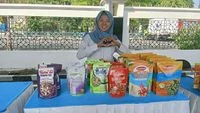
One of the most tangible outcomes of the training was the improvement in her seafood processing techniques. She learned how to transform raw fish into various derivative products, such as fish crackers (kerupuk ikan), which have a longer shelf life and higher market demand than fresh fish. This diversification allowed C’milzea to reach a broader consumer base and mitigate the risks associated with the perishability of seafood.
Financial Inclusion through KUR BRI
While training provided the "software" for her business—the skills and mindset—Rosyidah still required the "hardware" in the form of capital to scale her operations. To bridge this gap, she utilized the Kredit Usaha Rakyat (KUR) facility from BRI. KUR is a government-subsidized credit scheme aimed at empowering MSMEs that are productive but lack sufficient collateral.
The injection of capital from the KUR facility allowed Rosyidah to professionalize her production line. She used the funds to purchase bulk raw materials during peak fishing seasons when prices were lower, invest in better packaging materials, and maintain a consistent stock to meet growing demand. "With the existence of KUR, I no longer face difficulties when I need capital to fulfill customer requests. I am very grateful because my business is growing and sales have increased," she noted.
The impact of this financial support was immediate and measurable. Prior to receiving the KUR loan and undergoing training, C’milzea’s sales averaged around 50 packages per cycle. Following the intervention, production and sales surged to between 70 and 100 packages. Furthermore, the product range expanded from a single offering to three distinct variations of processed seafood, allowing her to cater to different market segments.
Contextualizing the Impact: Indramayu and the Migrant Worker Crisis
Rosyidah’s success must be viewed within the broader socio-economic context of Indramayu. According to data from the Indonesian Migrant Workers Protection Agency (BP2MI), Indramayu consistently ranks as one of the highest contributors of migrant workers in Indonesia. Thousands of residents leave the regency every year for countries like Malaysia, Taiwan, and Saudi Arabia, driven by the lack of lucrative local employment opportunities.
However, the "migrant worker cycle" is often a trap. Many workers return home only to deplete their savings on consumptive needs, eventually forcing them to migrate again. This phenomenon, known as "re-migration," prevents long-term wealth accumulation and community development. Programs like BRI’s empowerment initiatives are designed to break this cycle by turning "remittances" (money sent home) into "investment" (capital for local business).
By fostering entrepreneurship among former PMIs, BRI is helping to build a "Blue Economy" in coastal regions like Indramayu. The Blue Economy emphasizes the sustainable use of ocean resources for economic growth, improved livelihoods, and jobs while preserving the health of the ocean ecosystem. Rosyidah’s C’milzea is a micro-level manifestation of this macro-economic strategy.
Official Response and Strategic Vision from BRI
In a separate statement, BRI Corporate Secretary Dhanny emphasized that the empowerment of former migrant workers is a strategic priority for the bank. Under the BRI Peduli program, the bank aims to create a multiplier effect that benefits not just the individual worker, but the entire local ecosystem.
"The story of Rosyidah is proof that the training provided by BRI Peduli yields real benefits for former workers in building and developing businesses," Dhanny stated. He further explained that the program is meticulously designed to equip participants with the tools for economic resilience. "With the support of experienced mentors, the training provided can help increase the independence and welfare of former migrant workers, while actively contributing to driving the economic development of the community."
The BRI Peduli program focuses on three main pillars: education, environment, and MSME development. By targeting former PMIs, the bank addresses a critical demographic that possesses both the capital (from their time abroad) and the work ethic, but often lacks the local market knowledge to succeed. The goal is to ensure that these individuals do not just survive upon their return, but thrive as job creators.
Analysis of Implications and Future Outlook
The success of Rosyidah and the C’milzea brand offers several key takeaways for regional economic policy in Indonesia. First, it underscores the importance of "value-added" processing. For Indonesia to maximize its status as an archipelagic nation, coastal communities must move beyond extraction and toward manufacturing and processing.
Second, the integration of training with financial access is crucial. Providing credit (KUR) without training often leads to mismanagement of funds, while providing training without credit leaves entrepreneurs unable to implement their new skills. The BRI model of combining both elements provides a blueprint for effective MSME empowerment.
Third, the social impact of such businesses cannot be overstated. By employing the wives of fishermen, Rosyidah is contributing to gender-inclusive economic growth. This diversification of household income makes coastal families more resilient to climate change and the depletion of fish stocks, which are increasing threats to traditional fishing practices.
Looking forward, the challenge for Rosyidah and similar entrepreneurs will be scaling their businesses to reach national and perhaps even international markets. With the rise of e-commerce, there is a significant opportunity for products like C’milzea fish crackers to be sold on platforms like Shopee or Tokopedia, reaching consumers far beyond the borders of Indramayu.
In conclusion, Rosyidah’s journey from the palm oil plantations or domestic service of Malaysia to the seafood processing kitchens of Indramayu is a testament to the power of human agency when supported by the right institutional frameworks. Through the synergy of her own initiative, BRI’s educational programs, and the government’s KUR scheme, she has rewritten her future and, in the process, provided a beacon of hope for her community. As more former migrant workers follow in her footsteps, the vision of a self-reliant and prosperous rural Indonesia moves closer to reality.