Sultan Muhammad Ali Abdul Jalil Muazzam Syah Crowned National Hero for Pioneering Pekanbaru and Resisting Colonial Rule

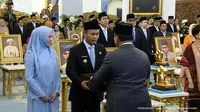
Jakarta, CNBC Indonesia — In a momentous acknowledgment of historical resilience and state-building, Indonesian President Prabowo Subianto officially conferred the prestigious title of National Hero for the year 2026 upon 19 distinguished historical figures. Among the honored luminaries is Sultan Muhammad Ali Abdul Jalil Muazzam Syah, a towering figure from the Sultanate of Siak Sri Indrapura, celebrated historically as the visionary founder of Pekanbaru, the capital city of Riau Province.
The solemn state ceremony took place at the State Palace in Jakarta on Tuesday, November 10, 2026, coinciding with the observance of Indonesia’s National Heroes Day. Representing the local government and the grateful populace of Riau, Pekanbaru Mayor Agung Nugroho, accompanied by the Chairperson of the Pekanbaru City Family Welfare Movement (TP PKK), Hj. Sulastri, formally received the decree and insignia on behalf of the late Sultan’s lineage and the city administration. The recognition marks the culmination of decades of advocacy, historical research, and petitions spearheaded by the Riau provincial government, local historians, and cultural institutions to cement the Sultan’s legacy in the national consciousness.
A Legacy Beyond the Throne: The Early Life and Maritime Prowess of Marhum Pekan
Sultan Muhammad Ali, widely revered by his enduring moniker "Marhum Pekan," served as the fifth Sultan of Siak. However, his contributions to the archipelago’s sovereignty extend far beyond his ascension to the royal throne. Historical records, including the seminal 2024 research publication titled "From War to Diplomacy: The Role of Sultan Muhammad Ali," indicate that his defense of the Siak Sultanate began long before he assumed supreme leadership.
In his formative years, Muhammad Ali served as the Grand Admiral of the Royal Siak Naval Fleet, a position that required profound strategic acumen, logistical mastery, and tactical bravery. His maritime expeditions spanned the volatile waters of the Malacca Strait, the South China Sea, and the coastal expanses of Kalimantan. These voyages were not merely navigational exercises; they served as the crucible in which he forged his military capabilities. During an era when the Dutch East India Company (VOC) aggressively sought to monopolize maritime trade routes and subjugate independent indigenous polities along the eastern coast of Sumatra, the young naval commander became a formidable obstacle to Dutch colonial ambitions.
The climax of his early military career involved direct, asymmetric warfare against the well-armed VOC flotillas. One of the most notable military engagements was the legendary War of Guntung. Facing superior Dutch firepower and heavily armed warships, Sultan Muhammad Ali employed brilliant riverine guerrilla tactics. Capitalizing on his intimate knowledge of local hydrology, tidal patterns, and river morphology, he orchestrated defensive maneuvers that neutralized the technological advantages of the VOC.
Historical accounts detail how Siak forces constructed ingenious river blockades using massive logs bound together with resilient rattan ropes, effectively trapping and restricting enemy vessel movements. Furthermore, the defense forces deployed blazing rafts sent downstream directly into the path of the oncoming Dutch fleet. These tactics forced the colonial forces into prolonged logistical stalemates, demonstrating that indigenous tactical intelligence and environmental adaptation could successfully disrupt imperial expansionism.
Economic Warfare: Establishing Senapelan as a Global Trading Hub
Sultan Muhammad Ali understood with acute clarity that military resistance alone was insufficient to defeat a commercial empire like the VOC. Because the Dutch colonial strategy relied fundamentally on economic strangulation and the monopolization of sea-lanes, the Sultan countered with a sophisticated economic offensive. He realized that the Sultanate needed to decentralize trade away from ports directly controlled or heavily monitored by the Dutch kongsi dagang.
His masterstroke in economic statecraft was the development of Senapelan, a strategic settlement situated gracefully on the banks of the Siak River. Recognizing its geographical advantages, Sultan Muhammad Ali transformed Senapelan from a modest river settlement into a bustling, vibrant international trading post. This newly established bandar (port city) quickly grew into a commercial magnet, deliberately bypassing VOC-controlled checkpoints and attracting merchants from diverse corners of the globe.
The port of Senapelan became a melting pot of international commerce, welcoming traders from China, Java, Arabia, India, and even Portuguese-controlled territories. A wide array of prized regional commodities flowed through its markets, including high-grade gambier, refined tin, alluvial gold, locally harvested rice, and the celebrated Siak gold-thread woven textiles.
Crucially, the rise of Senapelan established a vital economic corridor connecting the inland agricultural and mineral-rich communities of Minangkabau directly to the eastern Sumatran coast. By cutting out Dutch intermediaries, the Sultan ensured that indigenous populations retained the economic value of their labor and natural resources. Over time, this flourishing commercial center expanded rapidly, laying the foundational urban, economic, and cultural blueprint for modern-day Pekanbaru.
Diplomacy and Malay Solidarity
Beyond military defense and economic innovation, Sultan Muhammad Ali was a master architect of geopolitical alliances. Recognizing the fragmented nature of local kingdoms facing the systemic threat of European colonization, he actively cultivated diplomatic ties and kinship networks with neighboring Malay sultanates and regional polities.
His extensive diplomatic network reached across the Malacca Strait and the Sumatran mainland, encompassing the sultanates of Asahan, Batubara, Panei, Deli, Pelalawan, and the Riau-Lingga Archipelago, as well as the Sukadana Sultanate in southern Kalimantan. Through strategic intermarriages, formal political treaties, shared commercial ventures, and a celebration of a common Malay cultural identity, the Sultan wove a robust fabric of mutual defense and regional solidarity. This network not only facilitated cross-border trade but also created a united front that complicated VOC intelligence operations and military planning in the region.
Official Responses and Civic Pride
The official conferral of the National Hero title in November 2026 sent waves of immense pride throughout Riau Province. Civic leaders, cultural councils, and ordinary citizens expressed profound gratitude to the central government for formally acknowledging a historical debt that had spanned generations.
In his post-ceremony address in Jakarta, Pekanbaru Mayor Agung Nugroho emphasized that the recognition is not merely a symbolic accolade for a historical figure, but a validation of the collective identity and historical sacrifices of the people of Riau.
"The heroic journey of Sultan Muhammad Ali, or Marhum Pekan, represents the indomitable spirit of the Riau people. He fought not only with the sword on the rivers of Siak, but also with economic vision through the establishment of Senapelan, which today we proudly call Pekanbaru," stated Mayor Nugroho. He added that the city administration would spearhead educational initiatives to ensure that the younger generations understand the depth of Marhum Pekan’s sacrifices, transforming his historical ethos into modern civic inspiration.
Similarly, regional cultural figures and historians lauded the decision by President Prabowo Subianto’s administration, noting the rigorous academic vetting process that preceded the announcement. Historians point out that the recognition corrects historical omissions, placing Sumatran anti-colonial resistance fighters on an equal footing with their Javanese and Sulawesi counterparts in the national historical canon.
Broader Implications and Historical Re-evaluation
The elevation of Sultan Muhammad Ali Abdul Jalil Muazzam Syah to national hero status carries significant implications for contemporary Indonesian historiography and regional identity. For decades, mainstream Indonesian national histories tended to concentrate heavily on anti-colonial struggles centered in Java, Sumatra’s west coast, or Aceh, occasionally marginalizing the crucial maritime and riverine resistances of eastern Sumatra.
By honoring Marhum Pekan alongside 18 other figures in 2026, the state reinforces a more inclusive, archipelago-wide narrative of the Indonesian independence struggle. It highlights the reality that the Republic of Indonesia is built upon the accumulated resistance movements of diverse indigenous kingdoms that consistently fought to protect their sovereignty, economy, and culture from foreign subjugation.
Furthermore, economists and urban planners view this recognition as a profound opportunity to boost cultural tourism and historical appreciation in Pekanbaru. As the capital of Riau Province continues its rapid modernization into a major economic hub of central Sumatra, anchoring its urban identity in the legacy of Marhum Pekan provides a powerful cultural anchor. Heritage tourism centered around the historical sites of Senapelan, the Siak River pathways, and the remnants of the Siak Sultanate is expected to receive renewed impetus, driving local economic growth while preserving invaluable historical heritage.
Ultimately, the posthumous honor bestowed upon Sultan Muhammad Ali serves as an enduring reminder that the cities we inhabit today are built upon the visionary sacrifices of leaders who dared to challenge empire, build independent economies, and forge unbreakable regional bonds. Through resilience, strategy, and foresight, Marhum Pekan secured his place not only in the annals of Riau’s history, but now, deservedly, in the pantheon of Indonesia’s greatest national heroes.
Related posts: