Navigating the Precipice: Exploring Wat Phu Tok and the Architectural Marvel of Thailand’s Isolated Mountain Temple

Deep within the remote northeastern Isan region of Thailand, situated in the tranquil and lesser-visited Bueng Kan province, stands Wat Jetiyakhiri—more commonly known as Wat Phu Tok. Translating locally from the Isan dialect as the "lonely mountain," this solitary sandstone monolith rises 359 meters above the surrounding flatlands, bearing a striking resemblance to a miniature version of Sri Lanka’s renowned Sigiriya rock fortress. Over recent decades, this geographical anomaly has transformed from an isolated sanctuary for ascetic monks into one of Southeast Asia’s most daring architectural and spiritual destinations, drawing travelers and pilgrims willing to test their nerves against its dizzying wooden scaffolding.

Main Facts and Architectural Overview
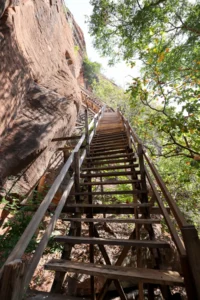
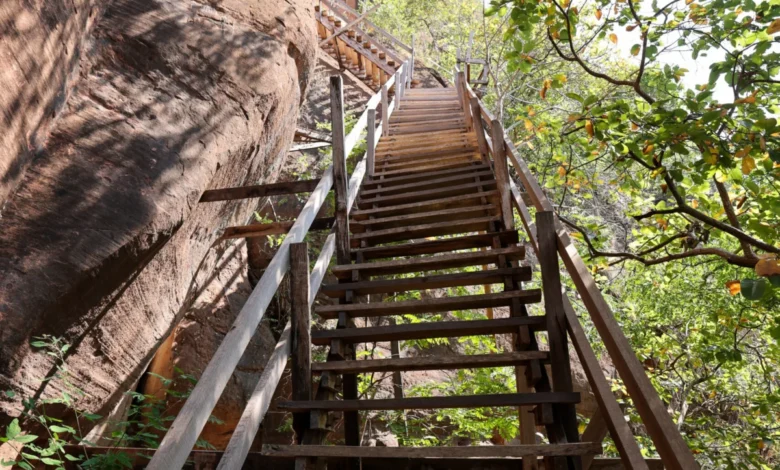
Wat Phu Tok is defined by its intricate, hand-built network of wooden staircases, ladders, and cantilevered walkways that cling precariously to the sheer vertical faces of the red rock mountain. Constructed to mirror the seven stages of Buddhist meditation, the path ascends through seven distinct levels, culminating at the densely forested summit.

The site’s defining feature is its labyrinthine construction. While the lower levels offer relatively gentle inclines through dense brush and rock formations, the upper tiers—particularly the fifth and sixth levels—introduce visitors to cliff-hugging boardwalks anchored directly into the rock face. The sixth level, recognized as the architectural and experiential peak of the temple, consists of a continuous path looping around the mountain’s circumference. Approximately half of this circuit is built upon wooden planks suspended over hundred-foot drops, offering sweeping, panoramic views of the Mekong River basin and the verdant expanses of Bueng Kan province.

Chronology and Historical Context
The development of Wat Phu Tok is deeply intertwined with the traditions of Thailand’s forest monastic movement. Historically, the rugged terrain, dense vegetation, and abundance of indigenous wildlife—particularly venomous snake populations—rendered the mountain largely inaccessible to the general public. However, these very characteristics made the remote outcrop an ideal location for spiritual seclusion and intense meditation.

The transformation of the lonely mountain began under the guidance of the venerated monk Luang Pu Juan. Recognizing the potential for spiritual cultivation within the harsh environment, the monk spearheaded the monumental task of constructing a pathway to the upper tiers. Monks, local craftsmen, and volunteers hauled timber and building materials up the sheer rock face, engineering a multi-level wooden scaffolding system designed to connect various natural caves, shrines, and meditation platforms.

The seven levels were deliberately mapped to the seven tiers of Buddhist enlightenment, creating a physical metaphor where the arduous physical climb parallels the mental shedding of worldly attachments. Although the visionary founder, Luang Pu Juan, tragically died in an aircraft accident prior to the completion of the complex’s modern infrastructure, his disciples and regional authorities have continued maintenance efforts, ensuring the preservation of the wooden walkways.

Supporting Data and Spatial Breakdown
A statistical examination of the temple complex highlights the engineering scale required to maintain safety and accessibility in such a remote environment:

- Elevation: The peak stands at 359 meters above sea level, providing unobstructed atmospheric conditions and vantage points overlooking the greater Mekong basin.
- Meditation Tiers: The mountain is divided into seven distinct vertical levels, each serving a specific structural and spiritual purpose:
- Levels 1 to 4: Transition zones featuring foundational staircases, dense regional flora, and minor shrines, serving to condition visitors for the steeper ascents.
- Level 5: The administrative and community hub of the upper mountain, housing the primary ordination hall, several auxiliary shrines, and wider ground-level pathways that diverge into secluded rock grottos.
- Level 6: The primary tourist and pilgrim attraction, characterized by cliff-anchored wooden plank walkways spanning roughly half the mountain’s circumference, offering high-altitude exposure and expansive regional views.
- Level 7: The remote summit area, devoid of architectural structures or artificial pathways, noted historically for dense populations of regional wildlife and accessed strictly at the visitor’s discretion.
Safety Protocols and Structural Integrity
Given the inherent risks associated with high-altitude cliffside walkways, regional tourism boards and temple administration have implemented standardized maintenance routines. The structural framework relies on heavy-duty timber planks secured to steel and wooden brackets bolted directly into the stable sandstone bedrock.

While the wooden structures exhibit natural flex and minor swaying under pedestrian weight—phenomena frequently noted by visiting travelers—engineers and local authorities maintain that routine inspections prevent structural degradation caused by monsoonal weathering. Despite these safety measures, municipal advisories consistently caution visitors regarding personal liability, emphasizing the necessity of situational awareness. The absence of high-altitude safety netting or modern handrails in certain historic sections means that a lack of focus on the narrow walkways could result in severe injury or fatal falls, particularly during the wet season when wooden surfaces become slick with moisture.

Broader Impact and Regional Implications
The emergence of Wat Phu Tok as a recognized landmark has significantly altered the socioeconomic landscape of Bueng Kan, one of Thailand’s youngest provinces established officially in 2011. Historically dependent on rubber agriculture and cross-border trade with Laos, the region has seen a steady influx of domestic and international tourism driven by adventurous travelers seeking alternatives to heavily commercialized hubs like Chiang Mai or Phuket.

Local tourism authorities view the temple as a vital anchor for off-the-beaten-path itineraries in the Isan region. By dispersing visitor traffic away from saturated central Thai destinations, sites like Wat Phu Tok contribute to sustainable regional development, supporting local hospitality providers, transportation networks, and small-scale commerce in Bueng Kan city.

At the same time, cultural preservationists emphasize the importance of balancing tourism promotion with the sanctity of the site. As a functioning monastery, Wat Phu Tok remains a place of active Buddhist practice. Provincial officials and monastic leaders continually encourage visitors to balance the thrill of the architectural ascent with respectful observance of local religious customs, ensuring that the lonely mountain preserves its foundational identity as a sanctuary for contemplation rather than merely an extreme adventure sport venue.