President Joko Widodo Strengthens Ties in Papua Through Cultural Engagement and Infrastructure Pledges in Wamena

The presence of President Joko Widodo in Wamena, Papua, was met with a jubilant reception from the local community, marking a significant moment in the administration’s efforts to foster closer ties with the country’s easternmost provinces. On Wednesday, December 30, 2015, hundreds of residents gathered at the Mini Education Stadium in the Wamena District of Jayawijaya Regency, displaying a palpable sense of joy and anticipation as they awaited the arrival of the President and his entourage. The atmosphere was festive, with many attendees wearing Santa Claus hats, reflecting the holiday season and the spirit of communal celebration. This visit was not merely a ceremonial appearance but served as a platform for the President to announce critical infrastructure projects and engage directly with the cultural heart of the Papuan highlands.
During his address to the gathered crowd, President Widodo, colloquially known as Jokowi, emphasized his administration’s commitment to bridging the infrastructure gap that has long hindered economic growth in Papua. The centerpiece of his speech was the ambitious pledge to construct a 278.6-kilometer road connecting Wamena to Mamugu. Scheduled to commence or see significant acceleration in 2016, this road project is a vital segment of the larger Trans-Papua Highway initiative. The announcement was met with thunderous applause, as the residents of the Central Highlands have historically faced immense logistical challenges due to the rugged terrain and lack of reliable land connectivity.
Direct Engagement and Local Aspirations
The significance of the visit was echoed by local residents who expressed a rare sense of accessibility to the highest level of government. One resident, Lewi, noted that even meeting a regional governor can often be a difficult task for the average citizen, making the President’s direct presence in Wamena a profound gesture of inclusivity. For many in the Jayawijaya Regency, the visit symbolized a shift toward a more "Indonesiacentric" development model, moving away from the traditional focus on Java and the western regions of the archipelago.
Following the presidential address, the event transitioned into a forum for local leaders and tribal elders to voice their concerns. The traditional elders of Wamena presented several key requests to the President, most notably the demand for a reduction in fuel (BBM) prices and the acceleration of regional development. In the highlands of Papua, the cost of living is significantly higher than in other parts of Indonesia, primarily due to the high cost of transporting goods and fuel by air. The elders emphasized that lower fuel prices are essential for reducing the prices of basic commodities and construction materials, such as cement, which can cost several times the national average in remote districts.
The Bakar Batu Ceremony: A Masterclass in Cultural Diplomacy
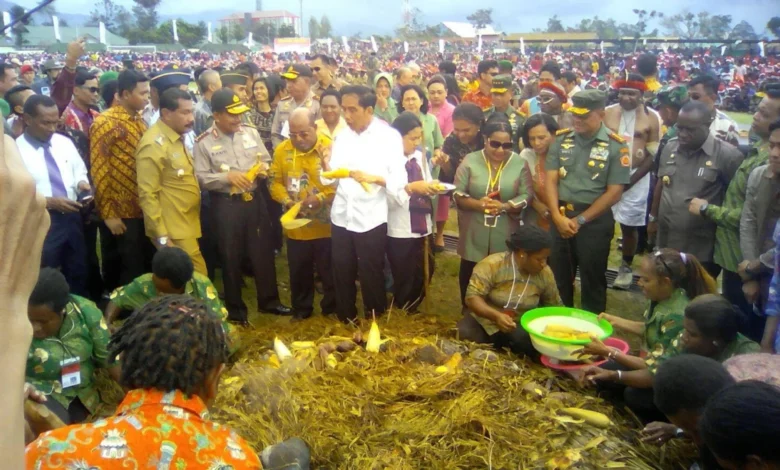
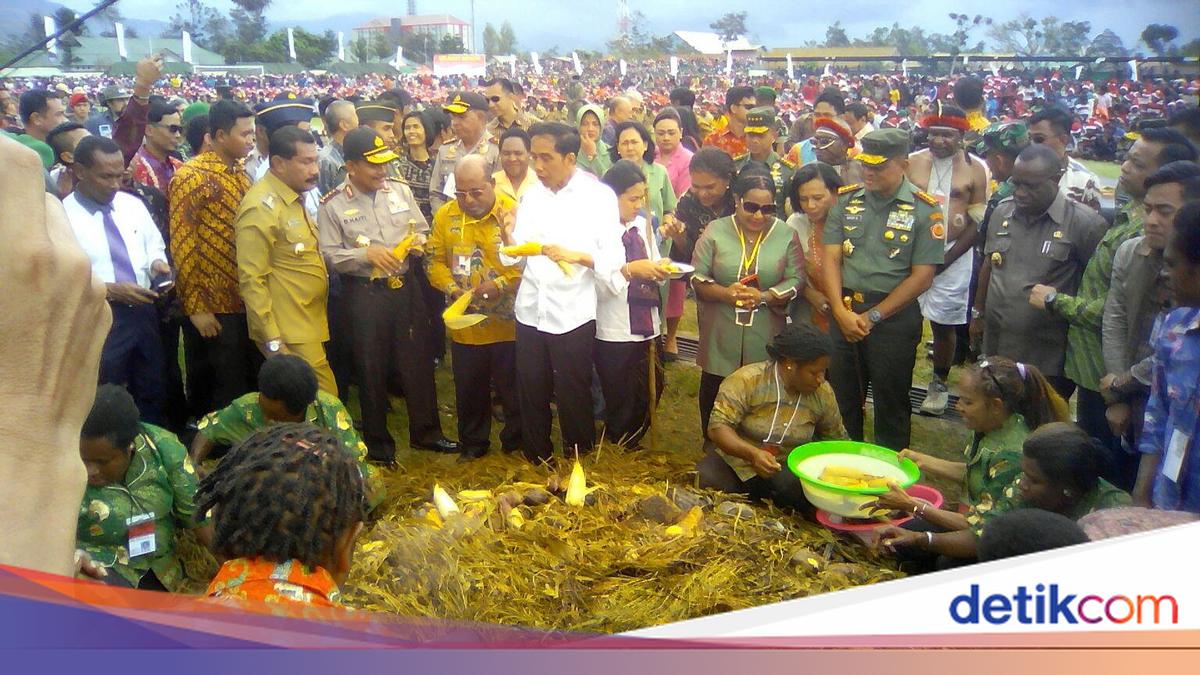
A pivotal moment of the visit was the President’s participation in the Bakar Batu (Stone Burning) ritual, one of the most important cultural traditions in the Papuan highlands. Guided by local women, President Jokowi, First Lady Iriana, TNI Commander General Gatot Nurmantyo, and Chief of Presidential Staff Teten Masduki joined the community in the traditional cooking process. The President was seen actively participating, even helping to clear away the alang-alang (thatch grass) that covers the hot stones and food during the steaming process.
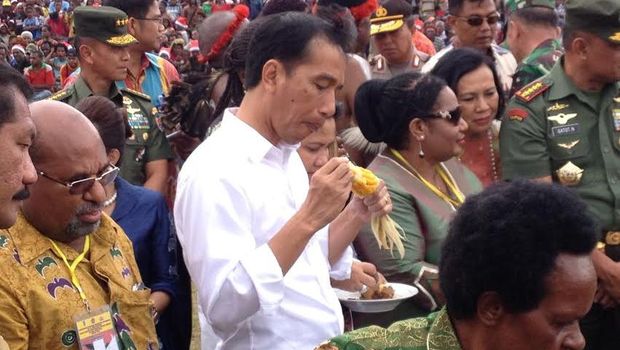
The Bakar Batu ceremony is more than just a method of cooking; it is a symbol of gratitude, peace, and social cohesion. As explained by a local resident named Romi, the ritual is performed for various occasions, ranging from celebrating a successful harvest to welcoming esteemed guests or resolving communal conflicts. In this context, the President’s participation was a powerful act of cultural diplomacy, signaling respect for indigenous customs. Beneath the layers of grass and hot stones, a feast of corn, sweet potatoes (ubi), and roasted chicken was prepared. The President was observed eating a cob of corn alongside the residents, a gesture that resonated deeply with the crowd, who climbed fences and gathered closely to witness the rare sight of their national leader sharing a meal in their traditional fashion.
Strengthening Education and Youth Engagement
Beyond infrastructure and culture, the visit also focused on the younger generation. President Jokowi held a lighthearted quiz for the children in attendance, a hallmark of his public appearances. He called upon a student, a first-year junior high school (SMP) student, to answer questions about the geography of the region. When asked to name three regencies in the Central Highlands, the student correctly identified Jayawijaya, Yalimo, and Nduga.
As a reward for his knowledge, the President gifted the student a bicycle, instructing him to choose the one he liked best from a line of ten units prepared for the event. This interaction served to humanize the presidency and encourage an interest in education among the local youth. The President subsequently directed his staff to distribute the remaining bicycles to other children and community members, further fueling the enthusiastic atmosphere at the stadium.
Background and Context: The Trans-Papua Highway Project
The promise to build the 278.6-kilometer road from Wamena to Mamugu is part of the broader Trans-Papua Highway, a massive infrastructure undertaking spanning over 4,300 kilometers. The project aims to connect the provinces of Papua and West Papua, linking major coastal cities with the isolated interior. The Wamena-Mamugu segment is particularly strategic because it connects the highlands to a river port in Mamugu, which provides a gateway to the Arafura Sea.
Historically, the lack of land routes has forced the highlands to rely almost exclusively on air transport for logistics. This "air bridge" is prohibitively expensive, leading to extreme price disparities. For example, while fuel prices in Jakarta might be set at a standard rate, the difficulty of transporting fuel to the highlands often resulted in "black market" prices that were five to ten times higher. By pledging to complete this road link, the Jokowi administration aimed to create a permanent logistical corridor that would permanently lower the cost of living for hundreds of thousands of people.
Economic Implications and the One Price Fuel Policy
The requests made by the Wamena elders regarding fuel prices were a precursor to what would later become the "BBM Satu Harga" (One Price Fuel) policy. At the time of the visit in December 2015, the President was already formulating a strategy to equalize fuel prices across the entire Indonesian archipelago. The voices of the Papuan people during visits like this provided the necessary political impetus to challenge the logistical and financial hurdles of such a policy.
Data from the Ministry of Energy and Mineral Resources indicates that before the full implementation of the One Price Fuel policy, residents in the interior of Papua could pay upwards of IDR 50,000 to IDR 100,000 per liter for gasoline, compared to the regulated price of around IDR 7,000 in Java. The construction of roads like the one promised in Wamena is a prerequisite for the sustainability of fuel price equalization, as it allows for more efficient distribution via tanker trucks rather than specialized aircraft.
Timeline of the Presidential Visit to Papua (December 2015)
The visit to Wamena was part of a larger year-end tour of Papua by President Jokowi, reflecting his stated goal of visiting the region multiple times a year.
- December 29, 2015: The President and his entourage arrived in Merauke, where he visited the "Time Capsule" monument and met with local farmers to discuss rice production and food security.
- December 30, 2015 (Morning): The President traveled to Wamena, Jayawijaya. He attended the gathering at the Mini Education Stadium, delivered his infrastructure pledge, and participated in the Bakar Batu ceremony.
- December 30, 2015 (Afternoon): After the events in Wamena, the President continued his journey to Sorong, West Papua, to inspect maritime infrastructure and port developments.
- December 31, 2015: The President spent New Year’s Eve in Raja Ampat, emphasizing the importance of tourism as a sustainable economic driver for the region.
Analysis of Broader Impacts and Security Considerations
The President’s visit to Wamena occurred against a backdrop of complex security and political dynamics in Papua. By focusing on "soft power" through cultural participation and "hard power" through infrastructure development, the administration sought to address the root causes of regional dissatisfaction—primarily economic marginalization and a perceived lack of attention from the central government.
The involvement of the TNI Commander and the Chief of Presidential Staff highlighted the multi-dimensional approach to Papua. While the military remains a presence in the region to ensure stability, the focus of this specific visit was clearly on civilian engagement and development. The choice of Wamena, a cultural and political hub for the highland tribes, was strategic. Success in improving the quality of life in Wamena often has a ripple effect across other highland regencies like Lanny Jaya, Tolikara, and Nduga.
Furthermore, the emphasis on the Wamena-Mamugu road segment reflects a shift in developmental philosophy. Rather than just connecting cities, the administration focused on connecting the "hinterland" to supply chains. Economists suggest that every kilometer of road built in Papua has a multiplier effect on local markets, allowing indigenous farmers to bring their produce—such as the sweet potatoes and coffee for which the Baliem Valley is famous—to larger markets with lower overhead costs.
Conclusion
President Joko Widodo’s visit to Wamena on December 30, 2015, stands as a landmark moment in his early presidency’s engagement with Papua. It combined the formal delivery of infrastructure promises with a deep, personal immersion into the local culture. By eating with the people, participating in their ancient rituals, and listening to the candid demands of tribal elders, the President attempted to bridge a psychological and political gap that had existed for decades.
While the physical challenges of building roads in the rugged terrain of the Central Highlands remain significant, the 278.6-kilometer pledge served as a blueprint for the administration’s long-term vision for the region. The enthusiastic response from the citizens of Wamena, characterized by their festive Santa hats and cheers for new roads, underscored a hope for a future where Papua is fully integrated into the national economy without losing its unique cultural identity. As the bicycles were wheeled away by smiling children and the smoke from the Bakar Batu pits faded, the visit left behind a tangible promise of progress and a renewed dialogue between the highlands and the capital.