Unlocking the Chemical Complexities of Your Morning Brew: What Really Lies Inside a Cup of Coffee

The morning ritual of brewing a cup of coffee is often appreciated through simple sensory experiences: the rich aroma filling a kitchen, the deep mahogany color, and the sharp, comforting bitterness that awakens the senses. Yet, behind this seemingly straightforward beverage lies a remarkably complex chemical universe. While a standard cup of black coffee is composed of more than 98.5% water, the remaining fraction contains an intricate matrix of hundreds—if not thousands—of distinct chemical compounds extracted from the roasted bean. Understanding what occurs during the extraction process requires looking beyond basic brewing parameters and examining the molecular architecture of coffee itself.
The Composition of Total Dissolved Solids
When water interacts with ground coffee, it extracts a specific fraction of soluble material known as Total Dissolved Solids (TDS). In a typical cup of brewed coffee, the TDS accounts for roughly 1.2% to 1.5% of the beverage’s total weight. This means that in a single liter of brewed coffee, approximately 12 to 15 grams of solid matter have been dissolved and carried over from roughly 60 grams of dry coffee grounds.
These extracted substances dictate everything from color and mouthfeel to acidity and aroma. Broadly speaking, these compounds can be categorized into volatile and non-volatile components. Volatile compounds readily vaporize at room temperature, traveling upward to engage the olfactory receptors in the nose, thereby shaping the aromatic profile. Non-volatile compounds, conversely, remain in the liquid phase, interacting directly with taste buds on the tongue to produce perceptions of bitterness, sweetness, acidity, and astringency. Additionally, suspended insoluble micro-particles and lipids contribute significantly to the overall body and textural weight of the drink.
The Historical Quest to Decode Coffee Chemistry
The scientific effort to map the chemical profile of coffee spans decades of rigorous chromatographic and mass spectrometric research. Landmark studies in flavor chemistry have consistently revealed new layers of complexity within the bean. For instance, a seminal Aroma Extract Dilution Analysis (AEDA) conducted in 2002 demonstrated that out of 40 key odorants identified in coffee, 13 remained completely unknown to science. Researchers attributed this knowledge gap to two primary factors: extremely low concentrations that hinder the isolation of sufficient sample sizes, and large, complex molecular structures that defy rapid structural elucidation.
Earlier research from 1996 attempted to recreate coffee synthetically by combining 22 key volatile compounds identified in Arabica and Robusta varieties. While sensory panels described the resulting "model" coffees as clearly bearing a resemblance to natural coffee, they fell short of replicating the authentic, multidimensional depth of a freshly brewed cup. This divergence underscored a fundamental truth of food science: approximating a flavor profile is vastly different from replicating the full biological symphony of natural extraction.
Concentration Versus Potency: The Role of Odor Thresholds
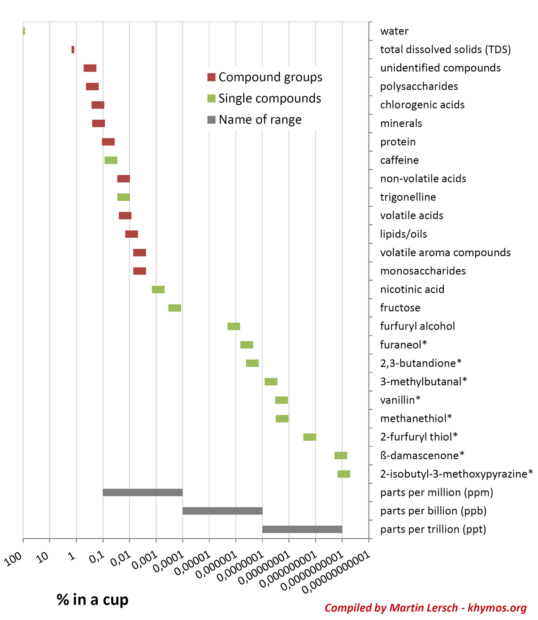
A common misconception in culinary science is that a compound present in lower concentrations must inherently exert a lesser influence on the final product. When examining the logarithmic concentration scale of coffee components—which spans more than nine orders of magnitude, ranging from macroscopic percentages down to parts per trillion (ppt)—this assumption quickly collapses.
The human olfactory system does not experience chemical compounds on a linear scale of abundance. Instead, every distinct molecule possesses a unique odor threshold—the minimum concentration required for the human nose to detect its presence. Consequently, a trace compound operating at an infinitesimal concentration of 0.0000000001% can prove just as vital to the overall sensory experience as a major component present at 0.01%.
A prime example of this phenomenon is $beta$-damascenone, a member of the rose ketone family first discovered in rose oil during the 1960s and famously utilized in high-end perfumery, such as Dior’s Poison fragrance. Despite appearing in coffee at concentrations as low as 1 part per trillion, $beta$-damascenone exhibits an exceptionally low odor threshold, yielding a remarkably high Odor Activity Value (OAV). Sensory analyses consistently rank it among the top five most impactful odorants in coffee, proving that the beverage’s character relies heavily on ultra-trace constituents.
Polar Versus Non-Polar Extraction Dynamics
The efficiency with which water extracts various compounds depends heavily on their chemical polarity. Water acts as a powerful polar solvent, successfully dissolving more than 75% of the polar compounds found in coffee grounds, including various acids, minerals, proteins, and carbohydrates.
On the other end of the spectrum lie non-polar compounds, which encompass essential lipids and many of the critical volatile aroma molecules. Because water is a poor solvent for non-polar substances, standard brewing methods typically extract only 10% to 30% of these components. Food scientists and coffee researchers frequently highlight this disparity when discussing extraction yields and brew times. Exploring alternative solvents, such as ethanol, represents an academic avenue for unlocking entirely new dimensions of the coffee bean that remain untouched by water alone.
Implications for Quality Control and Future Research
For decades, industry professionals have relied on TDS measurements as a primary benchmark for coffee strength and brewing efficiency. While TDS remains a fast, reliable metric for determining the concentration of dissolved mass, flavor chemists emphasize its severe limitations in predicting actual taste and aroma.
Because different chemical families—such as polar acids versus non-polar aromatics—extract at vastly different rates and efficiencies, a high TDS reading does not guarantee a balanced or pleasing flavor profile. The correlation between total dissolved mass and sensory quality simply does not hold up under rigorous chemical analysis.
As analytical techniques continue to advance, flavor chemists anticipate the discovery of additional key odorants currently hiding below current detection limits. Until technology bridges the gap between laboratory instrumentation and human perception, the human nose remains the ultimate analytical detector. For both scientists and coffee enthusiasts alike, this ongoing exploration ensures that every cup of coffee will continue to offer new mysteries waiting to be unraveled.