The Vertical Pilgrimage of Wat Phu Tok Exploring Thailands Architecturally Daring Cliffside Temple in Bueng Kan

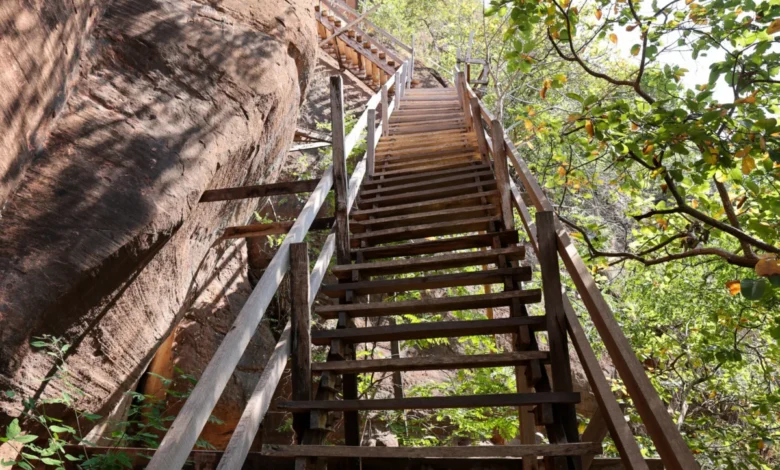
Wat Phu Tok, officially known as Wat Jetiyakhiri, stands as a singular marvel of religious architecture and spiritual endurance in the remote Bueng Kan province of northeastern Thailand. Situated approximately 30 kilometers from the provincial capital, this "lonely mountain"—as its name translates from the local Isan dialect—represents one of the most significant yet under-visited cultural landmarks in the Isan region. Unlike the ornate, gold-leafed temples of Bangkok or the ancient ruins of Ayutthaya, Wat Phu Tok is characterized by its raw integration with the natural environment, featuring a complex system of wooden staircases and precipitous walkways that encircle a massive red sandstone butte. These structures, built entirely by hand over a period of five years, serve a dual purpose: they provide access to various levels of the mountain and act as a physical metaphor for the seven stages of Buddhist enlightenment.
Historical Context and Spiritual Foundation
The history of Wat Phu Tok is inextricably linked to the life and vision of Phra Achan Juan Kullachettho, a revered monk of the Thai Forest Tradition. Arriving at the site in 1968, Luang Pu Juan sought a location that offered the solitude and hardship necessary for deep meditation. At the time, the sandstone formation was surrounded by dense jungle and inhabited by various species of wildlife, including venomous snakes, which reinforced the site’s reputation as a place where one must confront and overcome physical fear to achieve spiritual growth.
The construction of the wooden walkways began in the late 1960s. Without the aid of modern machinery or heavy engineering equipment, Luang Pu Juan, along with a dedicated group of monks and local volunteers, anchored wooden beams directly into the cliff faces. This feat of vernacular engineering was driven by the theological concept of the "Seven Stages of Enlightenment" (Satta Bojjhanga). Each level of the mountain corresponds to a specific stage of spiritual progression, ranging from mindfulness and investigation to the ultimate goal of equanimity.

The site’s historical trajectory was tragically altered in April 1980, when Luang Pu Juan and several other high-ranking monks of the forest tradition were killed in a plane crash near Bangkok. Despite the loss of its founder, the temple has remained a vital center for meditation and a testament to the ascetic rigor of the Thammayut Nikaya order. Today, it stands as a monument to Luang Pu Juan’s legacy, maintained by the monastic community and supported by pilgrims who travel from across the Mekong basin.
Geological and Geographical Significance
Geologically, Phu Tok is a sandstone butte that rises 359 meters above the surrounding Khorat Plateau. The formation is part of a larger system of sedimentary rock that defines much of the landscape in the Mekong River basin. Its sheer vertical walls and isolated position have drawn comparisons to Sigiriya in Sri Lanka, though Wat Phu Tok remains uniquely focused on active religious practice rather than historical fortification.

The temple is located in Bueng Kan, Thailand’s 77th and newest province, established in 2011 after being carved out of Nong Khai. This administrative shift has brought increased attention to the region’s tourism potential, yet Bueng Kan remains one of the least densely populated areas in the country. The "lonely mountain" is surrounded by a patchwork of rubber plantations and rice paddies, offering a stark contrast to the dramatic, rust-colored cliffs of the temple site.
The Seven Levels: A Chronology of Ascent
The ascent of Wat Phu Tok is organized into seven distinct levels, each offering a different environment for reflection and varying degrees of physical challenge.

Levels 1 and 2: The Foothills
The journey begins at the base of the mountain, where a large park, a lake, and traditional temple buildings provide a transition from the secular world. The initial staircases are wide and constructed of durable wood, leading through dense foliage. These levels represent the preliminary stages of preparation and the initial gathering of focus.
Levels 3 and 4: The Forest Transition
As the trail climbs higher, the vegetation thins, and the wooden planks become narrower. These levels are characterized by shrines tucked into natural rock alcoves. The path here begins to hug the mountain more closely, signaling the shift from the grounded earth to the verticality of the cliffs.

Level 5: The Center of Worship
Level 5 serves as the primary hub for religious activity. It features the largest ordination hall (Ubosot) on the mountain, along with numerous smaller shrines and residences for monks. A notable architectural feature of this level is a rock bridge that connects the main mountain to a smaller, adjacent outcrop, housing a solitary shrine. This level is largely on solid ground, providing a brief respite before the final, more harrowing stages of the climb.
Level 6: The Cliffside Walkways
This level is the most famous and architecturally daring section of the complex. It consists of a narrow wooden boardwalk that circles the circumference of the peak, anchored directly into the vertical sandstone face. The walkway offers unobstructed views of the Mekong basin and the distant mountains of Laos. For many visitors, Level 6 represents the pinnacle of the experience, where the physical sensation of height and the precariousness of the structure demand absolute presence of mind—a core tenet of Buddhist practice.

Level 7: The Wilderness and Final Enlightenment
The final level is accessed by a steep, ladder-like staircase. Unlike the lower levels, Level 7 is largely undeveloped and left in its natural state. It is characterized by dense brush and rock formations. Historically, this level was reserved for the most advanced practitioners of meditation. Local lore and signs warn of venomous snakes, reinforcing the idea that the final stage of enlightenment involves a return to nature and a total abandonment of worldly comforts and safety.
Safety, Maintenance, and Infrastructure
The maintenance of Wat Phu Tok is a continuous effort managed by the resident monks and local authorities. Given the tropical climate of the Isan region, the wooden walkways are subject to rapid weathering. Regular inspections and replacements of planks and support beams are necessary to ensure the safety of the hundreds of pilgrims and tourists who visit weekly.

While the structures are described as stable, they lack the standardized safety features of modern commercial tourist attractions, such as high guardrails or non-slip surfaces. This is intentional; the "danger" of the climb is considered part of the spiritual experience, forcing the climber to exercise mindfulness (Sati) with every step. There are no elevators or mechanized assists, ensuring that the ascent remains a physical sacrifice.
Economic and Tourism Impact
The rise of Wat Phu Tok as a destination coincides with the Tourism Authority of Thailand’s (TAT) "Go Local" initiative, which aims to distribute tourism revenue more equitably to secondary provinces. According to regional data, Bueng Kan has seen a steady increase in domestic tourism since 2015, with Wat Phu Tok serving as its primary anchor attraction.

Local businesses, including small-scale guesthouses and restaurants in the nearby town of Si Wilai, have benefited from the influx of visitors. However, the site remains free of the aggressive commercialization seen in more popular Thai destinations. There are no entrance fees for the temple, though donations for the upkeep of the wooden paths are encouraged. This preservation of sanctity over profit has helped Wat Phu Tok maintain its reputation as an authentic site of pilgrimage.
Official Responses and Cultural Preservation
Government officials in Bueng Kan have frequently highlighted Wat Phu Tok as a symbol of provincial identity. In statements regarding regional development, local governors have emphasized the need to balance increased tourist foot traffic with the preservation of the mountain’s spiritual atmosphere. "Wat Phu Tok is not merely a scenic viewpoint; it is a classroom for the soul," noted a spokesperson for the provincial cultural office during a recent heritage summit.

Religious scholars point to Wat Phu Tok as a rare surviving example of the "meditation mountain" tradition in Southeast Asia. As urban sprawl encroaches on many historic forest monasteries, the isolation of Bueng Kan has protected the temple’s environment. The site is increasingly used by educational institutions to teach students about the history of the Isan forest monks and the practical application of Buddhist philosophy in architecture.
Broader Implications and Global Significance
Wat Phu Tok represents a unique intersection of faith, engineering, and environmentalism. It challenges conventional Western notions of "temple architecture" by prioritizing the journey over the destination. The structure does not seek to dominate the mountain but rather to cling to it, reflecting a Buddhist worldview of humility and coexistence with the natural world.

As global interest in "slow travel" and spiritual tourism grows, Wat Phu Tok is positioned to become a significant site for international observers. However, its remote location and the physical demands of the climb serve as natural filters, ensuring that it remains a place of quiet contemplation rather than a high-volume tourist trap. The enduring presence of the wooden walkways, surviving decades of monsoon rains and shifting social landscapes, stands as a testament to the power of a singular vision and the resilience of the human spirit in its pursuit of the divine.
Related posts: