Freddy’s Frozen Custard & Steakburgers: Tracing 2 Decades of Expansion

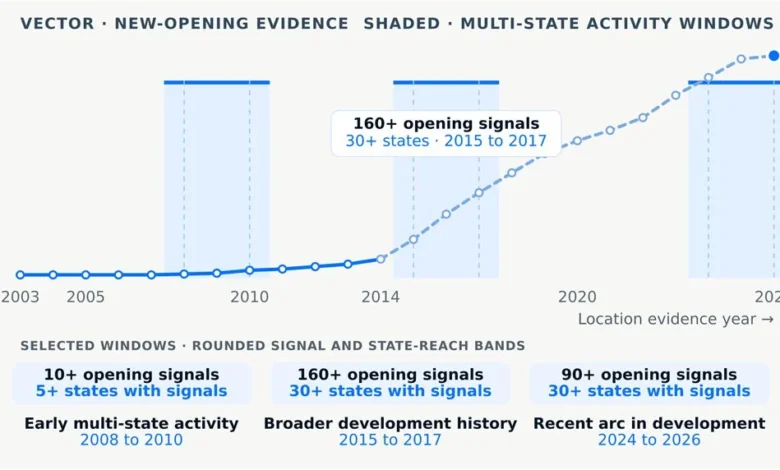
The rapid growth of the fast-casual dining sector over the past two decades has been defined by a select group of brands that successfully balanced nostalgic appeal with modern operational efficiency. Among these, Freddy’s Frozen Custard & Steakburgers stands as a quintessential example of scalable growth. Based on comprehensive research provided by RestaurantData, the brand’s trajectory from a single location in Wichita, Kansas, in 2003 to a national powerhouse in 2026 offers a compelling study in restaurant enterprise development. By mapping over twenty years of expansion, analysts can see how Freddy’s transitioned from a local favorite to a multi-state fixture, maintaining a consistent brand identity while navigating the complexities of the American food service landscape.
The Genesis of a Culinary Brand
The story of Freddy’s Frozen Custard & Steakburgers began in 2003, a period when the fast-casual market was beginning to displace traditional fast-food models. Founded by Scott Redler, Bill Simon, and Randy Simon, the concept was named in honor of Freddy Simon, the father of the co-founders, who was a decorated World War II veteran. This personal connection served as the bedrock for the company’s "retro" branding, which emphasizes Midwestern hospitality, cooked-to-order steakburgers, and freshly churned frozen custard.
In the early 2000s, the restaurant industry was facing a shift in consumer demand. Patrons were moving away from standardized, mass-produced fast food toward options that promised higher quality ingredients and a more personalized experience. Freddy’s captured this shift by focusing on a limited menu that prioritized quality over variety. The initial Wichita location acted as a laboratory for the company’s systems, testing the workflows that would eventually allow the brand to replicate its success across different state lines and diverse demographics.
Chronology of Strategic Growth
The expansion of Freddy’s did not happen overnight; it was the result of a deliberate, data-driven rollout. Following the 2003 debut, the company spent its formative years perfecting its business model. By the mid-2000s, the brand began to explore franchising, which proved to be the primary engine for its explosive growth in the 2010s and 2020s.
RestaurantData’s tracking reveals a distinct pattern of expansion. The early years (2003–2010) were characterized by a focus on the central United States, building brand equity in states where the "steakburger and custard" concept had strong cultural resonance. As the brand’s operational model matured, the company began to aggressively move into the Southeast and the Mid-Atlantic regions.
Specific milestones illustrate this geographic diversification:
- 2015: The brand cemented its presence in the Florida market, with a location opening in Sarasota at 6224 N Lockwood Ridge Rd. This move signaled a shift toward high-traffic, competitive markets in the South.
- 2017: Freddy’s expanded into the Northeast, with a strategic opening in West Chester, Pennsylvania. This location in Chester County demonstrated the brand’s ability to perform in suburban corridors outside of its traditional heartland.
- 2023: Continued penetration into the Southern coastal regions was highlighted by a new site in Kingsland, Georgia. This opening reflected the brand’s commitment to secondary and tertiary markets that often serve as growth hubs for fast-casual chains.
Current Expansion and Future Outlook
As of late 2026, the brand shows no signs of slowing its development pace. According to the latest data from RestaurantPipeline, the company is preparing for a November 2026 opening at 1445 Newtown Center Way in Lexington, Kentucky. This project is representative of the company’s current strategy: identifying high-visibility, accessible locations that can anchor a community. The selection of Lexington, a city with a robust retail landscape, indicates that Freddy’s continues to prioritize sites that provide strong visibility and steady traffic flow.

The inclusion of this project in the October 2026 industry release underscores the ongoing nature of the brand’s development. While market conditions such as labor costs, supply chain fluctuations, and rising real estate prices continue to challenge the restaurant industry, Freddy’s has managed to maintain a steady cadence of new openings. This consistency is a hallmark of a mature enterprise that has moved past the volatile "startup" phase and into a period of sustained, institutionalized growth.
Analytical Perspectives on Brand Scaling
The success of Freddy’s Frozen Custard & Steakburgers provides valuable insights into what constitutes a successful modern restaurant chain. Analysts point to several factors that have enabled this two-decade expansion:
- Operational Simplicity: By keeping the menu focused—steakburgers, hot dogs, and custard—the brand reduces kitchen complexity. This makes it easier to train new staff and ensures that the customer experience is consistent, whether in Kansas or Pennsylvania.
- Franchisee Relations: A significant portion of the growth has been driven by multi-unit franchisees. By partnering with experienced operators who understand local market nuances, the corporate team has been able to expand more rapidly than they could have through company-owned locations alone.
- Adaptable Real Estate: Unlike some fast-casual concepts that require massive, dine-in-heavy footprints, Freddy’s has successfully adapted to various building sizes and layouts. This flexibility allows them to move into diverse locations, from freestanding buildings to end-cap spaces in strip malls.
- Data-Driven Decision Making: The reliance on granular location research, as provided by firms like RestaurantData, allows the company to minimize the risk associated with new site selection. Understanding the demographic makeup and competitive landscape of a specific county before committing to a lease is a prerequisite for long-term survival in the current market.
The Broader Impact on the Fast-Casual Industry
The evolution of Freddy’s is reflective of a broader trend within the American dining sector: the rise of the "premium" fast-food experience. Today’s consumers are willing to pay a premium for food that is prepared to order, which has forced legacy quick-service restaurants to evolve or lose market share. Freddy’s was an early mover in this space, effectively bridging the gap between a sit-down diner and a drive-thru establishment.
The company’s growth also mirrors the increasing importance of the "Restaurant Enterprise Index," a metric that monitors the health and reach of large-scale restaurant companies. With 450 companies now included in the Index, it is clear that the industry is becoming increasingly professionalized. Brands like Freddy’s that can maintain high standards of quality while operating hundreds of locations are the ones that define the market standard.
Challenges and Future Considerations
While the historical data indicates success, the future of such a chain rests on its ability to innovate without losing the nostalgia that attracted customers in the first place. As the industry moves toward further digitization—including AI-driven order taking, automated kitchen equipment, and more sophisticated loyalty programs—Freddy’s will need to integrate these technologies without compromising the human-centric service that defined its early years.
Moreover, economic headwinds, including inflation and the cost of ingredients like high-quality beef and dairy, remain constant challenges. The brand’s ability to manage these costs through its supply chain, while keeping menu prices accessible to the average family, will determine its trajectory for the next two decades.
Conclusion: A Legacy of Steady Growth
Tracing the two-decade path of Freddy’s Frozen Custard & Steakburgers provides more than just a timeline of new restaurant openings; it offers a blueprint for how a regional concept can scale into a national leader. Through consistent branding, a disciplined focus on operations, and a strategic approach to real estate, the company has transformed from a single Wichita storefront into a significant player in the national restaurant scene. As the brand prepares to open its doors in Lexington this November, it continues to prove that in the restaurant industry, slow and steady growth, when backed by data and a clear vision, remains the most effective way to build a lasting legacy. For researchers, industry analysts, and aspiring entrepreneurs, the history of Freddy’s serves as a masterclass in modern restaurant development.