The Complex Chemistry of Coffee: What Really Goes Into a Cup Beyond the Water

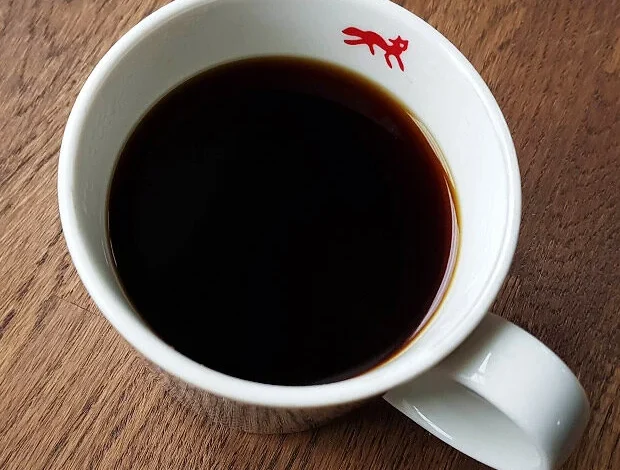
The morning cup of coffee, a daily ritual for millions around the globe, is chemically far more complex than its transparent appearance might suggest. While a standard brewed cup of black coffee consists of more than 98.5 percent water, the remaining fraction—typically comprising 1.2 to 1.5 percent in Total Dissolved Solids (TDS)—represents an intricate matrix of roughly 12 to 15 grams of extracted soluble and insoluble matter per liter. Drawn from approximately 60 grams of roasted coffee grounds, this microscopic array of compounds dictates every nuance of color, mouthfeel, aroma, and taste. Recent advancements in food science and chromatographic analysis continue to unveil the hidden chemical architecture of coffee, challenging traditional metrics of brew quality and offering a profound look into why a morning brew tastes the way it does.
The Evolution of Coffee Chemistry and Analytical Chronology
The scientific effort to decode the aromatic profile of roasted coffee spans several decades, transitioning from basic botanical observations to advanced molecular spectroscopy.
During the mid-20th century, food chemists began isolating individual compounds responsible for food aromas. A major milestone occurred in the 1960s with the discovery of rose ketones in rose oil—specifically a potent molecule known as beta-damascenone, derived from the Damask rose (Rosa × damascena). Decades later, this compound was found to play a vital role not only in luxury perfumery, such as its prominent use in Christian Dior’s iconic "Poison" perfume, but also in the flavor profile of roasted coffee.
By the mid-1990s, research into coffee volatiles accelerated. A landmark 1996 study by researchers P. Semmelroch and W. Grosch successfully isolated 22 key volatile compounds from coffee and attempted to synthetically reconstruct "model" coffees mimicking Arabica and Robusta varieties. While human assessors described the synthetic models as "clearly coffee-like," they lacked the complete depth of authentic brews, signaling that dozens—if not hundreds—of additional compounds were necessary to replicate the true sensory experience.
In 2002, a more granular Aroma Extract Dilution Analysis (AEDA) conducted by C. Sanz and colleagues revealed that out of 40 key odorants in coffee, 13 remained completely unidentified. These unknown entities continue to challenge analytical chemists due to two primary obstacles: either they exist in concentrations too minute to isolate for full structural elucidation, or their molecular structures are excessively large and complex to map quickly.
Decoding the Matrix: Volatiles, Non-Volatiles, and Solvents
To understand how a cup of coffee delivers its sensory impact, food scientists divide its chemical constituents into distinct categories based on volatility and polarity.
Volatile compounds are responsible for the complex aromas that travel up the retronasal passage into the olfactory bulb, while non-volatile compounds—such as acids, lipids, proteins, minerals, and carbohydrates—interact directly with taste receptors on the tongue. These non-volatiles and tiny insoluble particles are also responsible for the body, texture, and mouthfeel of the beverage. The primary tastes encountered in coffee include bitterness, sweetness, acidity, and astringency.
Furthermore, compounds are classified by their polarity. Polar compounds, which include acids, minerals, proteins, and soluble carbohydrates, readily dissolve in water. Because water acts as a strong polar solvent, standard brewing methods successfully extract more than 75 percent of the available polar compounds from roasted coffee.
Conversely, non-volatile lipids and aromatic volatile compounds are largely non-polar. Consequently, standard water-based brewing extracts only about 10 to 30 percent of these non-polar elements. Food scientists note that exploring non-traditional extraction methods—such as experimenting with less polar solvents like ethanol—could theoretically unlock entirely new dimensions of flavor extraction, though such methods remain outside the scope of daily culinary practice.
The Paradox of Concentration and Odor Activity Values
A common misconception in culinary science is that a compound’s concentration in a beverage directly correlates to its sensory impact. While this holds true for major components within a linear scale, it fails entirely when comparing different trace molecules, largely due to the varying sensitivities of the human olfactory system.
Each aromatic compound possesses a unique odor threshold—the minimum concentration required for the human nose to detect it. This dynamic is measured using the Odor Activity Value (OAV), defined as a compound’s concentration divided by its specific odor threshold.
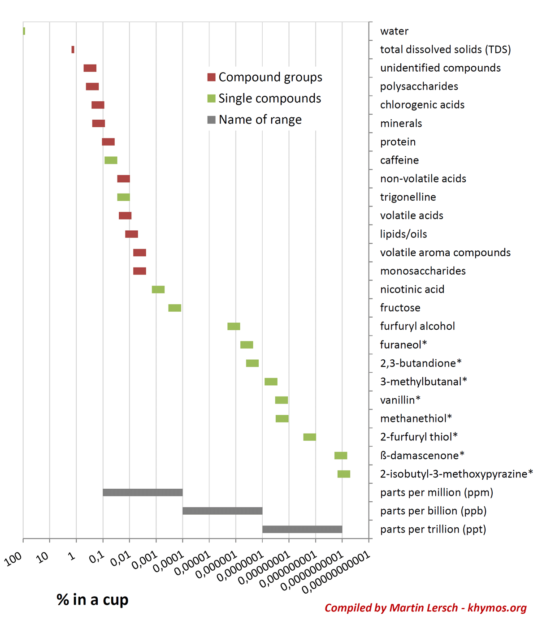
Beta-damascenone serves as a prime example of this phenomenon. Even though beta-damascenone is present in coffee at minuscule concentrations down to 1 part per trillion (ppt)—spanning a logarithmic scale of concentration ranges across more than nine orders of magnitude—it exerts a massive influence on flavor, ranking among the top five most impactful odorants in coffee. Consequently, a molecule present at 0.0000000001 percent can be just as crucial to the overall flavor profile as a macro-compound present at 0.01 percent.
Limitations of Current Industry Metrics and Future Implications
For decades, specialty coffee roasters and commercial cafes have relied on Total Dissolved Solids (TDS) refractometers to measure brew strength. Typically hovering between 1.2 and 1.5 percent in a standard cup, TDS serves as a fast, reliable gauge of extraction efficiency.
However, industry experts and analytical chemists caution that TDS has severe limitations. Because TDS measures only the total mass of dissolved solids, it fails to account for the qualitative differences between extracted compounds. Crucially, trace compounds that dictate aroma and complex flavor notes do not necessarily extract at the same rate or in direct correlation with the bulk solids that move the TDS needle. A high TDS reading indicates a strong brew, but it provides little to no predictive insight into whether the coffee will taste bright, balanced, muddy, or bitter.
As analytical techniques continue to evolve, researchers anticipate the discovery of additional key odorants currently hidden beneath the detection threshold. Until portable, rapid molecular spectrometers become standard kitchen appliances, the human nose—backed by sensory evaluation and an appreciation for chemical complexity—will remain the ultimate analytical instrument in the pursuit of the perfect cup of coffee.