Exploring the Rich Heritage and Culinary Science of Indonesian Pandan-Infused Traditional Market Snacks

The vibrant culinary landscape of the Indonesian archipelago is deeply rooted in tradition, where the visual and sensory appeal of food often holds as much significance as its flavor profile. Among the myriad ingredients that define traditional Indonesian gastronomy, the screwpine leaf—universally known as daun pandan—occupies a central position. Renowned for its distinct, sweet, and nutty aroma alongside its natural, brilliant green pigmentation, pandan functions as an indispensable element in the creation of authentic Indonesian street foods and traditional market delicacies, locally referred to as jajanan pasar.
Historically, these traditional confections have served as staples of daily communal life, celebrations, and rituals across the islands of Java, Sumatra, Bali, and beyond. The enduring popularity of jajanan pasar lies in their remarkable textural diversity and flavor harmony, which frequently balances the richness of coconut, the deep caramel notes of palm sugar, and the refreshing, botanical fragrance of pandan. While modern commercial food production increasingly relies on synthetic dyes and artificial flavorings, culinary historians and traditional bakers continue to advocate for the use of fresh botanical extracts, citing both cultural preservation and superior organoleptic qualities.
This comprehensive culinary report examines the cultural significance, historical context, and practical preparation methods of three iconic pandan-infused Indonesian market snacks: klepon, putu ayu, and dadar gulung. By exploring their ingredients, step-by-step methodologies, and broader socioeconomic implications, this article provides a detailed guide for both culinary enthusiasts and food historians.
Historical Evolution and Cultural Significance of Jajanan Pasar
The tradition of crafting jajanan pasar dates back centuries, evolving from localized rural practices into a sophisticated culinary art form deeply integrated into the social fabric of Southeast Asia. In traditional agrarian societies, communities utilized readily available local flora to enhance their food. Pandan leaves (Pandanus amaryllifolius) grew abundantly in tropical home gardens, offering a natural, safe, and aromatic solution for food coloring and flavoring long before the advent of industrial chemistry.
Sociological analyses of Indonesian culinary traditions indicate that jajanan pasar historically functioned as a medium for social cohesion. Markets served not merely as commercial hubs for the exchange of agricultural produce, but as vibrant social spaces where women, who traditionally held the primary role in artisanal food production, shared recipes, techniques, and cultural narratives. The bright green hues of pandan-based treats symbolized fertility, renewal, and the lush agricultural bounty of the tropical environment.
Over successive generations, the repertoire of sweet and savory snacks expanded significantly. While savory items frequently incorporate spices, coconut milk, and proteins such as minced meat or fish, the sweet variants rely heavily on the triumvirate of pandan, coconut, and palm sugar (gula jawa or gula aren). This specific flavor combination creates a complex profile where the herbal, grassy top notes of pandan cut through the rich, heavy fats of coconut milk, balanced by the deep, molasses-like sweetness of palm sugar.
In contemporary urban settings, jajanan pasar has undergone a renaissance. Culinary entrepreneurs and artisan bakers have reimagined these traditional items for upscale markets, cafes, and international food festivals, thereby preserving heritage recipes while adapting to modern consumer preferences for authenticity and artisanal craftsmanship.
The Botanical and Culinary Science of Pandan
To understand the culinary prominence of daun pandan, one must examine its chemical composition and physical properties. Unlike vanilla or synthetic flavorings, which provide a singular aromatic note, pandan leaves contain a complex mixture of volatile organic compounds. The primary aromatic compound responsible for pandan’s characteristic scent is 2-acetyl-1-pyrroline, a molecule that is also notably present in fragrant jasmine rice and certain varieties of bread.
When pandan leaves are bruised, crushed, or blended with water, these volatile compounds are released into the liquid matrix, creating what is traditionally known as air pandan suji (when combined with false daisy or suji leaves for intensified color) or simply pandan extract. In professional and home kitchens alike, the extraction process requires precision. Fresh leaves are finely sliced and macerated or processed in a blender with water, followed by rigorous straining to remove fibrous plant matter. The resulting liquid possesses a vivid emerald coloration derived from natural chlorophyll.
From a nutritional and food science perspective, utilizing natural pandan extract offers distinct advantages over synthetic alternatives. While artificial food dyes provide coloration without sensory depth, natural pandan contributes both aesthetic appeal and subtle aromatic complexity that enhances the overall dining experience. Furthermore, the absence of chemical additives aligns with the growing global consumer demand for clean-label, minimally processed foods.
Comprehensive Recipe Analysis and Preparation Methodologies
Mastering the art of traditional Indonesian confectionery requires strict adherence to ingredient ratios, temperature control, and precise techniques. Below are detailed, step-by-step culinary guides for three of the nation’s most celebrated pandan-infused market snacks: Klepon, Putu Ayu, and Dadar Gulung.
1. Traditional Javanese Klepon
Klepon is perhaps one of the most iconic sights in an Indonesian traditional market. These small, boiled rice cake balls are characterized by their chewy texture, vibrant green exterior, and an explosive center of molten palm sugar that releases upon the first bite. Coated in freshly grated coconut, klepon represents a masterclass in textural contrast—soft, chewy, sweet, and savory.
Originating primarily from the rural heartlands of Java, klepon historically formed part of harvest celebration offerings. The preparation technique demands careful attention to dough hydration to prevent the rice flour balls from cracking during the boiling process, which would cause the internal liquid sugar to leak out into the water.
Nutritional and Sensory Profile
- Preparation Duration: Approximately 60 minutes
- Skill Level: Moderate
- Yield: 4 servings
- Regional Origin: Central and East Java
- Category: Confectionery / Steamed and Boiled Pastry
Required Ingredients
- For the Dough:
- 250 grams glutinous rice flour ( tepung ketan )
- 30 grams tapioca flour (to improve elasticity)
- 200 ml lukewarm concentrated pandan-suji water (or warm water combined with high-grade pandan paste)
- 1/2 teaspoon fine sea salt
- For the Filling:
- 150 grams high-quality palm sugar (gula aren or gula jawa), finely shaved or chopped into small cubes
- For the Coating:
- 150 grams freshly grated mature coconut (white flesh only, dark skin removed)
- A pinch of fine salt
- 1 pandan leaf, knotted (steamed briefly with the coconut to enhance aroma)
Step-by-Step Preparation Methodology
- Preparation of the Coconut Coating: Begin by combining the freshly grated coconut with a pinch of salt. Place the mixture in a heatproof bowl alongside the knotted pandan leaf. Steam the coconut in a preheated steamer for approximately 10 to 15 minutes. This step is critical not only for imparting a subtle aroma but also for pasteurizing the coconut, thereby extending the shelf life of the finished klepon. Once steamed, remove from heat and allow it to cool completely on a wide tray.
- Dough Formulation: In a clean mixing bowl, combine the glutinous rice flour, tapioca flour, and salt. Mix thoroughly with a spatula to distribute the dry ingredients evenly.
- Hydration and Kneading: Gradually pour the lukewarm concentrated pandan-suji water into the dry flour mixture. Stir continuously with your hands or a wooden spoon until the liquid is fully incorporated. Knead the dough gently just until it becomes smooth, pliable, and non-sticky. If the dough feels too dry and crumbly, add a few drops of water; if too wet, incorporate a minimal dusting of glutinous rice flour.
- Portioning and Filling: Pinch off a small portion of the dough (approximately 15 grams per piece). Roll it between the palms of your hands to form a smooth sphere. Flatten the sphere slightly in the center using your thumb to create a small depression. Place a small amount of the shaved palm sugar (about 1/2 teaspoon) into the center. Carefully fold the edges of the dough upward to encase the sugar completely, ensuring no air pockets remain and the sugar cannot escape. Roll it gently between your palms again to restore its spherical shape.
- Boiling Process: Bring a large pot of water to a rolling boil over medium-high heat. Drop the prepared klepon spheres into the boiling water one by one to prevent sticking.
- Determining Doneness: Allow the klepon to boil. Initially, they will sink to the bottom of the pot. As the dough cooks and the internal sugar melts, the spheres will float to the surface. Once they rise to the top, allow them to cook for an additional 1 to 2 minutes to ensure the glutinous flour is thoroughly gelatinized and cooked through.
- Coating and Presentation: Using a slotted spoon or spider strainer, carefully lift the cooked klepon from the boiling water, allowing excess water to drip off. Immediately transfer the hot klepon directly into the tray of prepared grated coconut. Roll the pieces gently until they are evenly and generously coated with the coconut flakes. Serve at room temperature.
2. Putu Ayu: The Aromatic Steamed Sponge Cake
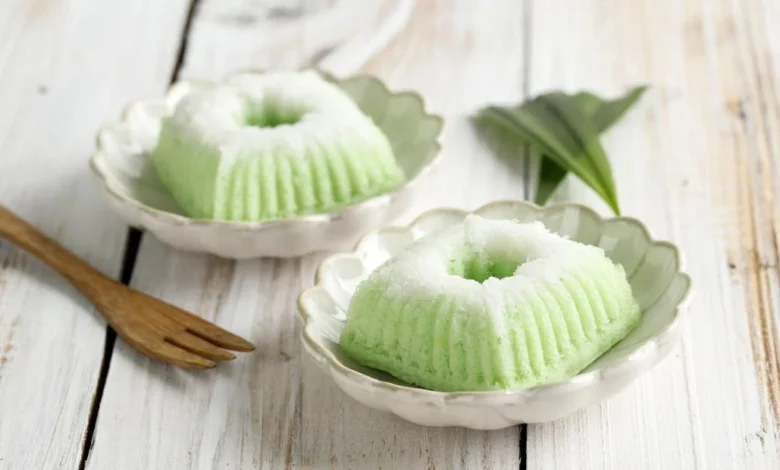
Putu ayu is a delightful variation of traditional sponge cakes, characterized by its bright green pandan-flavored body and a contrasting topping of snow-white, salted grated coconut. Traditionally baked in small, fluted floral molds, putu ayu offers a light, fluffy crumb that contrasts pleasingly with the savory, textured coconut layer at the base.
Unlike Western-style butter cakes that rely heavily on dairy fats, putu ayu achieves its tender crumb through the precise aeration of whole eggs combined with thick coconut milk and fragrant pandan juice. This traditional method produces a fat-light, highly digestible cake that pairs exceptionally well with morning or afternoon tea.
Nutritional and Sensory Profile
- Preparation Duration: Approximately 45 minutes
- Skill Level: Easy to Moderate
- Yield: 12 to 15 individual cakes (4–5 servings)
- Regional Origin: Pan-Indonesian
- Category: Steamed Cake
Required Ingredients
- For the Cake Batter:
- 4 grade-A chicken eggs (at ambient room temperature)
- 200 grams granulated white sugar
- 150 ml thick coconut milk (santan instan or freshly pressed thick coconut milk)
- 50 ml concentrated pandan-suji extract
- 200 grams medium-protein wheat flour (all-purpose flour)
- 1/2 teaspoon emulsifier (such as cake emulsifier / ovalet / SP, optional for stability)
- For the Coconut Topping:
- 150 grams freshly grated mature coconut (white flesh only)
- 1/2 teaspoon fine sea salt
- 1 tablespoon all-purpose flour or tapioca starch (to help bind the coconut layer during steaming)
Step-by-Step Preparation Methodology
- Preparation of Molds and Topping: Thoroughly mix the grated coconut, salt, and starch in a bowl. Lightly brush individual plastic or aluminum flower-shaped putu ayu molds with a small amount of neutral vegetable oil to prevent sticking. Pack a small portion of the salted coconut firmly into the bottom of each mold (filling approximately 1/3 of the mold’s height). Press down firmly with the back of a spoon to ensure a compact layer.
- Egg Aeration: Ensure all ingredients are at room temperature. In a large mixing bowl, combine the whole eggs, granulated sugar, and emulsifier (if using). Using an electric hand mixer set to high speed, whip the mixture continuously until it transforms into a thick, pale, voluminous, and ribbon-like batter (stage known as ribbon stage). This process typically takes 8 to 10 minutes.
- Incorporating Liquids and Flour: Sift the wheat flour to remove any lumps. Combine the thick coconut milk and the concentrated pandan-suji extract in a separate jug. Reduce the mixer speed to its lowest setting, or switch to a rubber spatula for folding. Alternately fold the dry flour and the pandan-coconut liquid into the whipped egg batter in incremental batches. Ensure you fold gently from the bottom upward to preserve the incorporated air bubbles, which provide the cake’s signature sponge-like rise.
- Filling the Molds: Gently pour or pipe the pandan cake batter into the prepared molds directly on top of the compressed coconut layer, filling each mold almost to the brim.
- Steaming Technique: Prepare a steaming apparatus, ensuring the water in the base pot is at a rolling boil and producing abundant steam. Wrap the lid of the steamer securely with a clean kitchen towel or cloth; this crucial step prevents condensed water droplets from dripping onto the cakes, which would mar their surface texture.
- Cooking Duration: Arrange the filled molds in the steamer basket, leaving adequate space between each mold to allow steam circulation. Steam over medium heat for exactly 20 minutes. Avoid opening the steamer lid during the first 15 minutes to prevent the cakes from deflating.
- Unmolding and Cooling: Once cooked, remove the molds from the steamer. Allow them to cool for 3 to 5 minutes until safe to handle. Gently run a thin toothpick around the inner edge of each mold, then invert gently to release the finished putu ayu onto a presentation plate.
3. Dadar Gulung: The Classic Rolled Pandan Pancake with Sweet Coconut Filling
Dadar gulung translates literally to "rolled pancake." This beloved delicacy consists of a thin, pliable, pandan-flavored crêpe wrapped securely around a rich, spiced filling of caramelized grated coconut, known locally as unti kelapa. Often elevated with the inclusion of aromatic jackfruit pieces and high-grade palm sugar, dadar gulung represents a harmonious synthesis of culinary techniques likely influenced by European crêpes introduced during the colonial era, adapted expertly with native tropical ingredients.
Achieving a successful dadar gulung requires mastering two distinct components: a perfectly smooth, porous, yet tear-resistant crêpe skin, and a luscious, cohesive coconut filling that is neither too wet nor excessively dry.
Nutritional and Sensory Profile
- Preparation Duration: Approximately 75 minutes
- Skill Level: Moderate
- Yield: 10 to 12 servings
- Regional Origin: Java and Sumatra
- Category: Rolled Pastry / Snack
Required Ingredients
- For the Pancake Skin:
- 250 grams all-purpose flour (serbaguna)
- 2 grade-A chicken eggs
- 500 ml fresh, medium-thick coconut milk
- 100 ml concentrated pandan-suji extract
- 1/4 teaspoon fine sea salt
- A few drops of neutral vegetable oil for greasing the pan
- For the Unti Kelapa (Coconut Filling):
- 200 grams freshly grated mature coconut
- 100 grams palm sugar (gula aren or dark gula jawa), finely chopped
- 2 tablespoons granulated white sugar (adjust according to sweetness preference)
- 1 pandan leaf, knotted
- 50 ml water
- 2 ripe jackfruit (nangka) pods, cored and diced into fine brunoise pieces
- A pinch of salt
Step-by-Step Preparation Methodology
- Preparation of the Coconut Filling (Unti): In a heavy-bottomed skillet or wok, combine the water, chopped palm sugar, granulated sugar, knotted pandan leaf, and a pinch of salt. Place over medium heat and stir until the sugars dissolve completely into a fragrant syrup.
- Infusing Fruit and Coconut: Add the diced jackfruit and the freshly grated coconut into the simmering syrup. Reduce the heat to low. Stir continuously with a wooden spatula, ensuring the coconut absorbs the liquid evenly. Cook until the moisture evaporates and the mixture thickens into a rich, cohesive, and glossy mass. Be careful not to caramelize the sugar to the point of burning. Once the filling holds its shape and is no longer watery, remove from heat, discard the pandan leaf, and transfer the filling to a bowl to cool completely.
- Preparing the Batter for the Skin: Place the all-purpose flour and salt into a spacious mixing bowl. In a separate container, whisk the eggs lightly until frothy, then whisk in the fresh coconut milk and the concentrated pandan-suji extract.
- Mixing and Filtering: Gradually pour the liquid mixture into the flour while whisking continuously with a wire whisk to prevent the formation of lumps. Stir until a smooth, thin, fluid batter is achieved (similar in consistency to heavy cream). To ensure a velvety, pore-free skin texture, pass the entire batter through a fine-mesh wire sieve into a clean bowl.
- Cooking the Crêpes: Heat a non-stick frying pan (approximately 18 to 20 cm in diameter) over low heat. Lightly grease the surface with a small amount of oil applied via a pastry brush or folded kitchen paper towel.
- Pouring and Pan-Frying: Pour one ladleful (approximately 40 to 50 ml) of the pandan batter into the center of the warm pan. Swiftly swirl the pan in a circular motion to coat the entire base evenly with a thin layer of batter. Cook over low heat until the edges of the pancake begin to lift slightly from the pan and the surface appears dry (do not flip the pancake, as only one side is cooked). Gently slide the cooked pancake out onto a clean plate. Repeat this process until all the batter is exhausted.
- Assembly and Rolling: Place one pancake skin on a clean flat surface with the cooked (smoother) side facing down. Place approximately 1 to 2 tablespoons of the cooled coconut filling near the lower edge of the pancake. Fold the bottom edge up over the filling, fold in the left and right lateral sides snugly (similar to wrapping a burrito or spring roll), and roll upward until completely enclosed. Repeat for all remaining pancakes and serve at room temperature.
Economic Implications and Modern Market Trends
The production and distribution of jajanan pasar occupy a vital niche within Indonesia’s informal and formal food economies. Micro, small, and medium-sized enterprises (MSMEs)—often operated by home-based artisans and traditional market vendors—rely heavily on the daily sale of these snacks for their livelihoods.
In recent years, government bodies and culinary associations have stepped up efforts to standardize hygiene practices and improve packaging for traditional snacks, enabling them to secure shelf space in modern supermarket chains, airports, and boutique cafes. Furthermore, the global rise of interest in Southeast Asian gastronomy has opened export pathways for frozen or vacuum-sealed traditional items, pointing toward a sustainable future for these heritage foods.
Conclusion
Jajanan pasar, particularly those infused with the aromatic essence of daun pandan such as klepon, putu ayu, and dadar gulung, represent far more than mere street food. They embody a rich cultural heritage, sophisticated culinary science, and enduring social traditions. By mastering the authentic preparation methods of these delicacies, home cooks and professional chefs alike contribute to the preservation of Indonesia’s illustrious culinary history, ensuring that the vibrant green flavors of pandan continue to delight future generations.
Related posts: