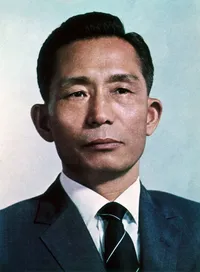
The national celebration of South Korea’s liberation day on August 15, 1974, transformed into a scene of unimaginable national grief when an assassination attempt targeting President Park Chung-hee instead claimed the life of First Lady Yuk Young-soo. Standing at the podium of the National Theater in Seoul before an audience of approximately 1,000 dignitaries, citizens, and foreign diplomats, President Park was delivering a commemorative address marking the 29th anniversary of the Korean Peninsula’s liberation from Japanese colonial rule. What should have been a moment of unified patriotic reflection instead exposed deep vulnerabilities in the nation’s security apparatus and triggered a profound political, social, and diplomatic crisis that reverberated far beyond the borders of South Korea.
According to historical archives, including reports from the Korea Herald, the proceedings were violently interrupted when a young gunman, later identified as Mun Se-gwang, infiltrated the heavily guarded venue. Mun drew a concealed firearm and rushed toward the stage, firing erratic shots intended for the president. While President Park survived the onslaught—ducking behind the sturdy wooden podium just as projectiles whizzed past him—the chaos proved fatal for the first lady. Yuk Young-soo, who was seated prominently in the VIP section alongside government officials and foreign guests, was struck in the head by a stray bullet. The ensuing pandemonium left the auditorium in shock, as security personnel scrambled to neutralize the threat while medical teams rushed to aid the fallen first lady.
Chronology of a Dark Day: August 15, 1974
The sequence of events on that fateful Independence Day unfolded with terrifying speed, leaving indelible scars on South Korea’s political landscape.
At approximately 10:00 AM, President Park Chung-hee took the stage at the National Theater of Seoul to deliver his scheduled address. The atmosphere inside the auditorium was festive, reflecting the country’s steady economic progress under Park’s authoritarian yet modernizing regime.
Roughly ten minutes into the speech, Mun Se-gwang—a 22-year-old ethnic Korean born and raised in Japan—stood up from his seat in the audience. Mun had managed to enter the theater using a falsified press credential and a stolen Japanese passport. As he moved closer to the stage, he drew a .38 caliber revolver stolen from a police box in Japan just days prior.
As Mun drew his weapon and began firing, his initial shots missed the president entirely, lodging into the wooden backdrop and the podium itself. In a panic, Mun attempted to advance, firing more rounds indiscriminately. One of these stray bullets struck First Lady Yuk Young-soo in the head, causing her to collapse instantly.
Security forces immediately swarmed the stage and the auditorium floor, subduing Mun Se-gwang before he could inflict further damage. Amidst the gunfire and ensuing stampede, a stray bullet also struck a tragic secondary victim, an 18-year-old high school student named Jang Bong-hwa, who was attending the ceremony. Jang succumbed to her injuries at the scene, adding an extra layer of tragedy to an already devastating national holiday.
First Lady Yuk Young-soo was rushed under heavy police escort to the Seoul National University Hospital. A dedicated team of top neurosurgeons and medical specialists performed exhaustive operations lasting several hours to extract the bullet and relieve intracranial pressure. Despite their strenuous efforts, the damage to the first lady’s brain was too catastrophic. At 7:00 PM local time, medical authorities officially declared Yuk Young-soo dead at the age of 48.
The Life and Legacy of Yuk Young-soo
The assassination of Yuk Young-soo was not merely the loss of a presidential spouse; it was the sudden removal of one of South Korea’s most beloved public figures. Serving as the nation’s first lady for approximately eleven years following her husband’s seizure of power in the 1961 military coup, Yuk had cultivated a public persona that sharply contrasted with her husband’s stern, militaristic image.
Often referred to by the South Korean public as the "Mother of the Nation," Yuk was renowned for her tireless philanthropic efforts and her soft-spoken, compassionate demeanor. While President Park focused on heavy industrialization, export-led growth, and national security against the communist threat from the North, Yuk dedicated her time to social welfare. She established various charitable foundations, advocated for the rights of the underprivileged, visited orphanages and leprosy colonies, and frequently intervened on behalf of ordinary citizens seeking redress from bureaucratic overreach.
Her approachable nature made her immensely popular across different social strata, serving as a stabilizing and humanizing anchor for the Park administration. Her sudden and violent death thus created an emotional vacuum within the South Korean polity, sparking widespread public mourning characterized by spontaneous vigils and millions of citizens lining the streets of Seoul during her state funeral on August 19, 1974.

Geopolitical Aftermath and Diplomatic Fallout
The repercussions of the 1974 shooting extended far beyond domestic grief, quickly escalating into a major international dispute involving neighboring Japan. Investigators probing the background of Mun Se-gwang quickly uncovered international dimensions to the assassination plot.
According to official South Korean government findings, Mun had been radicalized by pro-North Korean elements operating within the General Association of Korean Residents in Japan (Chongryon). Seoul asserted that Mun had received ideological indoctrination, financial backing, and logistical support from North Korean operatives stationed in Japan, who allegedly instructed him to eliminate President Park to destabilize the South Korean government.
This revelation placed immense strain on diplomatic relations between Seoul and Tokyo. The South Korean government fiercely criticized Japanese authorities for their lax border controls and failure to monitor subversive elements, which had allowed Mun to steal a weapon, forge documents, and travel to Seoul undetected. Mass anti-Japanese protests erupted across South Korean cities, demanding formal apologies and stricter security cooperation from Tokyo.
Under mounting diplomatic pressure, the Japanese government expressed deep regret over the incident, dispatching special envoys to Seoul to mend ties. Meanwhile, the South Korean judiciary accelerated legal proceedings against the perpetrator. Mun Se-gwang was tried, convicted of treason and murder, and subsequently sentenced to death. His execution was carried out swiftly on December 20, 1974, closing the judicial chapter of the tragedy but leaving the broader geopolitical tensions simmering.
Complacency, Security Failures, and the Fall of the Park Regime
Perhaps the most startling historical footnote to the assassination of Yuk Young-soo is the stark failure of institutional learning within South Korea’s presidential security apparatus. Despite the clear breach at the National Theater—which proved that even high-profile events were vulnerable to determined assassins—security protocols surrounding President Park remained dangerously flawed.
Five years and two months after the tragedy that claimed his wife’s life, President Park Chung-hee met a similarly violent end under eerily comparable circumstances. On October 26, 1979, during a private banquet at a safehouse in Seoul operated by the Korean Central Intelligence Agency (KCIA), Park was shot and killed. In a supreme irony of fate, the assassin was not an external communist agent or a radical activist, but Kim Jae-gyu, the sitting director of the KCIA and one of Park’s closest confidants. The assassination plunged the country into a severe constitutional crisis, ultimately bringing an end to Park’s nearly two-decade authoritarian rule and paving the way for a turbulent period of political transition.
Historical Implications and Modern Relevance
Examining the assassination attempt of 1974 through the lens of modern historical analysis reveals critical insights into the fragility of authoritarian regimes during the Cold War era. President Park Chung-hee’s era was characterized by the Korean Economic Miracle—a period of rapid modernization, industrial transformation, and infrastructural development that lifted the nation out of post-war poverty. However, this growth was achieved under strict martial law, suppression of political dissent, and pervasive internal security fears.
The 1974 attack underscored the deep polarization of the Korean Peninsula. Locked in a bitter ideological and military standoff with the Democratic People’s Republic of Korea (North Korea), South Korea was a pressure cooker where political violence was viewed by radical actors as a viable tool for regime change. The targeting of the leadership duo—Park and Yuk—demonstrated how deeply personal the conflict had become, transforming statecraft into a matter of daily physical survival for the nation’s chief executive.
Furthermore, the death of Yuk Young-soo marked a psychological turning point for President Park himself. Biographers and historians note that following the assassination of his wife, Park became increasingly isolated, melancholic, and paranoid, relying more heavily on closed-circle intelligence apparatuses rather than broad political consensus. This insular governance style directly contributed to the alienation of key loyalists within his administration, culminating in the fatal betrayal by his own intelligence chief in 1979.
Conclusion
Decades after the echoes of gunfire faded from the National Theater in Seoul, the events of August 15, 1974, remain etched in the collective memory of South Korea as a cautionary tale of political volatility, intelligence failures, and human loss. While the nation successfully transitioned from the turbulence of the Park era into a vibrant, robust democracy with advanced institutional checks and balances, the assassination of First Lady Yuk Young-soo stands as a poignant reminder of the heavy human costs paid during South Korea’s arduous journey toward modernization and national stability.