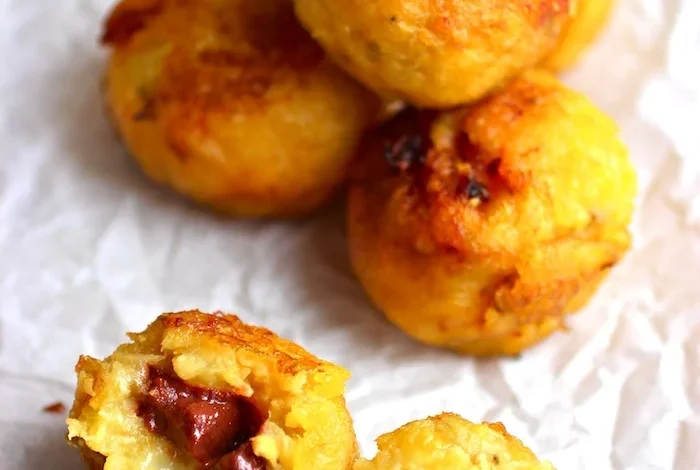
The culinary heritage of Colombia is defined by its regional diversity, where the humble plantain serves as a cornerstone of the national diet. Among the most cherished preparations is the Buñuelo de Plátano Maduro, a refined variation of the classic buñuelo that highlights the natural sweetness of ripe plantains. Unlike the traditional cheese-based buñuelos common during the Christmas season, these plantain-based fritters offer a complex flavor profile, balancing the savory, salty notes of white cheese with the caramelized sugars of the fruit and, frequently, the deep, fruity sweetness of guava paste (bocadillo). This dish functions as a versatile staple, appearing on menus ranging from casual street-side snack stalls to formal appetizer spreads across the Andean and Caribbean regions of Colombia.

Historical Context and Culinary Evolution
The evolution of the buñuelo in Latin American culture traces back to the colonial era, with origins rooted in Mediterranean fritter traditions introduced by the Spanish. However, the Colombian adaptation is distinct. While the base dough typically relies on yuca starch and fresh, semi-firm white cheese, the incorporation of plantains represents a localized innovation designed to maximize the utilization of one of the country’s most abundant crops.
In agricultural regions, the plantain—specifically the "maduro" or fully ripened variety—is valued for its high caloric density and versatility. As the plantain ripens, its starch converts into simple sugars, giving it a soft texture and a deep, golden-brown hue when fried. By the mid-20th century, the practice of stuffing these plantain balls with cheese and guava paste became standardized in many Colombian households. This specific combination—often referred to as a "maridaje" or marriage of flavors—aligns with the Colombian preference for contrasting tastes: the "sal-dulce" (salty-sweet) profile.

The Anatomy of the Dish
A standard preparation of Buñuelos de Plátano Maduro requires careful selection of ingredients. The plantains must be at the peak of ripeness, indicated by a peel that is almost entirely black. The internal chemistry of an overripe plantain is critical to the structural integrity of the final ball; the higher sugar content allows for a superior caramelization during the frying process.
The filling, typically consisting of a mild, salty cheese such as queso fresco or a similar crumbly variety, provides a necessary textural contrast to the soft, malleable plantain dough. When guava paste (bocadillo) is introduced, it creates a molten center that requires precise temperature control during frying. If the oil is too cold, the dough absorbs excess fat and loses its structural integrity; if the oil is too hot, the exterior will char before the interior cheese has reached an optimal melting point.

Chronology of Preparation and Service
The preparation process is relatively rapid but demands attention to detail. The workflow generally follows this timeline:
- Preparation (0–10 minutes): Plantains are boiled or steamed until tender. Once cooked, they are mashed into a smooth, homogenous paste. Some recipes incorporate a small amount of flour or cornstarch to improve binding, though purists often rely solely on the plantain’s natural starches.
- Assembly (10–20 minutes): A portion of the mash is flattened in the palm, a cube of cheese (and optional guava paste) is placed in the center, and the dough is folded over to create a sealed sphere.
- Thermal Processing (4 minutes): The balls are submerged in neutral oil heated to approximately 350°F (175°C). The objective is to achieve a uniform, deep golden-brown crust.
- Service: The dish is served immediately. Gastronomic experts note that the contrast between the crispy exterior and the viscous, heated center is at its peak within five minutes of leaving the fryer.
Data and Market Relevance
While precise global export figures for this specific appetizer are difficult to isolate, the market for Colombian plantain-based snacks has seen a steady increase. According to trade data from the Colombian Ministry of Agriculture, plantain production remains one of the most stable sectors in the domestic economy. The popularity of "picadas"—platters of various fried snacks—has driven a consistent demand for high-quality, pre-prepared plantain products in both domestic and international markets, particularly in regions with high concentrations of the Colombian diaspora, such as the northeastern United States and parts of Spain.

Nutritionally, a standard serving of these balls—typically two or three units—contains approximately 200–250 calories. While they are a fried food, they provide significant levels of potassium and Vitamin A, derived from the plantain base. However, the inclusion of cheese and, in some cases, sugar-dense guava paste, categorizes them as a "treat" or comfort food rather than a primary health-conscious meal.
Broader Impact and Culinary Implications
The global perception of Colombian cuisine has undergone a significant shift in the last decade. Once categorized largely by regional staples, it is now gaining recognition for its sophisticated use of tropical ingredients. The Buñuelo de Plátano Maduro serves as an excellent case study for this transition. It is a dish that honors traditional techniques while remaining highly adaptable to modern culinary fusion.

In professional kitchens, chefs are now experimenting with variations of the classic recipe. Some have introduced savory fillings, such as chorizo or chicharrón, to replace the traditional cheese, while others have utilized the dish as a dessert, pairing the plantain ball with cinnamon-infused syrups or dairy-based creams. Despite these innovations, the traditional version remains the benchmark, serving as a cultural touchstone that links contemporary Colombian families to the culinary traditions of their ancestors.
Storage and Handling Best Practices
From a food safety and quality management perspective, the shelf-life of these fritters is limited. The moisture content of the plantain, combined with the dairy filling, makes them susceptible to rapid spoilage if not stored correctly.

- Short-term storage: If prepared in advance, they can be kept at room temperature for a very limited duration, but refrigeration is required for any storage beyond one hour.
- Reheating protocols: To maintain the structural integrity of the crust, professional chefs advise against microwave heating, which renders the exterior soggy. Instead, a convection oven set to 350°F (175°C) for 15 minutes is recommended. This method allows the heat to penetrate the center without further oil absorption.
- Frozen storage: Commercially, many producers are now offering "ready-to-fry" versions. These are flash-frozen to lock in texture, allowing for a consistent end product that mimics the quality of fresh preparation.
Conclusion
The Buñuelo de Plátano Maduro is more than a mere snack; it is a refined example of how simple, accessible ingredients can be elevated through technique and cultural tradition. As Colombian food continues to find a larger audience on the international stage, the appreciation for such nuanced, flavor-forward dishes is expected to grow. Whether served as a quick after-school snack or as part of an elaborate appetizer menu, these plantain balls represent the core tenets of Colombian hospitality: warmth, generosity, and an unwavering commitment to the vibrant flavors of the tropics. Through the preservation of such recipes, the culinary legacy of Colombia is not only maintained but actively celebrated by new generations.