The Definitive Guide to France’s Premier Culinary Academies and International Gastronomy Training Programs for 2026

France has long held an unassailable position as the spiritual capital of the culinary world. From the refined techniques of classical fine dining and intricate pastry arts to the bustling, authentic atmosphere of neighborhood bistros, the nation’s food culture offers an unmatched framework for professional development. For aspiring chefs, pastry artisans, and future restaurateurs from around the globe, pursuing an education in France extends far beyond acquiring a diploma or professional qualification; it represents an immersion into a rigorous culinary philosophy rooted in history, precision, and respect for ingredients.
While domestic culinary education in France frequently begins during secondary school through specialized vocational tracks, the nation’s premier private institutions have increasingly tailored their offerings to adult learners, career changers, and international students. A critical barrier for many prospective students has traditionally been language proficiency. However, the contemporary educational landscape has evolved significantly. Today, numerous esteemed French culinary institutes offer comprehensive programs taught entirely in English, or feature bilingual instruction with simultaneous English translation.
Understanding the distinction between the language required within the classroom and the communicative competence demanded within a high-pressure commercial kitchen remains vital for international applicants. To assist prospective culinary students in navigating these diverse academic paths, this comprehensive guide examines seven of France’s leading culinary schools, detailing their unique educational approaches, curriculum structures, language accommodations, and financial commitments.
The Changing Landscape of International Culinary Education in France
The globalization of the food and hospitality industries has prompted traditional French institutions to adapt their administrative and instructional frameworks. Historically, immersion in the French language was an absolute prerequisite for admission to any recognized professional kitchen or academy. In response to rising international demand—driven heavily by the global fascination with French gastronomy, Michelin-starred dining, and pastry arts—top-tier academies have introduced dedicated English-language tracks.
However, industry experts emphasize that language acquisition cannot be entirely decoupled from professional success. While theoretical lectures, recipe breakdowns, and technical demonstrations may be delivered in English, the reality of working inside a professional kitchen—known colloquially as the brigade system—frequently demands functional French. Consequently, many leading academies now embed conversational or professional French language modules directly into their multi-month curricula, aiming to bridge the gap between international enrollment and employability in high-end European establishments.
1. Gastronomicom International Culinary Academy: Mediterranean Immersion and Practical Versatility
Situated in the sun-drenched landscape of Southern France, the Gastronomicom International Culinary Academy offers a distinct alternative to the high-pressure, urban environment of Paris. Tailored specifically for international students, the institution pairs rigorous culinary and pastry training with the lifestyle benefits of the Mediterranean region, including access to vibrant local food markets and regional producers.
A primary drawing point for Gastronomicom is its accessible language policy: all cooking and pastry classes are conducted entirely in English, eliminating the barrier of prior French fluency. The school structures its academic offerings across flexible timelines, ranging from short, two-month specialized courses in either cuisine or pastry (priced at approximately €5,100, or €6,900 for a combined track) to comprehensive seven-month and one-year programs.
The seven-month curriculum, priced at €9,800, integrates 12 weeks of intensive kitchen instruction and French language lessons with a mandatory four-month professional internship. For students seeking dual mastery, the one-year program (€19,000) provides 24 weeks of intensive instruction spanning both savory cuisine and pastry arts, followed by a 24-week professional placement.
Institutional data released by Gastronomicom indicates strong student outcomes, reporting a 92.6% certificate attainment rate among international enrollees for the 2024–2025 academic cycle, alongside high reported satisfaction metrics regarding instructor availability and curriculum organization. When evaluated against prominent Parisian institutions, Gastronomicom represents a financially accessible entry point for students seeking comprehensive English-language training paired with guaranteed industry placement opportunities.
2. FERRANDI Paris: Intensive Technical Rigor and Distinguished Alumni Networks
For professionals aiming directly for the upper echelons of the restaurant industry, FERRANDI Paris maintains an exceptional reputation. Often styled by industry observers as the "Harvard of Gastronomy," FERRANDI has cultivated a formidable track record of producing elite culinary talent. Historical institutional data underscores this pedigree: an analysis of France-based Michelin-starred chefs revealed that FERRANDI alumni accounted for a higher concentration of starred kitchens than any other single institution in the comparative sample.
English-speaking applicants are primarily drawn to FERRANDI’s Intensive Professional Program in French Cuisine. Spanning 16 weeks—with an optional three-month internship—the program is delivered in English, though guest chef demonstrations conducted in French are accompanied by consecutive translation, and all core manuals are provided in English.
The curriculum establishes a rigorous baseline, covering foundational knife skills, regional French gastronomy, wine pairing, restaurant service operations, and professional terminology. Students also gain direct commercial experience by preparing and executing service for patrons within the school’s on-site training restaurant.
Priced at €24,500, the intensive certificate fee includes all required professional uniforms, a comprehensive chef’s toolkit, instructional materials, and educational excursions. Prospective students must note, however, that while FERRANDI does not enforce a strict French language prerequisite for admission to the intensive track, the institution explicitly warns that many elite internship partners require functional communicative abilities in French, placing the onus on the student to supplement their language skills independently.
3. Institut Lyfe: Bridging Culinary Craft and Business Management
Located in Écully, just outside the gastronomic capital of Lyon—a region legendary for its traditional bouchons and the historic indoor food market Les Halles de Lyon Paul Bocuse—Institut Lyfe (formerly known as Institut Paul Bocuse) offers a distinctly academic approach to food education. Rather than focusing exclusively on short-term technical certification, the institution emphasizes the intersection of artisanal culinary execution and executive hospitality management.
Institut Lyfe offers a three-year Bachelor in International Culinary Arts Management featuring a fully English-taught track. The curriculum is structured to divide instructional time evenly between practical kitchen laboratories, training restaurants, and rigorous classroom study covering strategic marketing, financial cost control, human resources, and entrepreneurial leadership.
Each academic year incorporates a mandatory professional placement of at least 12 weeks, ensuring that theoretical management concepts are continuously tested in active commercial environments. Accumulating 180 ECTS credits upon completion, this higher-education degree is targeted at individuals whose ultimate career objectives extend beyond line cooking to executive chef positions, culinary consulting, or restaurant ownership.
Tuition for international students is structured at approximately €13,905 per academic year, supplemented by a one-time registration fee of €2,000 and an annual campus contribution tax of €105, excluding personal living and housing expenses.
4. Le Cordon Bleu Paris: Classical Foundations and Structured Diplomas
As one of the most globally recognized names in culinary education, Le Cordon Bleu has maintained a continuous presence in Paris since its founding in 1895. The Paris campus provides structured educational pathways centered around classical French culinary and pastry methodologies, appealing to both career changers and dedicated culinary traditionalists.
The instructional model at Le Cordon Bleu Paris requires careful consideration regarding language dynamics. While the academy accommodates international students, theoretical classes and masterclass demonstrations are delivered in French and consecutively translated into English. Consequently, admission criteria permit applicants to satisfy language requirements via either B2-level English or A2-level French proficiency.
The core Diplôme de Cuisine is structured across Basic, Intermediate, and Superior tiers, taking either nine months under a standard schedule or six months in an intensive format. Students seeking cross-disciplinary expertise frequently opt for the comprehensive Grand Diplôme®, which merges both culinary and pastry certifications.
For students seeking professional integration, Le Cordon Bleu offers a Cuisine Diploma with an Internship Pathway, extending the program duration to 13 to 18 months. Tuition for the standard Cuisine Diploma is listed at €35,500, while the internship-integrated pathway is priced at €38,500, inclusive of equipment, uniforms, and learning materials. To proceed with the internship component, students must demonstrate A2-level French competency by the conclusion of the academic phase.
5. École Ducasse: Precision, Innovation, and Dual Campus Specialization
Carrying the name of legendary multi-Michelin-starred chef Alain Ducasse, École Ducasse stands as a benchmark for contemporary French gastronomy, emphasizing technical precision, aesthetic creativity, and sustainability within the kitchen.
The institution operates across two distinct French campuses, each tailored to specific disciplines. The flagship Paris Campus, located in Meudon, serves as the primary hub for professional culinary training, leveraging proximity to the capital’s elite dining establishments and markets. Conversely, the École Nationale Supérieure de Pâtisserie (ENSP), situated in the historic town of Yssingeaux within the Auvergne region, provides a specialized, focused environment dedicated exclusively to advanced pastry, chocolate, confectionery, and artisan baking arts.
École Ducasse provides an extensive spectrum of educational pathways, ranging from short-term intensive "Essentials" courses for hobbyists and career-changers to professional diplomas and a rigorous three-year bachelor’s degree in culinary and pastry arts. The longer-duration programs integrate hands-on kitchen training with modules on business administration, cost management, and extended professional internships in Michelin-starred and high-volume commercial kitchens.
6. École Ritz Escoffier: Gastronomic Training Within Luxury Hospitality
Operating within the legendary confines of the Ritz Paris on Place Vendôme, the École Ritz Escoffier offers an exclusive educational environment explicitly linked to the world of ultra-luxury hotel management and elite service standards.
The school’s flagship Diploma in Culinary Arts spans 28 weeks and encompasses 840 hours of intensive instruction divided into six progressive levels covering initiation, intermediate, and advanced techniques in both cuisine and pastry. Instruction is conducted in French with consecutive English translation, maintaining small class sizes capped at eight participants per kitchen workspace to ensure maximal personalized oversight.
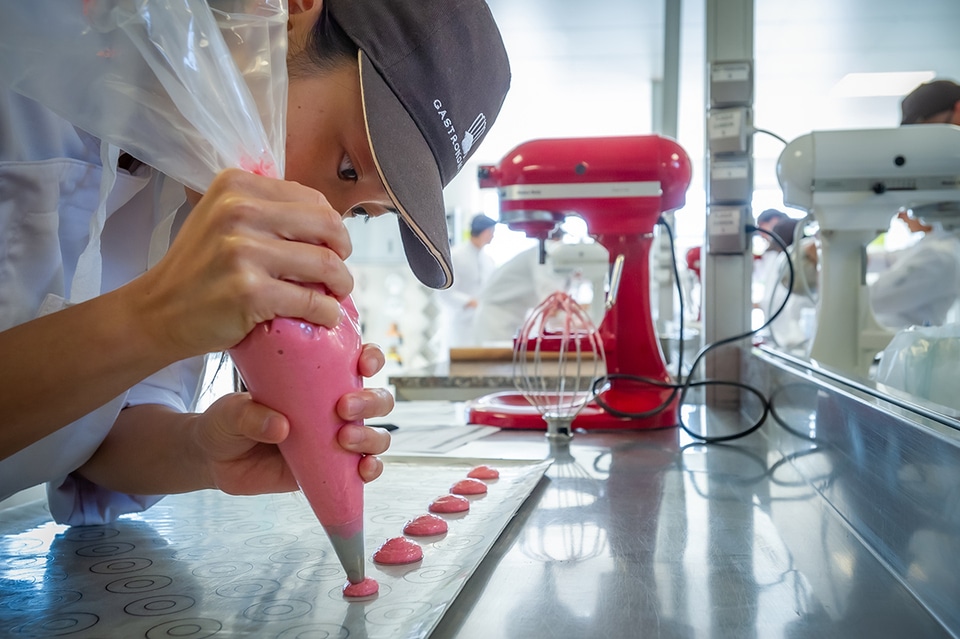
The curriculum incorporates experiential learning through guided market tours with master chefs, artisan workshops, and operational management seminars. Culminating evaluations require students to conceptualize and execute two signature creations presented during a formal celebratory showcase at the Ritz Paris.
While professional internships of up to six months may be arranged conditionally based on student performance and institutional partnerships—including potential placements within the Ritz Paris kitchens—they are not universally guaranteed. Priced at €42,500 inclusive of VAT, the program represents a significant financial investment targeted at individuals seeking immersion in elite hospitality operations.
7. École Lenôtre: Industrial Precision and Artisanal Heritage
Founded by the visionary pastry chef and chocolatier Gaston Lenôtre, École Lenôtre operates out of modern, purpose-built facilities located in Rungis, immediately adjacent to Paris’s massive international wholesale food market. This strategic positioning affords students immediate exposure to the high-grade supply chains that sustain professional French gastronomy.
The academy’s professional Cuisine Program features 21 weeks of rigorous technical training followed by a four- to nine-week mandatory industrial placement within Lenôtre’s production workshops or accredited partner kitchens. Emphasizing repetition and muscle memory, classes are strictly limited to a maximum of 12 participants.
In addition to advanced cooking techniques, the curriculum covers production scheduling, food safety compliance, inventory purchasing, and cost control calculations. While the school advertises instructional delivery in both French and English, prospective international applicants are advised to verify the precise language accommodations for practical examinations and to clarify the communicative expectations required during the subsequent work placement phase. Precise tuition figures are made available upon formal inquiry and quotation request.
Strategic Considerations for Prospective Students
Selecting the appropriate culinary academy in France requires a balanced evaluation of individual career objectives, prior kitchen experience, financial capacity, and linguistic adaptability. While prestigious institutions such as FERRANDI, Le Cordon Bleu, and École Ritz Escoffier offer unmatched historical cachet and rigorous classical training, alternative academies like Gastronomicom and Institut Lyfe provide targeted regional advantages and integrated business management frameworks.
Ultimately, prospective students must look beyond institutional prestige to assess curriculum structure, internship placement security, and the long-term employability value of the credential within their home geographic markets. Thorough financial planning—accounting for tuition, equipment, and separate living expenses in major French urban centers—remains an indispensable step in realizing the ambition of training within the world’s most storied culinary landscape.