Conquering Wat Phu Tok: Thailand’s Architectural Wonder on the Edge of a Cliff

Rising sharply from the flat agricultural plains of northeastern Thailand’s remote Bueng Kan province, Wat Jetiyakhiri—universally known as Wat Phu Tok—stands as one of Southeast Asia’s most extraordinary architectural and spiritual achievements. Translating locally from the Isan dialect as the "lonely mountain," this solitary sandstone monolith reaches an elevation of 359 meters and offers visitors a journey that is as much a test of physical endurance as it is a spiritual pilgrimage. Surrounded by the tranquil, boundless expanse of the Mekong River basin, the temple complex challenges conventional engineering and attracts travelers seeking an authentic departure from Thailand’s heavily commercialized tourist destinations.

The inception of Wat Phu Tok dates back to the late 20th century, transforming a rugged, snake-infested wilderness into a profound sanctuary for Buddhist meditation. The site was chosen and developed by the revered ascetic monk Luang Pu Juan, who envisioned a physical and metaphysical ascent mirroring the path to spiritual enlightenment. Understanding the historical context requires recognizing the deliberate choice of a hostile environment; the dense flora and dangerous wildlife provided the ideal conditions for monks seeking isolation and the rigorous mental discipline required to conquer fear and earthly attachments.

Chronologically, the development of the temple spanned decades of meticulous, manual labor. Monks, novices, and local villagers worked in tandem to carve pathways into the vertical stone faces. They engineered an intricate system of wooden staircases, vertical ladders, and cantilevered walkways anchored directly into the sheer cliffs. This labor-intensive construction culminated in a distinct seven-tiered structure. Each level of the mountain was purposefully designed to correspond directly to the seven stages of Buddhist spiritual purification and mindfulness, allowing practitioners to physically elevate themselves while purging mental defilements. Though the visionary founder, Luang Pu Juan, tragically perished in an aviation accident in 1980, the monastic community and regional authorities have maintained his monumental creation, preserving its structural integrity for future generations of monks and adventurous travelers.

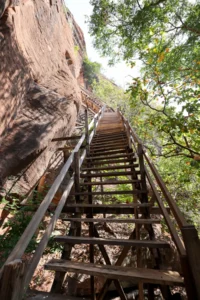
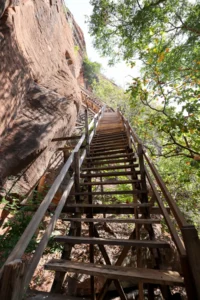
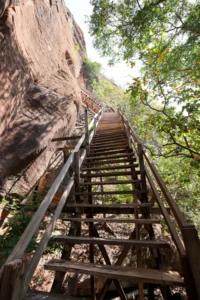
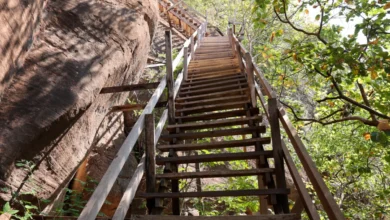
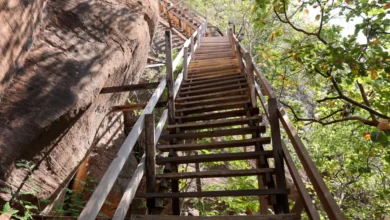
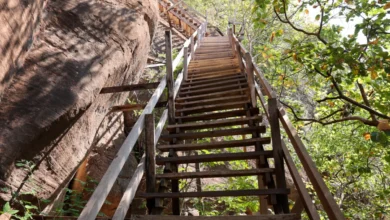
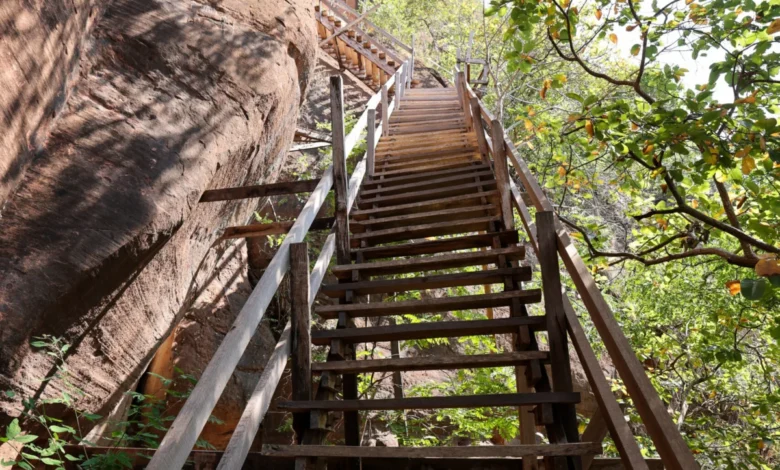
Geographically positioned approximately 30 kilometers south of Bueng Kan city, the temple complex spans a sprawling ground-level base featuring a large lake, verdant parklands, and comprehensive visitor facilities. Upon entering the main gate, the ascent begins deceptively gently along earthen paths before rapidly transitioning into steep timber staircases. These stairs gradually transform into near-vertical wooden ladders that cling precariously to the rock face. While the construction utilizes flexible wooden planks that may bow under the weight of a climber, structural assessments by local municipal engineers confirm that the scaffolding is rigorously maintained and reinforced with heavy-duty steel anchors embedded deep within the sandstone.

The structural layout of Wat Phu Tok is systematically divided into seven distinct tiers, each offering varying architectural features and psychological hurdles. The first two levels serve primarily as transitional zones, featuring dense vegetation and minor devotional shrines that prepare visitors for the physical demands ahead. By the time climbers reach the fifth level, the topography levels out significantly, opening onto a spacious plateau that houses the complex’s primary ordination hall and numerous secondary shrines. This level acts as a central hub where pilgrims can rest on solid ground and explore secluded rock-cut alcoves connected by short wooden bridges.

However, the defining feature of the complex is undoubtedly the sixth level. Spanning nearly the entire circumference of the mountain, the sixth tier consists of narrow wooden walkways cantilevered over sheer drops of hundreds of meters. Roughly half of this level is carved into solid rock, while the remainder hangs suspended over open air, secured to the vertical cliffside. Regarded by visitors and local guides alike as both the most spectacular and the most terrifying portion of the journey, this tier requires absolute focus. Despite the vertiginous heights and the panoramic, unobstructed views of the lush Isan canopy and distant Mekong basin, safety records indicate that fatal accidents remain exceptionally rare, largely due to mandatory visitor caution and the inherent stability of the modern anchoring systems.

The final ascent leads to the seventh level, the summit of the mountain. Historically avoided by casual visitors due to reports of dense populations of venomous snakes and aggressive wildlife, the summit lacks the elaborate architectural marvels found on the lower tiers. It consists primarily of dense forest canopy and natural rock formations. Regional forestry officials and temple administrators advise tourists to exercise extreme caution if they choose to venture onto the top tier, as there are no constructed walkways or protective handrails safeguarding the natural cliff edges.

From an economic and regional development perspective, Wat Phu Tok plays a vital role in boosting tourism within Bueng Kan, which officially became Thailand’s 77th province in 2011 after separating from Nong Khai. Tourism authorities have increasingly highlighted off-the-beaten-path destinations like Wat Phu Tok to distribute visitor revenue more equitably across rural provinces, alleviating over-tourism pressures in major hubs like Chiang Mai and Bangkok. Travel industry analysts note that sites offering experiential adventure tourism—combining cultural heritage, physical challenge, and ecological immersion—are experiencing a surge in demand among post-pandemic international travelers.

Local tourism boards emphasize that sustainable management of Wat Phu Tok remains a top priority. As social media exposure drives higher visitor volumes to the remote Isan region, municipal authorities coordinate closely with the resident monastic order to monitor structural wear and tear on the timber walkways. Maintenance crews conduct routine safety inspections ahead of the dry season—typically running from November to February—when tourist arrivals peak due to favorable weather conditions and cooler ambient temperatures.

For prospective visitors planning an excursion to Wat Phu Tok, regional tourism officials recommend several best practices to ensure a safe and respectful experience. Climbers are strongly advised to wear sturdy footwear with reliable traction, carry adequate hydration, and avoid visiting during heavy monsoon downpours when the wooden planks and exposed rock surfaces become slick. Furthermore, because the site functions as an active Buddhist monastery rather than a mere amusement attraction, visitors must adhere to traditional dress codes by covering their shoulders and knees, and maintain a quiet, respectful demeanor throughout the sacred grounds.

Ultimately, Wat Phu Tok transcends its reputation as a mere architectural novelty or an adrenaline-fueled tourist attraction. By harmonizing human engineering with a forbidding natural landscape, the mountain temple offers a living testament to centuries-old Buddhist philosophies regarding perseverance, mindfulness, and the conquest of fear. As Bueng Kan continues to emerge as a prominent eco-tourism frontier in Thailand, Wat Phu Tok remains a powerful symbol of the nation’s rich spiritual heritage, inviting those willing to brave its heights to discover a profound sense of peace suspended high above the earth.