Conquering Wat Phu Tok: Thailand’s Architectural Wonder on the Edge of a Cliff

Rising sharply from the flat agricultural plains of northeastern Thailand’s remote Bueng Kan province, Wat Jetiyakhiri—universally known as Wat Phu Tok—stands as one of the most remarkable and perilous architectural achievements in Southeast Asia. Reaching an elevation of 359 meters, this isolated sandstone monolith challenges visitors with a labyrinth of hand-built wooden staircases, vertiginous cliff-side walkways, and deep spiritual symbolism. Often described as Thailand’s most adventurous temple, the site attracts travelers and pilgrims seeking an off-the-beaten-path destination that merges intense physical thrills with profound Buddhist contemplation.
Geographical Context and Regional Significance
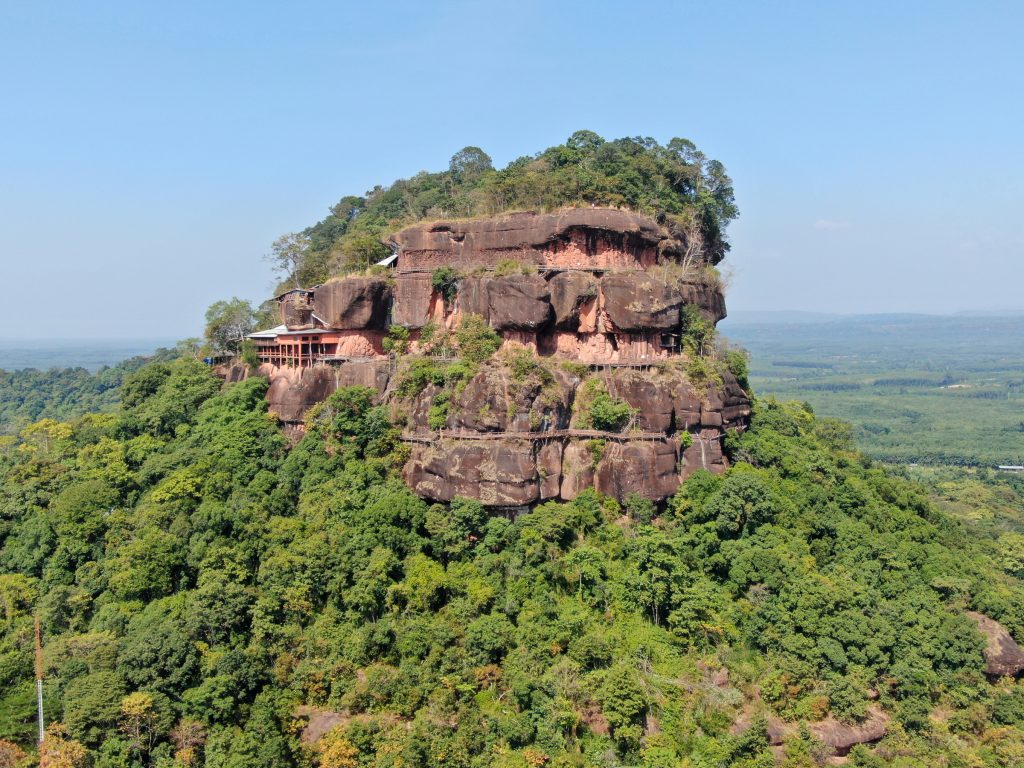
Located in the Isan region near the Mekong River basin, Bueng Kan is among Thailand’s youngest and least commercialized provinces, having officially split from Nong Khai province as recently as 2011. The relative isolation of the area has preserved its natural landscape, characterized by vast horizons, dense woodlands, and dramatic geological formations.
The centerpiece of this landscape is Phu Tok, a name derived from the local Isan dialect translating literally to "lonely mountain." Geologically, the formation bears a striking resemblance to a miniature version of Sigiriya in Sri Lanka, jutting out abruptly from the surrounding terrain. For centuries, the rugged topography and dense jungle canopy rendered the summit virtually inaccessible, creating a natural sanctuary dominated by native wildlife, including populations of venomous snakes.
Historical Origins and Architectural Evolution

The transformation of the lonely mountain into a sacred Buddhist site began in the latter half of the 20th century. Recognizing the solitude, pristine nature, and inherent physical challenges of the mountain as ideal conditions for ascetic Buddhist meditation, the revered monk Luang Pu Juan established Wat Jetiyakhiri.
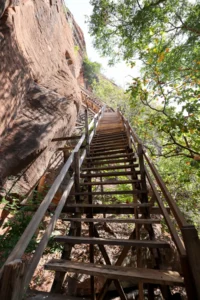
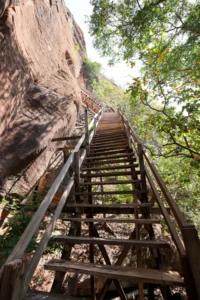
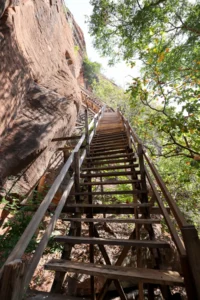
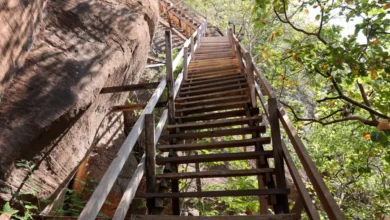
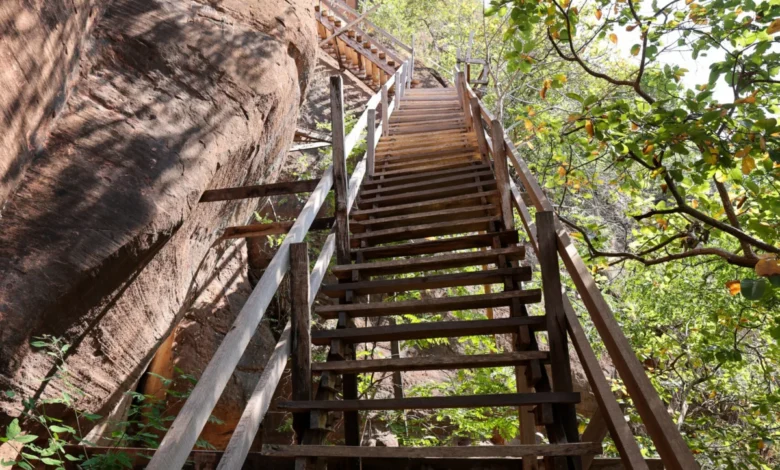
Under the guidance of Luang Pu Juan, monks and local lay Buddhists undertook the monumental task of constructing a vertical pilgrimage route. Without modern construction machinery, workers anchored wooden beams directly into the sheer vertical faces of the red sandstone cliffs. They engineered a system of staircases, ladders, and cantilevered walkways designed to navigate the rugged terrain.
Crucially, the architecture was intentionally divided into seven distinct levels. In Buddhist theology and cosmology, these seven tiers correspond directly to the seven stages of spiritual awakening and mental purification required to achieve liberation from the cycle of rebirth. While Luang Pu Juan tragically lost his life in an aviation accident in 1980—an event that deeply affected the monastic community—his disciples and local authorities have continued to maintain the wooden infrastructure, preserving the temple as a monumental tribute to his vision.

Navigating the Seven Levels of Wat Phu Tok
A visit to Wat Phu Tok begins at the base of the mountain, where a sprawling complex featuring a large lake, administrative buildings, and expansive parking facilities welcomes arrivals. The ascent starts gently through a formal gate, quickly transitioning into a series of wooden plank staircases that wind upward through dense vegetation.
As climbers ascend the lower tiers, the angle of the stairs steepens significantly, eventually transforming into near-vertical ladder formations. While the wooden planks occasionally flex underfoot, civil engineering assessments and ongoing maintenance ensure the structural integrity remains robust.

Level 5: The Center of Monastic Life
Upon reaching the fifth level, the nature of the journey shifts dramatically. Unlike the sheer cliff faces of the lower and upper sections, the fifth level broadens into a more stable plateau featuring ground-level trails. This tier serves as the administrative and ceremonial heart of the complex, housing the primary ordination hall, numerous shrines, and residence quarters for resident monks.
From this level, visitors can also take a well-marked detour along an elevated rock walkway that connects to an isolated stone chapel perched on a separate rocky outcrop. This architectural annex provides an early glimpse of the sweeping panoramic views that characterize the upper tiers.

Level 6: The Pinnacle of Thrills and Scenery
Ascending further via another steep flight of stairs brings visitors to the sixth level, widely acknowledged as the architectural and experiential highlight of Wat Phu Tok. Approximately half of the circumference of this level consists of wooden plank walkways anchored securely into the sheer rock face, while the remainder cuts through natural earth paths.
The cliff-hanging wooden section offers a visceral psychological challenge. Suspended hundreds of feet above the forest floor, the walkway wraps tightly around the sandstone precipice. Although handrails and secure anchor points mitigate the physical danger, the sheer drop-offs demand absolute concentration from every visitor.

Beyond the adrenaline, the sixth level offers unobstructed 360-degree vistas of the Mekong River basin and the verdant canopy of Bueng Kan province. The constant elevation breeze and expansive horizons create a sensory experience unique to the Isan region.
Level 7: The Final Ascent and Ecological Warnings
The final tier, the seventh level, represents the physical summit of the mountain. Unlike the heavily engineered lower levels, the seventh tier features no man-made walkways, shrines, or tourist infrastructure. It is simply the wild, forested top of the sandstone monolith.

Local authorities and monastic caretakers advise caution regarding the final ascent. Historically and ecologically, the upper plateau remains a natural habitat for various species of venomous snakes, prompting warning signs advising visitors to proceed entirely at their own risk. While a few strategic vantage points offer additional views, most travelers find that the architectural brilliance and scenic grandeur of the sixth level fulfill the primary objectives of the journey.
Economic and Tourism Implications for Bueng Kan
The ongoing popularity of Wat Phu Tok has significant implications for the local economy of Bueng Kan province. Long overshadowed by more heavily touristed Thai destinations such as Chiang Mai, Phuket, or Ayutthaya, Bueng Kan relies heavily on niche travelers interested in eco-tourism, cultural heritage, and adventure travel.

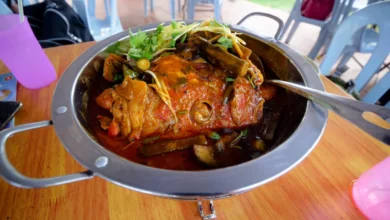
Tourism boards and regional hospitality operators have noted a steady, sustainable increase in domestic and international visitors drawn specifically by the architectural novelty of the cliff-side temple. This influx supports local guesthouses, transportation services, and food vendors, injecting vital revenue into a predominantly agricultural economy.
However, authorities maintain a delicate balancing act between promoting tourism and preserving the spiritual sanctity of the site. Because Wat Phu Tok remains an active place of worship and meditation for Buddhist monks, visitors are continually reminded to observe strict codes of conduct, including modest dress and respectful silence in sacred areas.
Practical Information for Future Visitors

For travelers planning an excursion to Wat Phu Tok, strategic preparation is essential. The journey from Bueng Kan city center takes approximately 30 minutes by private vehicle or hired transport. There is no admission fee to enter the temple grounds, though donations toward the maintenance of the wooden walkways are strongly encouraged.
Experts recommend visiting during the cool dry season, which spans from November to February, when temperatures are manageable and morning mist often blankets the Mekong basin below. Conversely, the rainy season between May and October can render the wooden planks slick and treacherous, occasionally prompting temporary closures of the upper levels for public safety. Visitors should wear sturdy footwear with reliable traction, carry adequate hydration, and assess their personal comfort with heights before attempting the ascent of the sixth and seventh levels.