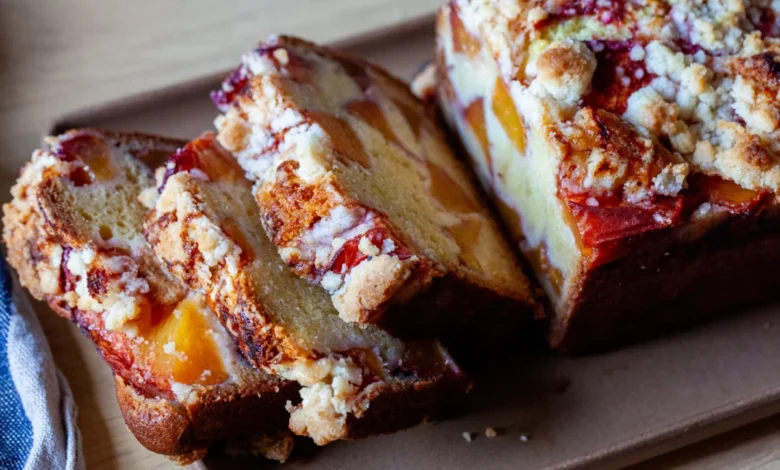
After six consecutive summers of rigorous culinary testing, meticulous note-taking, and countless batches of discarded stone fruit, a definitive recipe for the Peach Cobbler Loaf has finally been released to the public just as the seasonal window for fresh peaches draws to a close. The multi-year development process highlights the extreme precision and stubborn persistence required in modern recipe testing, where home bakers and professional pastry chefs alike often spend years pursuing the exact intersection of texture, moisture, and structural integrity.

The Six-Year Evolution of a Recipe
The journey toward the final Peach Cobbler Loaf began half a decade ago, driven by a pursuit that many culinary professionals recognize: the refusal to settle for "close enough." According to development notes, the initial iterations of the loaf suffered from persistent structural and flavor defects. Diced peaches yielded a bland, watery profile that failed to permeate the crumb, while thinly sliced variants vanished entirely into the baking batter. Furthermore, early attempts to infuse spices directly into the cake base resulted in an unappealing beige aesthetic without adding substantive depth to the flavor profile.
Each summer, as stone fruit made its brief appearance in markets, testing resumed. Copious logs were kept, primarily consisting of variations on a single deflating conclusion: "this wasn’t it." The primary engineering challenge lay in balancing competing physical properties. A successful loaf required a dense, sturdy crumb capable of supporting heavy, moisture-laden fruit without becoming soggy, all while maintaining a tender mouthfeel and a contrasting crisp streusel topping.

Technical Specifications and Baking Chronology
The finalized recipe demands specific parameters to ensure structural success. Culinary experts emphasize that loaf pan dimensions are critical to the outcome. The designated pan size—measuring 8 by 4 inches at the base and expanding to 9 by 5 inches at the rim, with a six-liquid-cup (1420 ml) capacity—fills completely during the baking process. Because the high moisture content of fresh peaches can cause juices to overflow, bakers are instructed to place the loaf pan on a larger baking sheet lined with parchment paper.
The chronology of preparation is meticulously timed:

- Preparation and Maceration: Fresh peach wedges are tossed with freshly squeezed lemon juice, cinnamon, and a measured portion of brown sugar to draw out and season the natural fruit flavors, while lemon zest is integrated directly into the base fats.
-
**Batter
Development:** Melted butter, granulated and brown sugars, and dairy (yogurt or sour cream) are emulsified before eggs are incorporated. Leavening agents—specifically baking powder, baking soda, and salt—are whisked directly into the wet surface before flour is gently folded in to prevent gluten over-development.

- Assembly and Layering: The loaf is constructed in strata. Half the batter is spread into the prepared pan, followed by a uniform layer of seasoned peaches, the remaining batter, a second layer of peaches, accumulated fruit juices, and finally a butter-sugar-flour streusel topping.
- Baking and Cooling: The loaf bakes at 375°F (190°C) for 60 to 70 minutes. Testing for doneness requires checking both the center crumb and the micro-climate beneath the top peach layer where unbaked batter frequently pools.
Industry Implications and Seasonal Timing
The release of the recipe arrives during the final weeks of the domestic peach harvest, a timing that underscores the fleeting nature of fresh stone fruit availability. Food scientists and agricultural economists note that baking with peak-season fruit yields vastly superior chemical and flavor results compared to off-season or canned alternatives, due to higher natural sugar concentrations and optimal acid-to-sugar ratios.
Culinary analysts point out that multi-year recipe development projects are increasingly common in digital food media, where consumer demand for foolproof recipes has escalated. When home cooks encounter failures with viral recipes, reader trust diminishes. Consequently, creators are investing significantly longer validation cycles—sometimes spanning multiple years—before publishing anchor recipes.

Nutritional and storage studies embedded within the recipe’s testing data also reveal practical consumer insights. The loaf exhibits improved structural and flavor cohesion on its second and third days. Food safety and quality guidelines recommend storing the cake unwrapped at room temperature within a controlled micro-environment—such as an unpowered oven or microwave functioning as a makeshift bread box—to preserve the crisp exterior texture of the streusel while preventing the interior crumb from drying out.
As the stone fruit season officially winds down, the debut of the Peach Cobbler Loaf stands as a testament to the endurance of empirical kitchen testing, proving that even simple rustic baked goods can demand scientific rigor to achieve perfection.