How McDonald’s Franchises Funneled Covid-19 Relief Loans Into Corporate Rent Payments

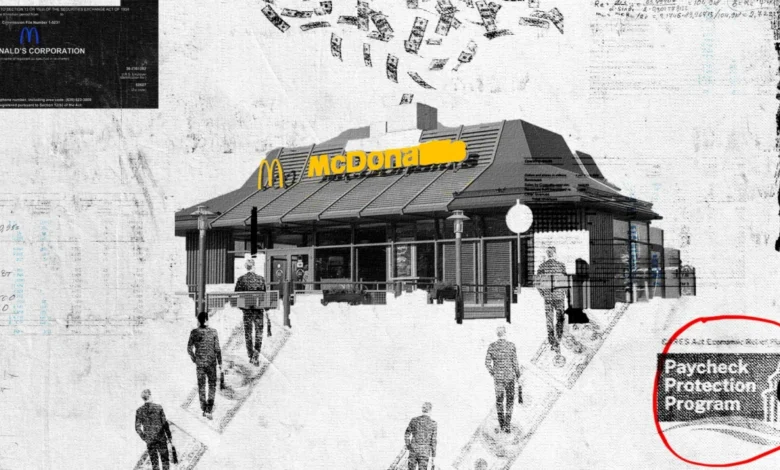
When the global coronavirus pandemic brought the restaurant industry to a sudden and grinding halt in the spring of 2020, fast-food operators faced an unprecedented financial crisis. Storefronts across the United States were forced to shutter their dining rooms, shifting entirely to drive-thru, carryout, and delivery models that initially resulted in plummeting sales volumes. Seeking a lifeline to weather the storm, franchisees representing the world’s largest burger chain turned to the corporate mothership for assistance. Specifically, the National Franchisee Leadership Alliance—an organization advocating for the interests of store owners—petitioned McDonald’s corporate headquarters for a straightforward measure: temporary rent relief.
Unlike many competing quick-service restaurant chains that lease or own their real estate through independent third parties, McDonald’s operates on a unique and deeply entrenched business model established in the 1950s. The parent corporation owns or holds the master leases for the vast majority of the land and physical buildings housing its U.S. franchises. According to former corporate executives and company financial filings, the McDonald’s corporation serves as the landlord for an estimated 85 to 90 percent of its domestic store locations.
This real estate empire functions as a massive profit generator. In 2019 alone, the global corporation collected approximately $7.5 billion in rental payments from its network of franchisees. This revenue stream eclipsed the total amount the company gathered through brand royalties and accounted for more than one-third of the total consolidated revenues reported across the entire corporate entity and its franchised stores combined. For a corporation holding nearly $38 billion in real estate assets before depreciation, the physical properties represent a bedrock of financial stability.
However, when franchisees requested a modest two-week rent forgiveness period to navigate the initial shockwaves of the public health emergency, corporate leadership flatly refused. The denial sent shockwaves through the franchise community, leaving store operators scrambling for alternative sources of liquidity to cover fixed operational overhead.
The Paycheck Protection Program Emerges as an Alternative
Faced with a rigid corporate landlord unwilling to waive rental obligations, restaurant owners quickly pivoted to federal relief. Congress enacted the Coronavirus Aid, Relief, and Economic Security (CARES) Act in March 2020, establishing the Paycheck Protection Program (PPP) under the administration of the Small Business Administration (SBA). Designed as an emergency economic stabilization tool, the PPP offered low-interest, federally guaranteed loans of up to $10 million per business entity. The core legislative intent of the program was unambiguous: to incentivize small businesses to keep their rank-and-file workers on payroll during extended government-mandated lockdowns.
If borrowers utilized the loan proceeds for designated operational expenses—primarily payroll costs—the legislation permitted the full forgiveness of the debt. Recognizing the urgency of the moment, franchise advocacy groups mobilized quickly. Blake Casper, then-chair of the National Owners Association, detailed the strategy in an April 7, 2020, communication to corporate executives. Casper noted that franchisee leadership actively prepared its members to be first in line for federal assistance, recognizing that the government was stepping in to provide the necessary liquidity that the global corporate office refused to supply.
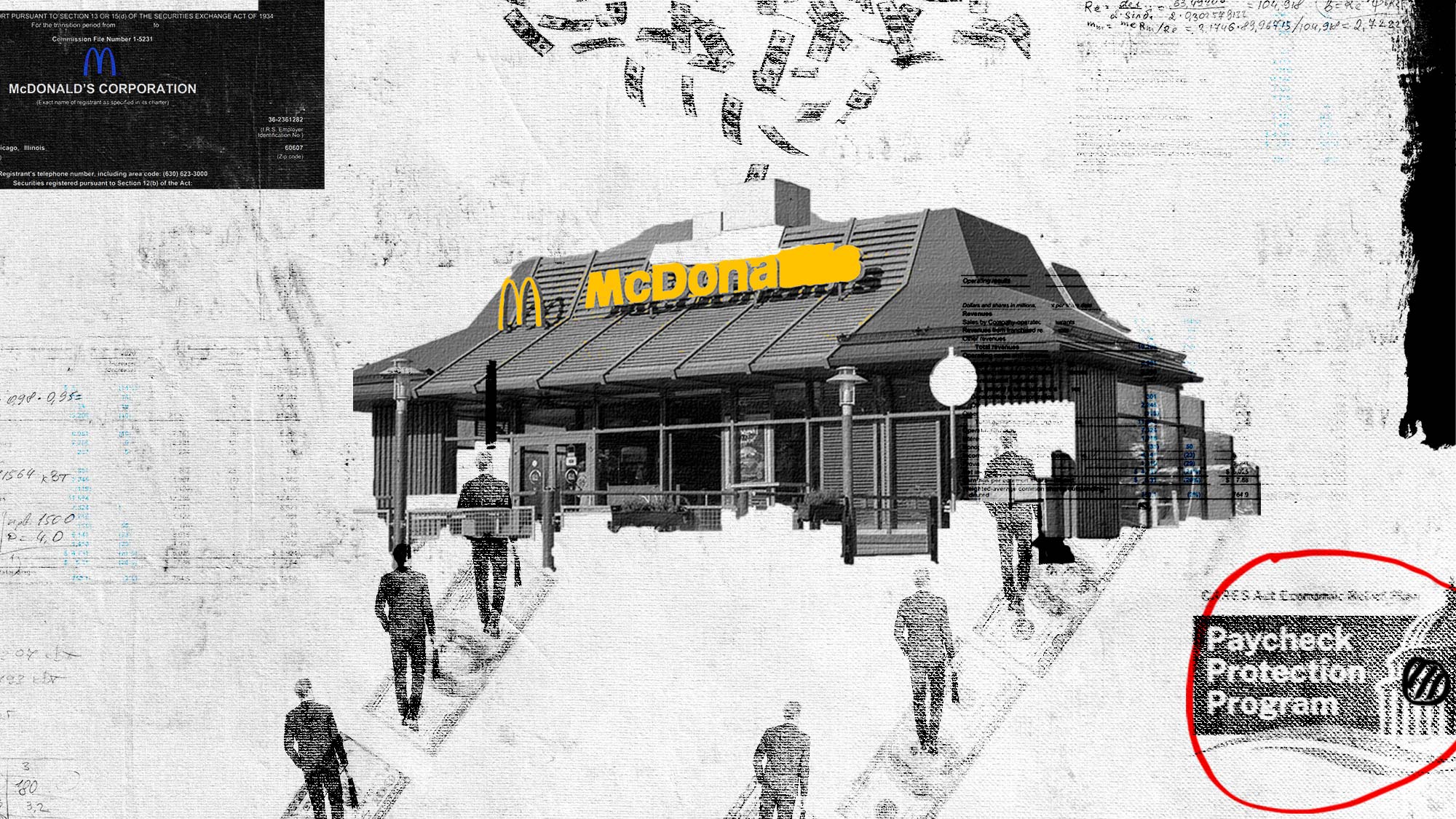
Subsequent data analysis of the federal loan portfolios revealed the massive scale of this intervention. According to Small Business Administration records released in January, approximately 2,389 individual McDonald’s franchises successfully secured PPP loans, accumulating a cumulative total of roughly $1.3 billion in taxpayer-backed funding. Within the entire landscape of the federal relief program, McDonald’s stores emerged as the second-largest corporate franchise recipient by total dollar volume, surpassed only by automotive dealership franchises affiliated with General Motors.
The Mechanics of Taxpayer-Funded Rent Transfers
While the primary public justification for the Paycheck Protection Program was the preservation of low-wage employment, the structural rules governing the funds created a conduit for indirect corporate bailouts. An investigative analysis conducted by journalistic outlets revealed that hundreds of McDonald’s franchise applications explicitly allocated portions of their requested loans toward impending rent obligations.
Out of the thousands of loans distributed to McDonald’s operators, 421 loan applications explicitly itemized projected rent figures, totaling more than $31 million in planned real estate expenditures. Because the corporate office demanded the continuation of rent collections, franchisees used the influx of federal capital to satisfy their lease requirements. Consequently, taxpayer-backed dollars appropriated by Congress to preserve jobs at the local level were effectively funneled upward to service the real estate liabilities of a multinational corporation boasting billions in market capitalization.
Interviews with franchise operators who participated in the program highlighted the precarious position of small business owners caught between corporate demands and federal oversight. While a small number of owners confirmed that portions of their federal loans were directly utilized to clear rental balances owed to McDonald’s, the vast majority declined to comment or discuss their financial accounting. Those willing to speak on the record requested strict anonymity, citing a persistent fear of swift corporate retaliation, lease non-renewal, or franchise agreement termination by headquarters.
Regulatory Loopholes and the Push for Flexibility
The utilization of emergency federal relief for non-payroll expenses expanded significantly following a legislative shift in June 2020. As the economic fallout of the pandemic deepened, trade groups—including the International Franchise Association and various restaurant coalitions—lobbied intensely for a loosening of the strict statutory thresholds governing PPP loan forgiveness.
Initially, the program mandated that borrowers dedicate at least 75 percent of loan proceeds strictly to payroll costs, capping non-payroll expenses like rent, utilities, and mortgage interest at 25 percent. Congress subsequently passed the Paycheck Protection Program Flexibility Act, which altered the formula by lowering the required payroll expenditure threshold to 60 percent and permitting businesses to direct up to 40 percent of the funds toward overhead and rent. Trade associations publicly praised the legislative adjustment, arguing that stringent regulatory limitations threatened to sink independent operators. However, critics noted that the policy change effectively widened the gateway for federal funds to subsidize commercial landlords and utility providers rather than directly supporting frontline workers.

The Corporate Response and Official Stance
As questions mounted regarding the flow of federal capital into corporate coffers, representatives for McDonald’s Corporation consistently maintained a strict legal and operational separation between the parent company and the independent business decisions of its franchisees.
In public statements responding to media inquiries, Joseph LaPaille, McDonald’s global communications manager, asserted that the corporation itself “never asked for assistance from any government entity.” A subsequent statement issued by a company spokesperson reiterated this position, emphasizing that independent small business franchisees autonomously applied for and utilized PPP loans to sustain payroll for the hundreds of thousands of local restaurant employees working beneath the golden arches across the United States.
Corporate filings from the period demonstrate that while McDonald’s declined to forgive rental liabilities outright, it did implement a temporary deferral program. During the height of the crisis in the spring of 2020, the corporation deferred the collection of approximately $490 million in rental income, alongside nearly half a billion dollars in royalty payments.
Despite these temporary deferrals, the corporate entity demonstrated remarkable financial resilience. Financial reports filed with the U.S. Securities and Exchange Commission revealed that McDonald’s successfully recouped more than 80 percent of the deferred rental income by the close of 2020, remaining on track to collect the remainder throughout the following year. In total, the corporation collected $6.8 billion in rent payments during the turbulent 2020 fiscal year. By January of the following year, corporate leadership characterized the financial period as a banner year, reporting global revenues of $23.2 billion—the highest aggregate total recorded by the company since 2016.
The Transparency Gap and Accountability Concerns
Evaluating the ultimate destination of the $1.3 billion absorbed by McDonald’s franchisees remains a formidable challenge for policy analysts and independent watchdogs due to structural limitations in federal reporting.
To manage the unprecedented administrative burden of processing millions of emergency loans in a matter of weeks, the Small Business Administration decentralized the application and forgiveness workflows. Rather than retaining centralized records of itemized expenditures, the agency delegated the collection of detailed financial documentation to individual private lenders, including commercial banks and credit unions. Consequently, the SBA does not maintain comprehensive category breakdowns of how specific borrowers ultimately spent their funds once approved.

Sean Moulton, a senior policy analyst at the Project on Government Oversight (POGO), noted that the reliance on initial, nonbinding estimates submitted during the application phase obscures the true distribution of taxpayer resources. While roughly three-quarters of franchisee applications estimated that 100 percent of the funding would target payroll, the lack of centralized forgiveness auditing leaves external evaluators unable to verify whether those projections reflected reality or served as procedural compliance measures.
“This is practically a black hole,” Moulton observed regarding the scarcity of transparent forgiveness data. “We’ve gotten almost no information about what these companies are claiming, and it makes it impossible then for any kind of outside evaluation of whether the forgiveness makes sense. The stated purpose of this program from the beginning was to try and preserve jobs. The more you dilute that with the authorization to use it on rent or mortgage payments or utilities, it really dilutes its impact.”
Broader Implications for Emergency Relief Design
The convergence of corporate real estate dominance, rigid franchisor policies, and emergency federal spending has sparked broader economic debates regarding the architecture of government relief programs during national crises. Analysts from public interest organizations, such as Public Citizen, argue that the McDonald’s case study illustrates systemic vulnerabilities within large-scale stimulus legislation.
While the Paycheck Protection Program successfully injected vital liquidity into the broader economy, the structural design permitted vertically integrated megacorporations to shield their primary revenue streams—such as commercial real estate leases—at public expense. Because parent companies like McDonald’s retained the legal right to enforce lease agreements against their franchise operators, federal capital functioned indirectly as a corporate subsidy, mitigating financial risk for an entity well-equipped to absorb market volatility through its extensive property portfolio.
As policymakers review the lessons of pandemic-era economic policy, the lack of granular transparency surrounding loan forgiveness continues to complicate efforts to measure the precise cost-effectiveness of federal interventions. For millions of workers employed across the fast-food sector, the emergency loans served to maintain employment during a period of profound uncertainty. Yet for corporate landlords and institutional real estate holders, the multi-billion-dollar federal program provided an unintended financial buffer, ensuring that corporate rental revenues remained remarkably insulated while public coffers bore the cost of business overhead.