The Science of Coffee Extraction: Deconstructing the Physics and Chemistry of Pour-Over and Immersion Brewing

The pursuit of the ultimate cup of coffee has long bridged the gap between culinary art and rigorous physical chemistry. At the microscopic level, a brewed cup of coffee is a complex aqueous solution containing hundreds of volatile and non-volatile chemical compounds spanning nine orders of magnitude in concentration. Each compound possesses a distinct solubility and extraction rate. Rather than presenting a uniform hurdle, this chemical diversity is the foundational mechanic that allows baristas and coffee enthusiasts to exercise creativity and variation in flavor profiles.
Understanding Extraction: Even Versus Uneven Yields
If the primary objective of coffee extraction were merely to mirror the complete soluble composition of a roasted coffee bean, the methodology would be straightforward: grind the coffee to an ultra-fine powder and steep it for an extended duration, potentially introducing heat to accelerate the process. This approach mirrors the preparation of traditional Turkish coffee—brewed without added sugar or spices—yielding extraction rates approaching 30 percent. While such a brew delivers significant strength and robust flavor, it does not reliably produce the most balanced or nuanced cup.
Instead, optimal brewing relies on selective extraction. While the term "even extraction" is frequently invoked in professional coffee lexicon, chemical analysis reveals that the ultimate goal is actually a controlled "uneven extraction," wherein various compounds are dissolved to varying degrees. The pour-over, or percolation, technique has emerged as the premier method for achieving this delicate selectivity, allowing controlled interaction between hot water and the coffee bed.
The Mechanics and Complexities of Percolation
Percolation—distinct from the historical convection-driven coffee percolator popularized in the mid-20th century—relies on gravity to pull hot water through a bed of coffee grounds held within a filter. Deceptively simple in practice, pour-over brewing is governed by a sprawling matrix of interdependent variables.
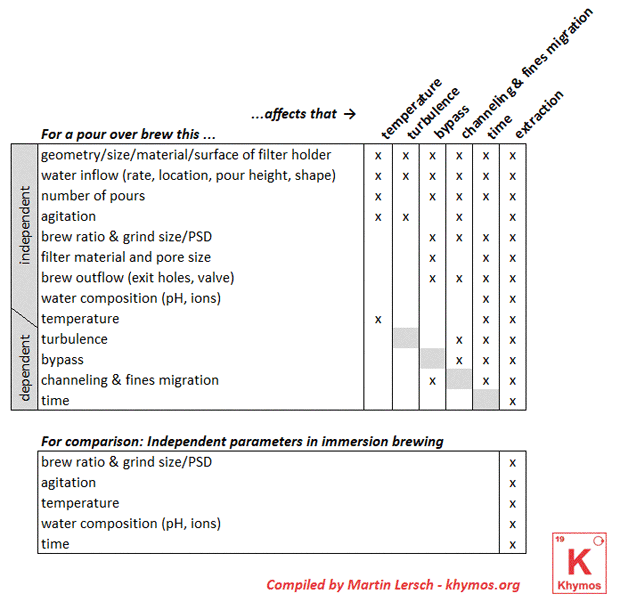
Primary independent parameters, which can be directly manipulated by the brewer, include brew ratio, particle size distribution (PSD), water chemistry, water temperature, and filter material. However, these variables trigger a cascade of dependent outcomes. For instance, particle size distribution directly dictates the total surface area available for extraction. Finer grinds increase surface area but simultaneously reduce flow rate, extending contact time and elevating extraction yields.
This dynamic introduces a persistent operational challenge: channel formation. Water, acting according to the path of least resistance, frequently bypasses dense clusters of coffee grounds, seeking out wider channels through the filter paper or along the walls of the dripper. When water circumvents the coffee bed entirely, it fails to participate in the extraction process, acting merely as a diluent that compromises the final brew. This phenomenon is exacerbated by fine grinds and filter geometries that minimize direct contact between the paper and the container walls, accelerating fluid velocity through peripheral pathways.
Historical Evolution of Coffee Equipment
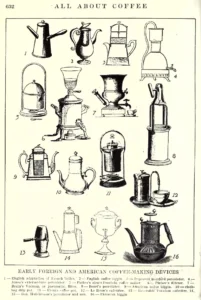
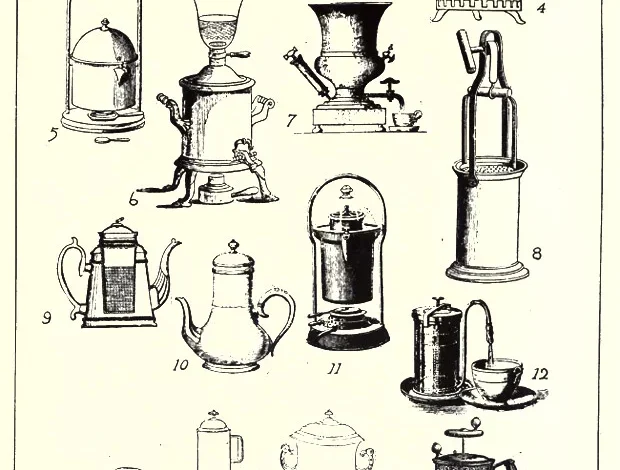
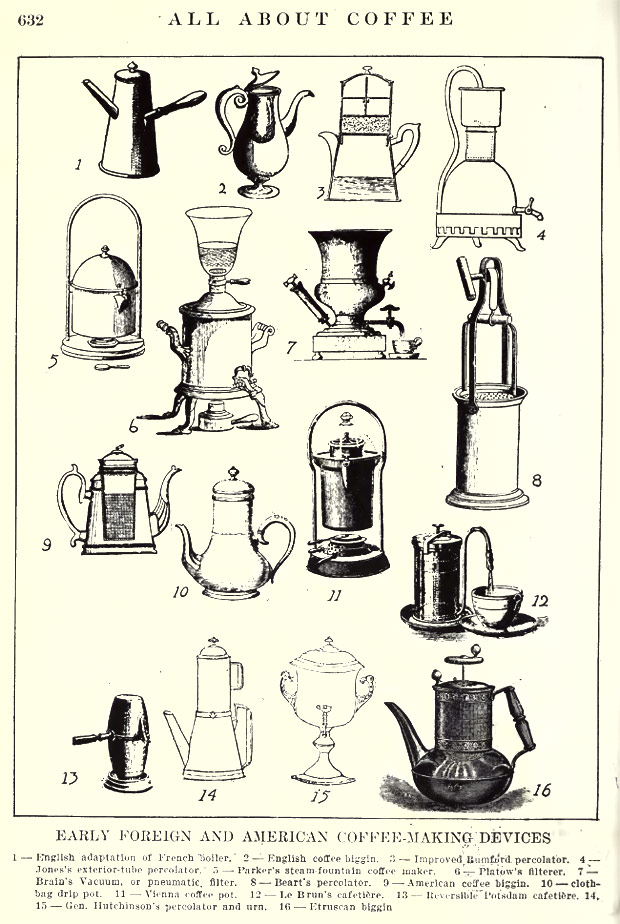
The complexity of controlling these variables has inspired more than a century of industrial design and mechanical innovation. Archival records, including illustrations from William H. Ukers’ landmark 1922 publication "All about Coffee," demonstrate that inventors have spent generations attempting to optimize the physics of extraction.
Modern manufacturers continue this tradition, engineering specialized drippers to address specific thermodynamic and fluid-dynamic bottlenecks. A comprehensive assessment of contemporary pour-over and immersion devices reveals how design variations seek to master the interplay of five core elements: material and thermal mass, internal geometry, surface wall texture, filter typology, and flow control valves.
Material Selection and Thermal Dynamics
Thermal retention is paramount during extraction, as water temperature directly influences solubility rates. High-conductivity metals, while durable, rapidly drain heat from the brewing slurry unless paired with vacuum insulation, as seen in devices like the Stagg X/XF. Conversely, glass offers poor thermal mass and high fragility under daily handling. Consequently, industry professionals and home brewers frequently favor polypropylene plastics or ceramics, which strike an optimal balance between structural sturdiness, cost-efficiency, and minimal thermal loss.
Geometry and Bed Morphology
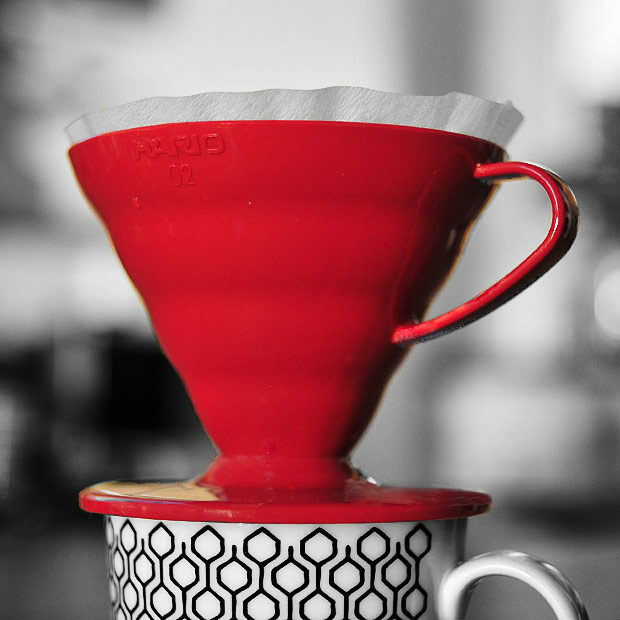
The shape of the filter holder dictates the morphology of the coffee bed. Traditional trapezoidal Melitta-style holders contrast sharply with cone-shaped drippers like the Hario V60 and flat-bottom designs like the Kalita Wave. Cylindrical, high-aspect-ratio beds promote prolonged contact between water and grounds but restrict flow rates, whereas flat-bottom beds encourage rapid, even draw-downs while remaining susceptible to edge channeling.
Wall Textures and Bypass Mitigation
Smooth-walled drippers, such as the Chemex, force wet filter paper to cling directly to the interior surface, effectively eliminating peripheral fluid bypass by blocking flow along the sides. While this increases extraction efficiency, it demands precise pouring techniques to prevent stalling. To counter this, most modern drippers incorporate internal ridges, ribs, or patterned fluting, which maintain channels for air and liquid to escape, albeit at the cost of introducing uncontrolled water bypass.
Valves and Outflow Control
Advanced drippers have increasingly integrated mechanical shut-off valves—exemplified by devices like the Clever Dripper and the Hario Switch. These mechanisms allow brewers to isolate the initial stage of extraction into a dedicated immersion phase before opening the valve for a final percolation draw-down. This hybrid approach decouples contact time from grind size, offering unprecedented control over total dissolved solids (TDS) and extraction yield (EY) without requiring constant recipe readjustments.
Comparative Equipment Landscape
To contextualize the vast array of equipment available to the modern consumer, brewers can be categorized by their mechanical attributes. The following data highlights representative devices across the global market:
| FILTER HOLDER | MATERIAL | INSULATION | SHAPE | STRUCTURE | FILTER | BOTTOM TYPE | BYPASS | INFLOW CONTROL | OUTFLOW CONTROL |
|---|---|---|---|---|---|---|---|---|---|
| Aeropress | Plastic | Material | Straight | None | Plain | Perforated (97 holes) | No | No | Pressure |
| April Pour Over | Ceramic | Material | Tapered | Ridge | Folded | Flat/Open | Yes | No | None |
| Chemex | Glass | Material | Tapered | None | Plain | Cone | No | No | None |
| Clever Dripper | Plastic | Material | Tapered | Ridge | Plain | Trapezoid (1 hole) | Yes | No | Stop Valve |
| Hario V60 (Plastic/Ceramic) | Plastic/Ceramic | Material | Tapered | Ridge | Plain | Cone | Yes | No | None |
| Kalita Wave | Metal/Glass/Ceramic | Material | Tapered | None | Folded | Flat (3 holes) | Yes | No | None |
| Stagg X/XF | Metal | Vacuum | Tapered | None | Folded | Flat (10 holes) | Yes | No | None |
| Tricolate | Plastic | Material | Straight | None | Plain | Perforated (51 holes) | No | Yes | None |
Immersion Brewing: The Pursuit of Repeatability
While percolation offers high ceiling potential for flavor customization, its complexity introduces significant vulnerability to user error and random variation. This limitation drives many practitioners toward immersion brewing techniques, such as the French Press or the standard Aeropress method.
In immersion systems, coffee grounds are fully steeped in a fixed volume of water for a predetermined duration before separation via physical filtration. From a chemical perspective, immersion is a robust, equilibrium-driven process. As extraction time increases, both TDS and extraction yield rise asymptotically before stabilizing as chemical equilibrium is approached. Because water temperatures naturally decline below 90 degrees Celsius during the steeping phase, immersion inherently limits the extraction of harsh, over-extracted compounds.
Furthermore, immersion brewing divorces extraction time from particle size distribution. The French Press, characterized by its coarse wire-mesh metal filter, permits micro-fine coffee particles ("fines") to pass into the final beverage. These suspended solids enhance body and tactile mouthfeel, though they can leave a lingering sediment and introduce bitterness if allowed to steep indefinitely. Pairing immersion brewers with paper micro-filters strips away these suspended solids and aromatic oils, yielding a cleaner cup profile at the expense of traditional body.
Implications for the Coffee Industry
The ongoing technical debate between percolation and immersion underscores a broader reality within the specialty coffee sector: precision demands standardization. As specialty coffee continues to grow into a multi-billion-dollar global industry, equipment manufacturers face increasing pressure to eliminate variables that lead to preparation myths and inconsistent consumer experiences.
Recent analyses by coffee scientists and fluid dynamicists—such as Jonathan Gagné’s research on optimal percolation—emphasize that future equipment design must prioritize the minimization of uncontrolled fluid bypass and the standardization of thermal stability. Whether through advanced valve-controlled drippers, precision-engineered water distributors like the Melodrip, or high-extraction cylindrical geometries like the Tricolate, the industry’s trajectory points toward eliminating guesswork.
Ultimately, while the quest for the ultimate cup of coffee involves navigating a labyrinth of thermodynamics, fluid mechanics, and organic chemistry, the underlying goal remains singular. By understanding the intricate mechanisms governing extraction, both commercial baristas and home enthusiasts can better decode the variables transforming raw seeds into a sophisticated sensory experience.