The Birth of a Waffle Revolution: How Amedeo Avogadro Inspired a Parametric Recipe Generator on His 250th Anniversary

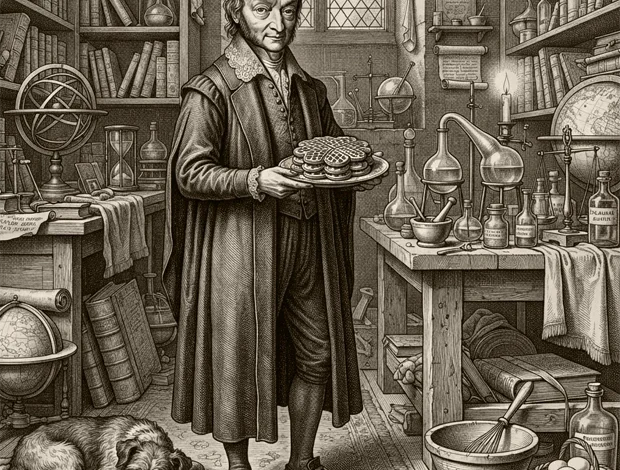
On August 9, 2026, culinary science and chemical history converged in an unexpected digital creation: the launch of Avogadro, a parametric waffle recipe generator that bridges the gap between historical gastronomy and mathematical modeling. Unveiled to mark the 250th birth anniversary of the Italian physicist and chemist Amedeo Avogadro, the application allows users to dynamically generate custom waffle batters using a sophisticated system of sliders and ingredient selections rather than relying on a static recipe database.
The tool, hosted at avogadro.khymos.org, represents the culmination of a conceptual project that began more than a decade ago. By moving away from traditional cookbook formats, the platform challenges contemporary notions of culinary formulation, asking a fundamental question of baking science: what precisely transforms a mixture of ingredients into a viable waffle batter, and at what point does it cease to function as one?
The Genesis and Evolution of a 12-Year Project
The conceptual foundation of the Avogadro generator was laid in 2014, when the initial idea was conceived alongside rough interface mockups and a rudimentary spreadsheet model. For years, the project remained dormant, existing only as a theoretical framework for understanding the underlying ratios of baking. However, the approach of Avogadro’s sestercentennial provided the ideal catalyst to bring the application to life.
The software’s release on August 9, 2026, coincides precisely with the 250th anniversary of Amedeo Avogadro’s birth in Turin, Italy, in 1776. Avogadro is globally renowned for his eponymous hypothesis formulated in 1811, which posited that equal volumes of all gases, at the same temperature and pressure, contain the same number of molecules. This foundational concept paved the way for the introduction of the mole as a standard unit in chemistry, defining the number of constituent particles—atoms or molecules—in a substance.
By naming the waffle generator after the historical scientist, the creator draws a deliberate parallel between the molecular quantification of chemistry and the precise measurement of culinary components.
How the Avogadro Waffle Generator Operates
Unlike traditional recipe websites or digital databases that store pre-written culinary instructions, Avogadro operates entirely on-the-fly. Users select core ingredient categories—spanning liquids, dairy, fats, eggs, starches, and sweeteners—and adjust a series of interactive sliders that modulate physical and sensory properties such as sweetness, richness, and tanginess.
Once parameters are adjusted, the application computes a precise batter formulation in grams, dynamically scaled to the number of eggs designated by the user. A central feature of the user interface is the "waffle heart quality indicator," a real-time diagnostic graphic that serves two distinct functions. First, it evaluates the structural viability of the batter, indicating whether the combination will successfully bake into a waffle. Second, it assesses how typical the formulation is when compared against a corpus of approximately 1,000 authentic Norwegian and Scandinavian waffle recipes collected over years of culinary research.
Interestingly, the system demonstrates that deviation from traditional norms does not necessarily equate to culinary failure. The developer notes that several highly successful commercial waffle mixes sit surprisingly far outside the standard clusters of traditional recipes, proving that innovation often occurs on the fringes of convention.
Standard Versus Expert Modes for Culinary Exploration
To accommodate varying levels of user expertise, the platform is divided into two distinct environments: Standard Mode and Expert Mode.
Standard Mode is designed for casual users or those seeking guaranteed results with minimal friction. It features a curated, shorter ingredient list and a restricted set of control sliders, ensuring that any combination built within this mode remains structurally sound and palatable.
Expert Mode, conversely, removes these guardrails to offer uninhibited access to the full inventory of ingredients, all eight control sliders, and a broader array of presets. This mode is tailored for culinary experimenters, food scientists, and adventurous home cooks willing to push the boundaries of traditional baking. By utilizing Expert Mode, users can explore uncharted culinary territory, generating batter combinations that have likely never appeared in any published cookbook.
The Mathematics of Waffles: Exploring 10²⁷ Theoretical Recipes
The scale of the Avogadro generator is vast, driven by the sheer number of possible permutations between ingredient selections and slider positions. Calculations indicate that the application spans approximately $10^27$ distinct control settings. To put this figure into perspective, it represents one octillion—or one billion billion billion—theoretical recipes.
This colossal number invites a direct comparison to Avogadro’s number itself, which defines the number of particles in a mole ($6.022 times 10^23$). The generator’s total parameter space encompasses roughly 1,660 moles’ worth of theoretical waffle batters.
Despite the staggering magnitude of potential configurations, culinary researchers acknowledge important caveats regarding the practical application of the tool. While $10^27$ control settings exist within the software architecture, they do not all translate into meaningfully distinct recipes. System rounding, the automated pruning of trace ingredients, and physical baking constraints mean that many different settings ultimately resolve to identical batters. Furthermore, a significant portion of the theoretical parameter space yields non-viable mixtures, which are clearly flagged by the absence of lobes on the waffle heart quality indicator.
Nevertheless, the remaining pool of functional recipes is effectively infinite for human exploration, ensuring that users who spend time experimenting with the controls will frequently encounter entirely original formulations.
Bridging Tacit Knowledge and Modern Food Science
Historically, many traditional baking recipes—particularly older Scandinavian ones—relied heavily on unwritten culinary intuition. Instructions in historical texts frequently omitted exact measurements, opting instead for prescriptive phrases such as "add flour until the batter has the right consistency."

This reliance on tacit knowledge presented a significant hurdle when compiling the database of 1,000 traditional recipes that informed the Avogadro project. It raised fundamental questions regarding food science: Where is the definitive boundary of a waffle batter? What chemical and physical thresholds separate a functional batter from an unusable mixture?
By translating qualitative instructions like "the right consistency" into parametric data models, Avogadro acts as a bridge between historical baking traditions and modern computational food science. It attempts to reverse-engineer the unwritten expertise of past generations into a measurable, reproducible framework.
Developer Notes, Limitations, and Call for Community Feedback
Given that testing $10^27$ individual batters is a physical impossibility, the developer presents Avogadro not as an infallible culinary oracle, but as an educated, data-driven hypothesis regarding the chemistry of waffles.
Because the model relies on generalized algorithms to interpret complex ingredient interactions, it inevitably encounters edge cases. The creator has explicitly invited public participation and feedback, noting that identifying absurd outputs or model miscalculations holds immense value for future refinements. Users are encouraged to test the application, report anomalies, and share successful culinary discoveries. Furthermore, the platform supports direct URL sharing, allowing bakers to exchange specific recipe configurations and test them across different kitchens globally.
Implications for the Future of Computational Gastronomy
The launch of Avogadro on August 9, 2026, serves as a notable case study in the growing field of computational gastronomy. By applying mathematical modeling and algorithmic generation to everyday food items, projects like Avogadro demonstrate how digital tools can democratize recipe development and food science.
While the application began as a whimsical conceptual exercise inspired by a historical chemist and a 2014 spreadsheet mockup, its realization highlights a broader trend: the intersection of data science, culinary arts, and digital accessibility. As home cooks and professionals alike utilize the tool to engineer novel batters, the project offers a fresh perspective on how we understand, categorize, and innovate within the culinary arts.
For those seeking an intellectually engaging and delicious way to commemorate Amedeo Avogadro’s sestercentennial, the prescribed course of action is clear: navigate to the platform, design a personalized batter, and bake a waffle.