The Chemistry of Coffee Extraction: Deconstructing the Physics and Variables of Pour-Over and Immersion Brewing

The pursuit of the optimal cup of coffee has long bridged the gap between culinary art and rigorous physical chemistry. At its core, brewing coffee is a solid-liquid extraction process wherein water dissolves hundreds of distinct chemical compounds embedded within roasted and ground coffee beans. These compounds span an enormous concentration range—spanning nine orders of magnitude—each possessing its own unique solubility profile and extraction rate.
Rather than presenting an obstacle to consistency, this chemical diversity is the foundational mechanism that allows for creativity and variation in coffee preparation. If every compound extracted at the exact same rate, the resulting beverage would lack nuance, and roasting or brewing variations would yield identical results. True mastery of coffee extraction requires an understanding of how physical parameters, equipment design, and fluid dynamics interact to shape the final product in the cup.
The Chemistry of Extraction: Selective Versus Total Yield
Achieving a theoretically "complete" extraction requires maximizing both surface area and contact time. By grinding coffee to a microscopic powder and steeping it extensively—or by boiling the mixture entirely—an extraction yield approaching 30 percent can be attained. This method mirrors the preparation of traditional unfiltered Turkish coffee. While undeniably strong, such exhaustive extraction often incorporates undesirable, harsh-tasting compounds that lower overall cup quality.
Consequently, modern baristas and coffee scientists aim for a controlled, selective extraction. Paradoxically, while industry jargon frequently favors the term "even extraction," chemical analysis reveals that the most flavorful brews actually stem from a deliberately uneven extraction. Different flavor and aromatic compounds dissolve at staggered rates, creating a complex sensory profile.
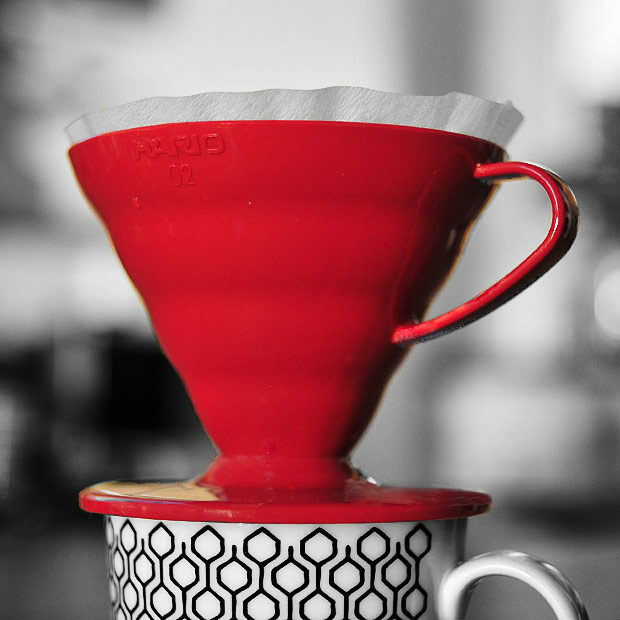
Percolation, commonly executed via pour-over techniques, remains the premier method for achieving this selective extraction. However, pour-over brewing introduces a dizzying array of interdependent variables that make absolute standardization difficult.
The Anatomy of Pour-Over Complexity
Pour-over brewing appears deceptively straightforward: hot water is poured over a bed of ground coffee, relying on gravity filtration to drip into a vessel below. In practice, however, the process is governed by a multitude of independent and dependent variables. Independent parameters—those directly controlled by the brewer—include brew ratio, water temperature, water composition, pour rate, agitation, and grind size. Dependent variables, which react dynamically to these inputs, include extraction time, total dissolved solids (TDS), extraction yield (EY), thermal loss, and flow resistance.
Grind size and particle size distribution (PSD) serve as primary drivers of these dependent variables. Finer coffee particles increase the total surface area available for water interaction, yet they simultaneously restrict flow rates and increase contact time. Furthermore, fine grinds heighten the risk of filter clogging and channel formation.
Water, governed by fundamental fluid dynamics, invariably follows the path of least resistance. When a fine grind creates high resistance in the upper coffee bed, pooled water frequently bypasses the grounds entirely by tracking down the sides of the filter holder. This phenomenon, known as bypass flow, dilutes the beverage and leaves portions of the coffee bed under-extracted.
Historical Evolution and Equipment Engineering
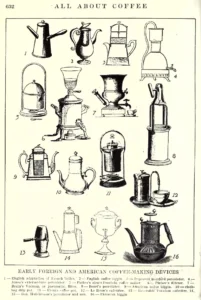
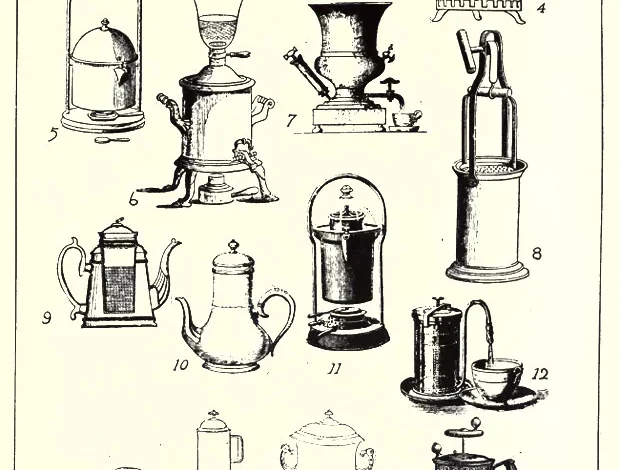
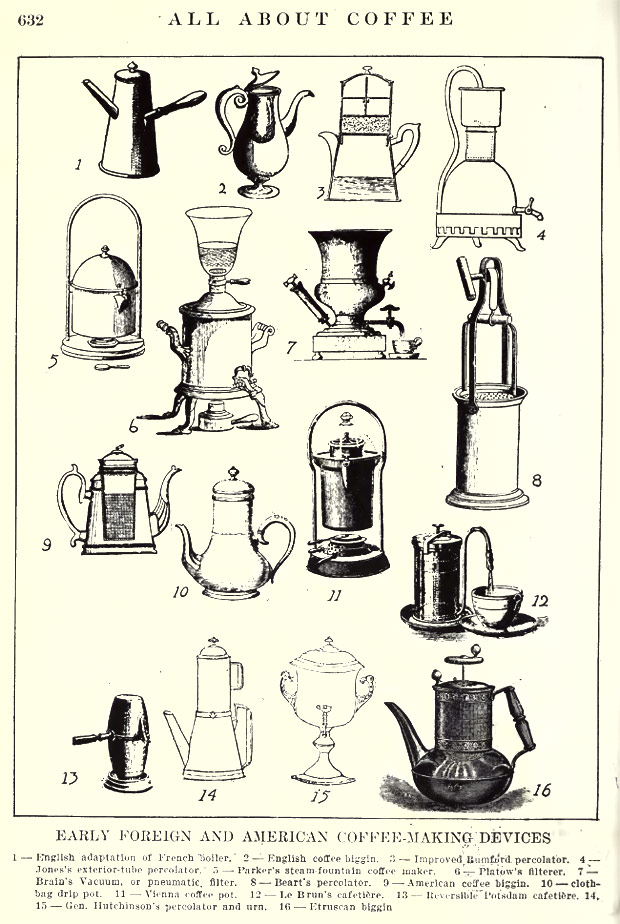
The complexity of drip and pour-over coffee has spurred centuries of industrial innovation. Historical texts, such as William H. Ukers’ comprehensive 1922 publication All About Coffee, illustrate that inventors have spent generations attempting to optimize extraction vessels. Modern equipment manufacturers continue this tradition, engineering specialized drippers to address specific thermodynamic and hydrodynamic challenges.
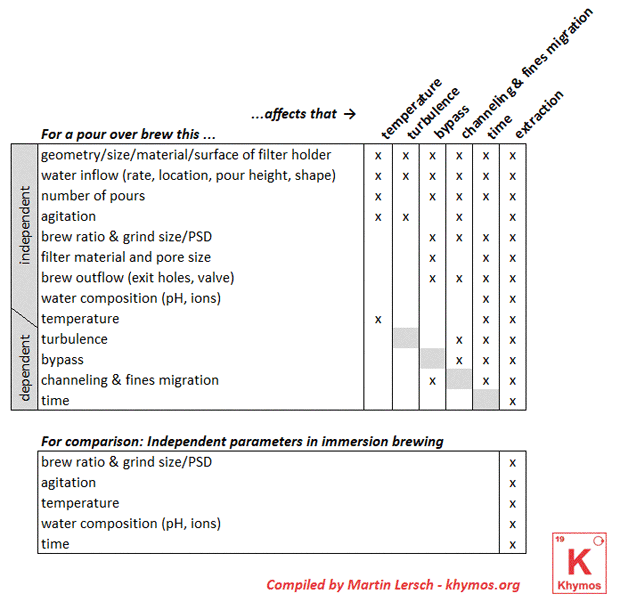
Material Selection and Thermal Mass
Maintaining an optimal water temperature throughout the extraction cycle is critical. Metal, while durable, acts as a high thermal conductor that rapidly drains heat from the brewing slurry unless paired with vacuum insulation, such as the Stagg X/XF dripper. Conversely, glass offers poor thermal properties and high fragility during handling. Consequently, professional preference frequently aligns with sturdy plastics—such as polypropylene—or ceramics, which balance cost, structural integrity, and minimal heat loss.
Geometry and Surface Engineering
Filter geometry dictates the shape of the coffee bed, which in turn influences fluid mechanics. Cone-shaped drippers, like the ubiquitous Hario V60, produce a deep, tapered bed that encourages prolonged water contact. Flat-bottomed alternatives, such as the Kalita Wave, utilize W-folded papers to create a shallower bed that mitigates channeling risks while promoting faster, more uniform drawdown times.
Inside wall construction plays an equally vital role. Smooth-walled vessels risk allowing wet filter paper to seal flat against the interior surface, halting filtration entirely—a design characteristic leveraged intentionally by the Chemex to eliminate side bypass. Most modern drippers counteract this by incorporating vertical ridges or structural patterns, which maintain interstitial channels for coffee to flow even when the paper clings to the wall.
Inflow and Outflow Control
Uncontrolled pouring can aggressively disturb the coffee bed, causing localized erosion and uneven extraction channels. The introduction of specialized gooseneck kettles allows precise control over pour height and flow rate. More advanced accessories, such as the Melodrip or Gabi Dripmaster, utilize multi-hole dispersion screens to gently rain water across the entire surface of the coffee bed, virtually eliminating physical agitation while ensuring a flat extraction plane.
Outflow control mechanisms have similarly evolved. While traditional drippers rely solely on the geometry of their exit holes and paper resistance, valve-equipped brewers—such as the Clever Dripper or Hario Switch—introduce an on-off valve. This innovation decouples extraction time from grind size by allowing an initial immersion phase followed by a controlled percolation draw-down.
Immersion Brewing: The Pursuit of Repeatability
While pour-over methods offer exceptional control, their complexity introduces random variations that can compromise consistency. For home brewers and commercial operations prioritizing repeatability, immersion brewing provides a robust alternative.
In immersion methods, such as the French Press or standard Aeropress techniques, coffee grounds are steeped directly in water for a fixed duration. Because extraction is bounded by equilibrium dynamics, TDS and extraction yield plateau naturally over time. Furthermore, as water temperatures slowly decline below 90 degrees Celsius during the steep, bitter, over-extracted compounds are naturally suppressed.
Despite its robustness, immersion brewing presents its own sensory trade-offs. Traditional wire-mesh filters used in French presses allow microscopic coffee fines and natural oils to pass into the final cup. While these suspended solids enhance body and mouthfeel, they leave a distinct sediment at the bottom of the vessel and can introduce minor bitterness due to extended particle extraction. Incorporating secondary paper filtration can clarify the cup profile, though it occasionally mutes delicate aromatic notes.
Industry Implications and Future Outlook
The exhaustive cataloging of coffee equipment—ranging from traditional porcelain cones to vacuum-insulated metal drippers—highlights an enduring industry truth: there is no single universal standard for coffee preparation. Each design represents an engineering compromise between extraction yield, flow rate, bypass control, and thermal retention.
For specialty coffee roasters, equipment manufacturers, and café operators, understanding these underlying thermodynamic and hydrodynamic principles is essential for troubleshooting recipes and educating consumers. As analytical tools and scientific research continue to deconstruct the physics of percolation and immersion, the gap between subjective coffee lore and objective brewing science continues to narrow, moving the global coffee community ever closer to absolute control over the extraction process.