The Microscopic Symphony: Unpacking the Complex Chemistry Behind a Perfect Cup of Coffee

Brewed coffee, a daily ritual for billions worldwide, is far more than just a hot beverage; it is an intricate chemical concoction, predominantly water, yet harboring a universe of dissolved solids that orchestrate its beloved aroma, taste, and texture. While visually simple, appearing as over 98.5% water, the remaining 1.2-1.5% of total dissolved solids (TDS) represents a remarkable concentration of extracted compounds. In practical terms, this means that a single liter of black coffee contains approximately 12 to 15 grams of complex solids, meticulously drawn from about 60 grams of ground coffee beans. This minuscule fraction is where the magic of coffee’s unparalleled sensory experience resides, a testament to the sophisticated interplay of hundreds, if not thousands, of unique molecules.
A Universe of Molecules: The Quest to Unravel Coffee’s Flavor Profile
The journey to understand coffee’s chemical complexity is a continually unfolding scientific endeavor, driven by both consumer demand for quality and scientific curiosity. For centuries, the appreciation of coffee was purely sensory, relying on the palate and nose. However, with the advent of advanced analytical chemistry techniques in the latter half of the 20th century, scientists began to systematically dismantle coffee’s molecular structure. Techniques such as gas chromatography-mass spectrometry (GC-MS), high-performance liquid chromatography (HPLC), and aroma extract dilution analysis (AEDA) became indispensable tools, capable of separating and identifying individual chemical components even at incredibly low concentrations.
Early research, while groundbreaking, highlighted the daunting scale of the challenge. A pivotal study in 1996, for instance, demonstrated that even with 22 key volatile compounds identified, researchers could only produce "model" coffees that were described as "clearly coffee-like" by assessors, but not perfect replicas of Arabica and Robusta varieties [2]. This suggested that a significant number of other compounds, perhaps in trace amounts, were crucial for the full, nuanced coffee aroma. Further underscoring this complexity, a 2002 AEDA study revealed that a substantial 13 out of the 40 most impactful odorants in coffee remained unidentified [1]. The difficulty in characterizing these elusive molecules stems from several factors: their presence in extremely low concentrations, making isolation for structural elucidation challenging; or their large molecular size, which complicates the analytical process. This ongoing frontier of discovery underscores that despite decades of research, the complete chemical blueprint of coffee remains partially uncharted.
The Dual Nature of Flavor: Volatile Aromatics and Non-Volatile Taste Compounds
The rich sensory profile of coffee is a symphony played by two main sections of its chemical orchestra: volatile and non-volatile compounds. Volatile compounds, characterized by their ability to vaporize easily, are responsible for coffee’s complex aroma, reaching the olfactory receptors in the nose. In contrast, non-volatile compounds primarily interact with taste receptors on the tongue, contributing to the fundamental tastes such as bitterness, sweetness, acidity, and astringency. Some molecules can influence both aroma and taste, though typically, a much higher concentration is required to elicit a taste sensation compared to an odor perception. Beyond taste, non-volatile components like oils and insoluble microparticles also contribute significantly to the "body" and "texture" of the beverage, influencing its mouthfeel and crema formation.
A closer examination of the soluble components extracted into a cup of coffee reveals several key groups:
- Carbohydrates: These include various sugars (e.g., sucrose, glucose, fructose) and soluble oligosaccharides. While much of the sugar content in green coffee is caramelized or degraded during roasting, residual sugars contribute subtle sweetness, while larger carbohydrate molecules enhance the body and viscosity of the brew.
- Acids: Coffee is rich in acids, which are crucial for its brightness, complexity, and overall taste balance. Chlorogenic acids are particularly abundant in green coffee, acting as powerful antioxidants and precursors to many flavor compounds formed during roasting. These also contribute to bitterness and astringency. Other organic acids such as quinic, citric, malic, and acetic acids provide fruity, sour, or sharp notes that define a coffee’s characteristic acidity profile [3].
- Minerals/Salts: Trace minerals and salts extracted from the bean, alongside those present in the brewing water itself, play a role in influencing taste perception and extraction efficiency. Water composition, particularly its mineral content, is a critical parameter influencing the final cup profile.
- Proteins: While most proteins are denatured during roasting, soluble protein fragments contribute to the body and potential foam stability (crema) in espresso.
- Lipids: Coffee oils, while not highly water-soluble, are partially extracted, particularly in brewing methods that do not use paper filters (e.g., French press, espresso). These lipids carry many hydrophobic aroma compounds, contributing to mouthfeel and flavor persistence.
- Caffeine: The most famous compound in coffee, caffeine, is a potent stimulant and also contributes a distinct bitter note to the beverage. Its concentration varies significantly depending on the coffee species (Robusta typically has more than Arabica) and brewing method.
- Volatile Aroma Compounds: This diverse group includes hundreds of molecules responsible for coffee’s characteristic scent. They belong to various chemical classes such as pyrazines (roasty, nutty), furans (caramel, bread-like), thiols (sulfury, meaty), aldehydes (green, fruity), and ketones (fruity, sweet). The precise blend and concentration of these compounds define the nuanced aroma profile of different coffees.
- Unidentified Compounds: A substantial portion of the extracted solids, particularly those contributing to color and bitterness, remain chemically uncharacterized, representing a continuing area of research.
The impact of these compounds is not merely proportional to their concentration. The human olfactory system possesses an extraordinary sensitivity to certain molecules, meaning a compound present at a miniscule 0.0000000001% (parts per trillion, ppt) can have as profound an impact on overall flavor as another compound present at 0.01%. This phenomenon is quantified by the Odor Activity Value (OAV), which relates a compound’s concentration to its individual odor threshold, highlighting that a small amount of a highly potent odorant can be far more significant than a large amount of a less potent one.

Beta-Damascenone: A Potent Player in the Coffee Orchestra
Among the myriad of volatile compounds, one stands out for its profound impact despite its incredibly low concentration: beta-damascenone. This remarkable molecule, often found in coffee at concentrations as low as 1 part per trillion (ppt), is recognized as one of the top five most impactful odorants in coffee [1]. Its sensory description is complex and highly desirable, encompassing notes of fruit (blackcurrant, apple), floral (rose), sweet, honey, and even hints of tobacco.
Beta-damascenone belongs to a class of compounds known as rose ketones, which were first identified in rose oil in the 1960s. Its name itself, damascenone, is derived from the Damask rose (Rosa × damascena), a flower renowned for its exquisite fragrance. The flavor and fragrance industry quickly recognized the potential of these compounds. Firmenich, a leading company in the sector, pioneered their use, with beta-damascenone and other rose ketones becoming integral to iconic perfumes such as Dior’s "Poison."
In coffee, beta-damascenone is not directly present in the green bean but is formed during the roasting process through the thermal degradation of carotenoids, which are pigments found in the coffee bean. This transformation during roasting exemplifies how the complex chemical reactions occurring at high temperatures are essential for developing coffee’s characteristic flavor. The challenge of accurately measuring and quantifying compounds like beta-damascenone at such minute concentrations highlights the sophistication required in modern analytical chemistry. The ongoing refinement of these techniques promises to uncover even more key odorants in the years to come, further enriching our understanding of coffee’s intricate flavor profile.
Extraction Dynamics: Polar, Non-Polar, and the Art of Brewing
The brewing process itself is a delicate act of selective extraction, primarily dictated by the solvent properties of water. Water, being a highly polar solvent, is exceptionally efficient at dissolving and extracting polar compounds from coffee grounds. This category includes acids, minerals, proteins, and carbohydrates, with typically more than 75% of these compounds being extracted during a standard brew [2]. This explains why these components largely define coffee’s taste profile, contributing to its sweetness, acidity, and fundamental bitterness.
However, water’s effectiveness diminishes when it comes to non-polar compounds, such as many volatile aroma molecules and lipids. These compounds, being hydrophobic, have low solubility in water, meaning only about 10-30% of them are typically extracted during the brewing process [2]. This differential extraction has profound implications for the final cup. Brewing methods that expose grounds to water for longer durations or at higher temperatures, or those that allow for greater retention of fine particles and oils (e.g., French press, espresso), tend to extract a higher proportion of these less soluble non-polar compounds, leading to a fuller body and a more intense aroma. Conversely, methods employing fine paper filters (e.g., pour-over) often result in a cleaner cup with a brighter acidity, as they selectively filter out insoluble particles and some oils.
The understanding of polar versus non-polar extraction opens avenues for future innovation. Researchers are exploring the use of alternative solvents, such as ethanol, which possesses different polarity characteristics, to potentially extract a broader or different spectrum of compounds from coffee. Such advancements could lead to novel coffee extracts with unique flavor profiles for the food and beverage industry or even entirely new types of coffee beverages, pushing the boundaries of what a "cup of coffee" can be.
Beyond TDS: The Limitations of Simple Metrics in Predicting Flavor
While Total Dissolved Solids (TDS) measurements provide a convenient and widely used metric for coffee strength, they offer an incomplete picture of a coffee’s actual flavor and aroma. TDS readings, typically measured with refractometers, primarily reflect the concentration of the most abundant soluble compounds in coffee. As evident from the vast concentration ranges of different compounds, only a handful of compound groups are present in sufficient quantities to significantly influence the overall TDS reading.
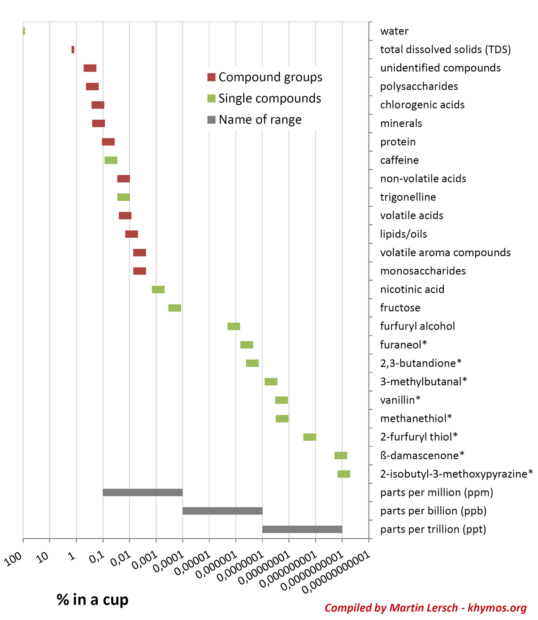
The critical limitation of TDS lies in its inability to correlate directly with perceived aroma and flavor. This is primarily due to the differential extraction rates of polar and non-polar compounds, coupled with the profound impact of highly potent, trace-level odorants. A compound present in parts per trillion, while having a negligible effect on TDS, can dramatically shape the overall sensory experience. Therefore, a high TDS might indicate a strong brew in terms of overall dissolved matter, but it provides little insight into the balance of acidity, sweetness, bitterness, or the intricate aromatic nuances that define a truly exceptional cup.
Consequently, despite technological advancements, the human nose and palate remain the most sophisticated and irreplaceable analytical detectors for evaluating coffee quality. Expert sensory panels, utilizing standardized cupping protocols, continue to be the gold standard for assessing coffee, recognizing the complex interplay of hundreds of compounds that transcend simple quantitative measurements.
The Future of Coffee Science: Innovation, Sustainability, and the Pursuit of Perfection
The ongoing scientific exploration into coffee’s chemical makeup holds significant implications for various facets of the coffee industry and consumer experience. For the specialty coffee sector, a deeper understanding of these compounds is crucial for enhancing quality control, refining roasting profiles, and optimizing brewing techniques to consistently achieve desired flavor outcomes. Organizations like the Specialty Coffee Association (SCA) and World Coffee Research (WCR) actively support such research, leveraging scientific insights to develop new coffee varietals with enhanced flavor profiles and greater resilience to environmental challenges, thus ensuring the future sustainability of coffee production.
Moreover, this knowledge fuels innovation. The flavor and fragrance industry continues to draw inspiration from coffee’s complex chemistry to create both natural and synthetic flavorings for a wide array of products. While the idea of "synthetic coffee" that perfectly replicates the natural brew remains a distant prospect, advancements in identifying and synthesizing key aroma compounds could lead to novel applications or even the creation of tailored coffee experiences.
Beyond flavor, future research continues to investigate the health implications of coffee consumption, focusing on antioxidants, polyphenols, and other bioactive compounds. The impact of climate change on coffee bean chemistry, and consequently on its flavor and nutritional profile, is another critical area of study. As scientists continue to uncover the mysteries hidden within the coffee bean, consumers and professionals alike stand to benefit from an ever-deeper appreciation and mastery of this universally cherished beverage, ensuring that the daily ritual of coffee remains a source of both delight and discovery.