How McDonald’s Franchises Used COVID-19 Relief Loans to Pay Rent to the Corporate Office

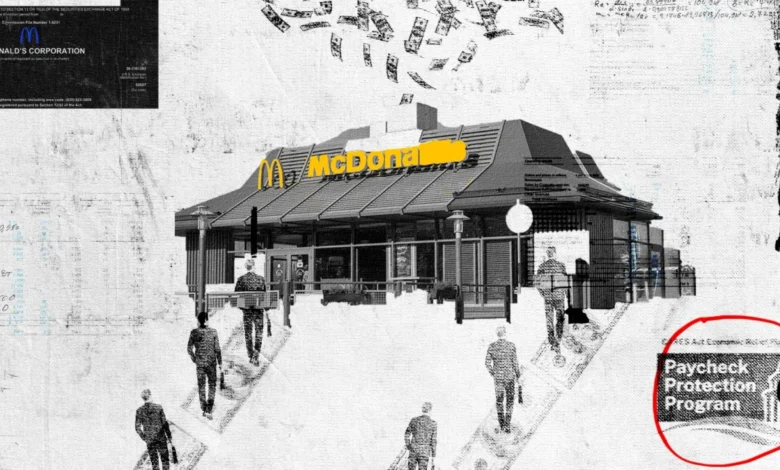
When the global coronavirus pandemic brought the hospitality industry to a screeching halt in the spring of 2020, American fast-food operators faced an unprecedented operational crisis. As dining rooms emptied and revenues plummeted overnight, franchise owners sought immediate lifelines to keep their businesses afloat. For the vast majority of McDonald’s operators in the United States, relief was urgently needed to cover fixed overhead costs, most notably real estate leases. However, an investigative analysis of federal loan data reveals an indirect flow of taxpayer-backed pandemic relief funds: millions of dollars from the federal Paycheck Protection Program (PPP) were explicitly allocated by franchisees to cover rent payments owed directly to the McDonald’s corporate headquarters.
This financial pipeline underscores a structural vulnerability within the federal government’s emergency economic stimulus packages. While the PPP was engineered to preserve employee payrolls during public health lockdowns, its structural design permitted funds to be funneled toward non-payroll obligations, including commercial rent and utilities. Consequently, rather than absorbing financial losses or extending direct operational relief to struggling store operators, the world’s largest fast-food corporation effectively utilized federal emergency funding as a conduit to safeguard its massive, real estate-driven revenue streams.
The Roots of the Crisis: A Real Estate Empire Under Pressure
To fully understand how federal relief dollars traveled from small-business bank accounts to a multinational corporation, one must examine the foundational business model of McDonald’s Corporation. Unlike many contemporary restaurant competitors that rely primarily on royalty fees generated from food sales, McDonald’s functions fundamentally as a commercial real estate holding company.
Established in the 1950s, the company’s hyper-growth strategy centered on purchasing or master-leasing the land and physical structures housing its franchise network. Under typical franchise agreements, independent operators pay the corporate parent a baseline monthly rent alongside additional percentage fees derived from gross sales. This dual-revenue architecture has historically insulated the parent company from market volatility. According to company financial disclosures, McDonald’s corporate entities collected approximately $7.5 billion in global rental payments in 2019 alone—surpassing total revenue generated from brand royalties and accounting for over a third of the corporation’s total system-wide revenues.
When the pandemic struck in March 2020, this immovable overhead cast an immediate shadow over independent franchisees. Recognizing the impending financial catastrophe, the National Franchisee Leadership Alliance—an advocacy group representing store owners—approached the corporate office with an urgent appeal for temporary rent relief. Specifically, operators requested a modest two-week rent forgiveness period to weather the initial lockdown phase.
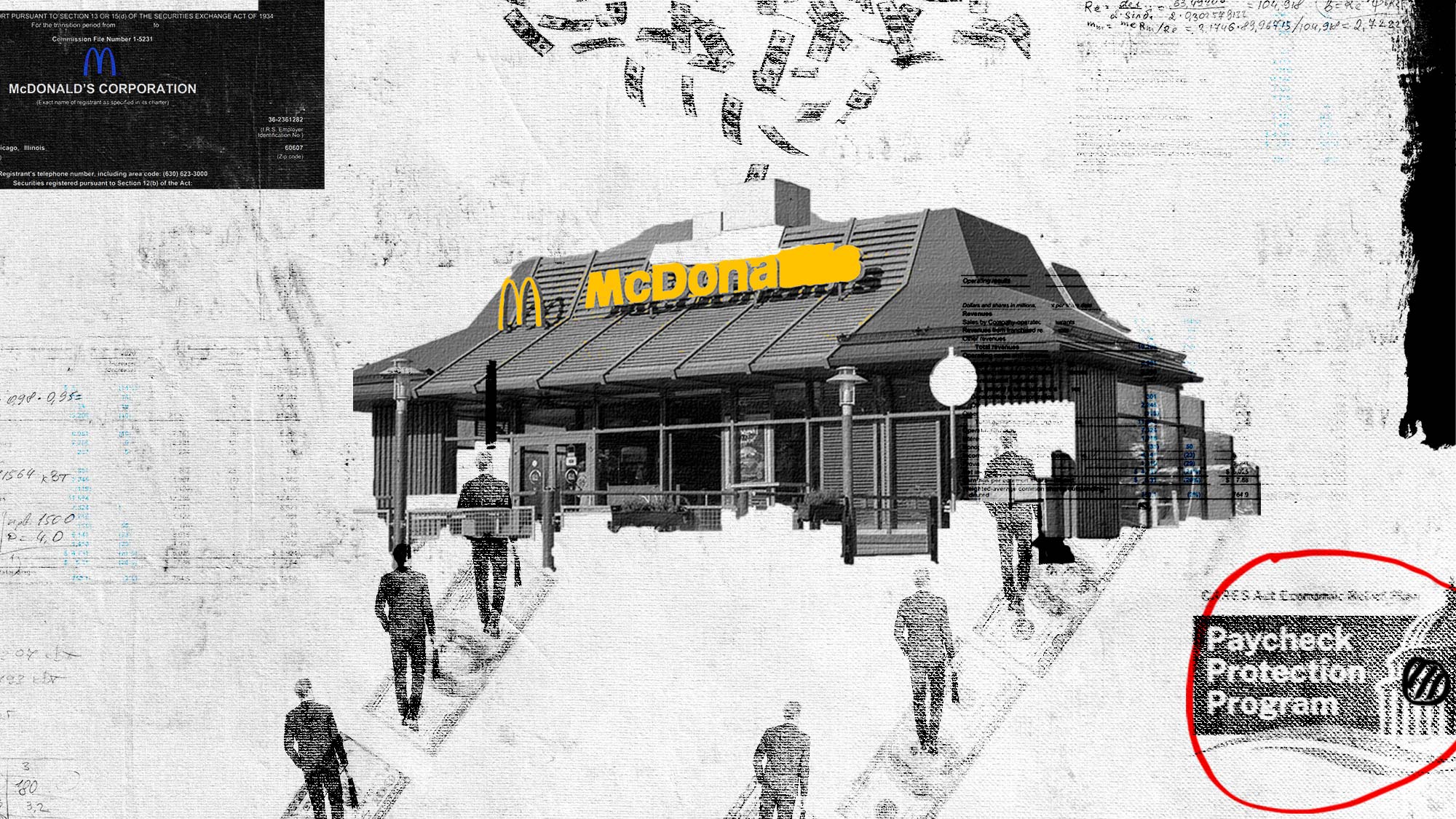
Corporate Rejection and the Pivot to Federal Loans
Despite collecting billions in annual lease payments and sitting on a real estate portfolio valued at tens of billions of dollars before depreciation, McDonald’s corporate leadership flatly rejected the franchisees’ request for rent forgiveness. While the company eventually agreed to defer the collection of roughly $490 million in rent and an equivalent amount in royalties—deferrals that were aggressively recouped by the end of 2020—operators were left scrambling for immediate liquidity during the critical spring months.
Faced with corporate inflexibility, franchise owners turned their attention toward Washington, D.C. In late March 2020, Congress passed the Coronavirus Aid, Relief, and Economic Security (CARES) Act, establishing the $789 billion Paycheck Protection Program administered by the Small Business Administration (SBA). Designed as an emergency lifeline for small businesses, the PPP offered low-interest, government-backed loans that could be fully forgiven if borrowers directed the lion’s share of the funds toward keeping workers on the payroll.
Franchise associations immediately mobilized to help their members navigate the application process. Blake Casper, then-chair of the National Owners Association, a separate group representing McDonald’s franchisees, noted in an April 2020 executive letter that leadership actively prepared members to be at the front of the queue. Operators recognized that the federal government was stepping in to provide the necessary liquidity that their franchisor had refused to supply.
Tracing the Flow of Taxpayer Dollars
An in-depth data analysis conducted by investigative news outlets reveals the sheer scale of federal participation by McDonald’s operators. Data released by the SBA indicates that 2,389 individual McDonald’s franchises secured approximately $1.3 billion in cumulative PPP loans. Among all corporate franchise systems nationwide, only General Motors automobile dealerships secured a higher total funding volume.
While the vast majority of borrowers submitted initial loan applications estimating that 100 percent of the funds would be dedicated to payroll—mirroring broader national compliance trends—a substantial subset of applications explicitly accounted for non-payroll fixed costs. An examination of loan documentation from 421 McDonald’s franchises identified over $31 million earmarked specifically for commercial rent.

Independent interviews with participating franchise owners corroborated these figures. Operators who spoke under conditions of anonymity, citing fear of corporate retaliation against their store licenses, acknowledged utilizing federal loan disbursements to fulfill monthly rental obligations owed directly to McDonald’s real estate subsidiaries.
Policy Shifts and the Lobbying Apparatus
The allocation of federal funds toward commercial rent was further enabled by legislative changes pushed through Congress during the summer of 2020. Initially, SBA guidelines mandated that at least 75 percent of PPP loan proceeds be spent on payroll costs to qualify for full forgiveness, capping non-payroll expenses at 25 percent.
However, intense lobbying efforts spearheaded by trade groups such as the International Franchise Association (IFA)—alongside various franchise advisory councils—pressured lawmakers to relax these restrictions. In June 2020, Congress passed the Paycheck Protection Program Flexibility Act, which altered the statutory spending threshold by lowering the mandatory payroll allocation to 60 percent and expanding non-payroll allowances to 40 percent. This statutory adjustment legally cleared the path for an even greater volume of federal relief funds to be redirected toward overhead expenses like rent, mortgages, and utility bills.
Matt Haller, a senior vice president at the IFA, defended the legislative push at the time, arguing that rigid initial regulatory constraints threatened to sink small businesses regardless of loan availability. Conversely, government watchdogs and public interest advocates have argued that loosening the restrictions fundamentally compromised the core mission of the stimulus program.
The Data Black Hole and Accountability Challenges
Assessing the ultimate destination of these federal funds remains an extraordinary challenge due to systemic transparency gaps within the SBA administration process. To rapidly deploy hundreds of billions of dollars across the American economy, the federal agency delegated the administrative processing of loan applications and forgiveness reviews to private commercial lenders, banks, and credit unions.

Consequently, the SBA does not centrally collect or maintain itemized category breakdowns of how individual PPP loans were ultimately spent or forgiven. When independent watchdogs and media organizations submitted Freedom of Information Act (FOIA) requests alongside targeted inquiries to dozens of private lenders who processed McDonald’s franchise loans, virtually no detailed spending records were provided.
Sean Moulton, a senior policy analyst at the Project on Government Oversight (POGO), described the lack of oversight as a regulatory black hole. Without access to itemized forgiveness audits, external evaluators cannot definitively determine whether taxpayer-backed emergency relief genuinely preserved vulnerable jobs or functioned primarily as an indirect subsidy for corporate landlords and utility providers.
The Broad Implications for Corporate Accountability
The episode highlights structural tensions inherent in the modern franchise business model during economic emergencies. While corporate representatives maintained that independent operators applied for and utilized the loans autonomously to protect nearly 800,000 restaurant workers nationwide, public interest organizations view the outcome as a systemic failure of policy design.
Lisa Gilbert, executive vice president of the public interest group Public Citizen, observed that while the PPP served an indispensable role in preventing total economic collapse, its administrative flaws generated troubling outcomes. When massive corporations insulate their core real estate assets and revenue streams during a national crisis, the burden of emergency financial stabilization is effectively shifted onto public debt markets and taxpayers.
For McDonald’s Corporation, the pandemic ultimately proved to be a temporary disruption rather than a structural threat. By the close of fiscal year 2021, corporate executives were celebrating a "banner year" of financial recovery. Driven by surging digital sales, strategic menu pricing, and the relentless collection of baseline lease revenues, McDonald’s reported global revenues exceeding $23.2 billion—marking the highest annual total recorded by the multinational giant since 2016.
As lawmakers and economists continue to review the efficacy of pandemic-era fiscal interventions, the intersection of federal relief spending and corporate real estate portfolios remains a critical case study in how emergency economic policy can inadvertently reinforce corporate wealth accumulation under the guise of small-business rescue.
Related posts: