
My Great Grandmothers Ham Croquettes

Great Grandmother’s Ham Croquettes: A Nostalgic Journey to Culinary Heritage
The allure of ham croquettes lies not merely in their crispy exterior and creamy interior, but in the stories they tell. These humble, golden cylinders are more than just a dish; they are a tangible link to generations past, a culinary heirloom passed down through the meticulous hands and loving heart of my great grandmother. Her ham croquettes were a staple, a comfort food that graced holiday tables and weeknight suppers with equal aplomb. Understanding the precise alchemy of her recipe, the subtle nuances that distinguished her creations from all others, is to embark on a journey through culinary history, personal memory, and the enduring power of tradition. This article delves deep into the creation of these cherished croquettes, exploring the ingredients, techniques, and the intangible magic that made them so special.
At the core of any exceptional ham croquette is, predictably, the ham. My great grandmother’s preference was for a good quality, fully cooked ham, often a leftover from a festive occasion. The type of ham itself played a crucial role in the final flavor profile. A slightly salty, well-seasoned ham provided a depth of flavor that infused the entire mixture. She was not one for overly processed or bland hams; a ham with character was essential. The process began with finely mincing or grinding the cooked ham. This was not a coarse chop; rather, a very fine texture was achieved, ensuring that the ham was evenly distributed throughout the creamy béchamel base. This fine mince allowed the ham’s savory essence to meld seamlessly with the other ingredients, creating a harmonious bite. The quantity of ham was also significant. Too little, and the croquette would lack its signature porky punch. Too much, and the mixture could become overly dense or oily. My great grandmother’s intuitive understanding of ratios, honed over years of practice, ensured a perfect balance.
The foundation of the croquette’s creamy interior is a classic béchamel sauce. This French mother sauce, derived from a roux of butter and flour, enriched with milk, provides the luscious texture and binds the ingredients together. For my great grandmother’s ham croquettes, the roux was meticulously prepared. Unsalted butter was melted over medium-low heat, and then an equal amount of all-purpose flour was whisked in. The key here was to cook the roux until it achieved a pale blonde color, not a deep brown. This ensured that the flour’s raw taste was eliminated without imparting any toasted flavor that could clash with the delicate ham notes. The slow and steady whisking of milk into the roux was another critical step. Warm milk, gradually incorporated, prevented lumps and yielded a silken smooth sauce. The sauce was cooked until it thickened to a point where it would coat the back of a spoon beautifully, a consistency that was crucial for shaping the croquettes later. Seasoning the béchamel was an art in itself. Beyond salt, a generous pinch of freshly ground black pepper was indispensable. Some variations might call for a hint of nutmeg, which adds a subtle warmth and complexity, though my great grandmother’s specific recipe often omitted it, allowing the pure flavor of ham and béchamel to shine.
The incorporation of the finely minced ham into the béchamel was a pivotal moment in the croquette-making process. The ham was folded in gently, ensuring that it was fully integrated without overmixing. The mixture at this stage was warm and wonderfully aromatic. It was then spread out onto a shallow dish or baking sheet, typically lined with parchment paper, and allowed to cool completely. This cooling period was non-negotiable. It allowed the béchamel to set and firm up, making it possible to shape the croquettes without the mixture becoming too soft or unwieldy. Some recipes suggest chilling the mixture for several hours, or even overnight, to achieve optimal firmness. This thorough chilling transformed the soft, warm mixture into a pliable yet firm mass, ready for its transformation into golden cylinders.
Shaping the croquettes was a tactile experience, a direct connection to the culinary lineage. My great grandmother would often use two spoons, or her lightly floured hands, to form the mixture into uniform, torpedo-like shapes. Each croquette was approximately three to four inches long and about an inch in diameter. Uniformity was important, not just for aesthetics, but also for ensuring even cooking. The gentle handling of the mixture preserved its delicate texture. The process required a light touch, preventing the croquettes from becoming dense or compressed. This shaping phase was often accompanied by a sense of anticipation, as these humble beginnings would soon culminate in a deeply satisfying dish.
The breading process, a triple-threat of flour, egg, and breadcrumbs, is what provides the iconic crispiness of a perfectly executed ham croquette. Each shaped croquette was first dredged in all-purpose flour, ensuring a light, even coating that would help the egg adhere. The excess flour was gently shaken off. Next, the floured croquette was dipped into a beaten egg wash. The egg wash, often seasoned with a pinch of salt and pepper, acts as the adhesive for the breadcrumbs. Finally, the egg-washed croquette was rolled in fine, dry breadcrumbs. My great grandmother favored fine breadcrumbs over coarse ones for a smoother, more delicate crust. The breadcrumbs were pressed gently onto the croquette to ensure full coverage. Some families might opt for Panko breadcrumbs for an extra crispy texture, but the classic fine breadcrumb yielded a satisfying crunch that was characteristic of her cooking. This triple-coating ensured a robust barrier that would fry to a beautiful golden brown, protecting the creamy interior.
The cooking method for my great grandmother’s ham croquettes was invariably frying. Pan-frying in a generous amount of hot oil was the preferred technique. A neutral-flavored oil with a high smoke point, such as vegetable oil or canola oil, was essential. The oil was heated in a heavy-bottomed skillet to a temperature of approximately 350-375°F (175-190°C). Too low a temperature, and the croquettes would absorb excess oil, becoming greasy. Too high, and the exterior would burn before the interior was heated through. The croquettes were carefully placed into the hot oil, a few at a time, to avoid overcrowding the pan. Overcrowding would cause the oil temperature to drop, leading to uneven cooking and a greasy product. They were fried for a few minutes on each side, until they achieved a deep golden-brown hue and were heated through. The delicate dance of turning the croquettes to ensure even browning was a skill that was perfected with practice.
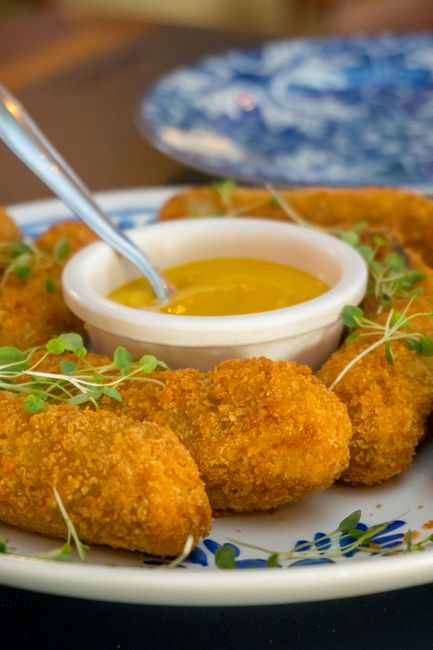
The final resting place for the freshly fried ham croquettes was a wire rack set over a baking sheet. This allowed any excess oil to drain away, preserving the crispiness of the crust. The aroma that wafted from the kitchen at this stage was intoxicating – a savory perfume of fried ham, creamy béchamel, and toasted breadcrumbs. These croquettes were best served hot, immediately after frying, when their exterior was at its crispiest and their interior was molten and yielding. They were often served as a main course, accompanied by a simple green salad or mashed potatoes. Alternatively, they made a delightful appetizer, served with a side of mustard or a tangy dipping sauce.
The longevity of the recipe and its impact speak volumes about its inherent quality and the love it was created with. My great grandmother’s ham croquettes were more than just sustenance; they were an experience, a taste of home, and a testament to the power of simple ingredients prepared with care and intention. While the exact measurements might have been etched more in her memory than on paper, the principles remain the same. The art of the béchamel, the meticulous preparation of the ham, the careful shaping, the precise breading, and the perfectly controlled frying – these are the cornerstones of this beloved dish. Recreating these croquettes is an act of culinary archaeology, a way to connect with a cherished past and to ensure that these delicious memories are not lost to time. The enduring popularity of ham croquettes, and specifically those inspired by my great grandmother’s recipe, lies in their comforting familiarity, their satisfying textures, and the undeniable warmth they evoke. They are a reminder that some of the most profound culinary joys can be found in the simplest of dishes, elevated by tradition and the love of a skilled home cook.


