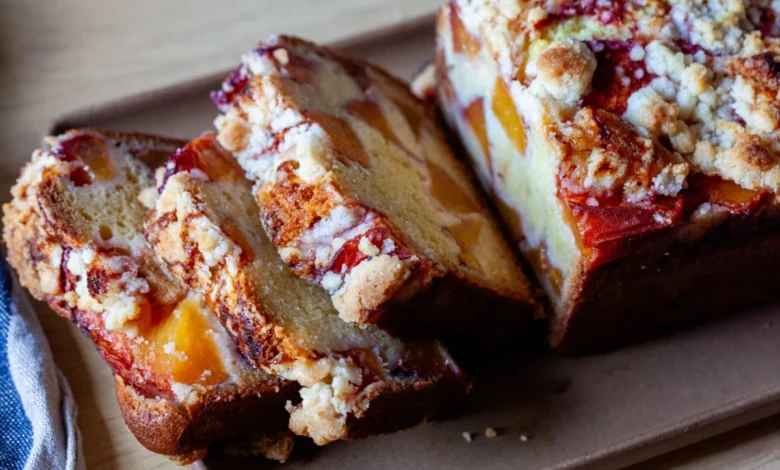
The journey of culinary perfection often demands patience, precision, and an unrelenting commitment to experimentation, a reality underscored by a six-year development cycle for a single baking recipe. In the food and hospitality sector, recipe development is rarely a linear or instantaneous process; it frequently involves years of trial, error, and meticulous documentation. The culmination of this multi-year effort has resulted in a finalized formula for a peach cobbler loaf, highlighting the rigorous testing required to balance structural integrity, moisture levels, and flavor distribution in seasonal fruit baking.

Chronology of Development and Experimental Phases
The formulation of the peach cobbler loaf began six summers prior to its publication, driven by the challenge of incorporating fresh stone fruit into a traditional cake structure without compromising texture or taste. Initial iterations faced significant technical hurdles common to fruit-based baked goods. Early trials utilizing finely diced peaches yielded bland flavor profiles, as the fruit pieces failed to impart sufficient essence into the surrounding crumb. Subsequent adjustments involving thinly sliced peaches resulted in the fruit disappearing entirely into the batter during the baking process.

Further complications arose when attempting to enhance the flavor through spices mixed directly into the batter. These variations resulted in an unappealing beige coloration without delivering the intended aromatic depth. Consequently, development was repeatedly paused at the end of stone fruit seasons, with notes cataloged for future analysis. The breakthrough came through a structural restructuring that prioritized layered assembly—alternating batter and peach wedges—alongside a designated streusel topping and precise pan-sizing parameters to manage moisture release.
Supporting Data and Technical Specifications

Baking seasonal stone fruits presents distinct culinary chemistry challenges due to the high water content of peaches. Ripe peaches release significant moisture during baking, which can lead to a soggy crumb if not properly accounted for. The finalized recipe dictates specific volumetric constraints, requiring a loaf pan with a six-cup (1420 ml) capacity, measuring eight by four inches at the base and nine by five inches at the top.
To mitigate structural failure and spillage caused by fruit expansion and bubbling juices, the protocol mandates baking the loaf on a lined sheet pan at 375°F (190°C) for 60 to 70 minutes. The inclusion of dairy—specifically yogurt or sour cream—provides the necessary acidity to activate the leavening agents while maintaining a tender crumb structure that supports the weight of the fruit layers. Additionally, the recipe incorporates a dual-sugar approach (granulated and brown sugar) and lemon zest to brighten the flavor profile of late-season fruit.

Industry Implications and Culinary Analysis
The prolonged development cycle of the peach cobbler loaf reflects broader trends in home baking and culinary journalism, where consumers increasingly demand reliability, precision, and depth in published recipes. Food science experts note that fruit cakes and quick breads require exact ratios of fat, flour, and liquid to prevent structural collapse, particularly when utilizing fresh, high-moisture ingredients.

Furthermore, the publication timing—arriving near the conclusion of the peak peach harvesting season—highlights the seasonal nature of agricultural integration in modern cooking. Culinary analysts suggest that detailed troubleshooting notes, such as specific pan dimensions and storage recommendations (storing unwrapped at room temperature to preserve the streusel crust texture), enhance the practical utility of recipes for home practitioners. The emphasis on aging the cake for 24 to 48 hours to improve flavor integration aligns with established pastry arts principles, reinforcing the value of methodical recipe testing over rapid, trend-driven content generation.