Conquering Wat Phu Tok: Thailand’s Architectural Wonder and Cliffside Buddhist Sanctuary in Bueng Kan Province

Nestled within the remote and tranquil expanse of Bueng Kan province in northeastern Thailand’s Isan region lies Wat Jetiyakhiri, more commonly known by its local designation, Wat Phu Tok. Translating literally to "lonely mountain" in the regional Isan dialect, this 359-meter-high solitary sandstone monolith rises abruptly from the surrounding flat terrain. Over the decades, the site has evolved from an isolated wildlife habitat into one of the Kingdom’s most visually striking and mechanically audacious architectural landmarks. Featuring a network of wooden staircases, suspended cliffside walkways, and sacred meditation halls engineered directly into sheer rock faces, the temple complex offers a unique synthesis of engineering, spirituality, and geological wonder that attracts travelers seeking off-the-beaten-path destinations far removed from the mass tourism hubs of central and southern Thailand.
Main Facts and Geographic Overview
Wat Phu Tok is situated approximately 30 minutes by road from the municipal center of Bueng Kan city. The complex is anchored at the base by a expansive monastic park, a serene lake, and visitor infrastructure designed to accommodate the steady influx of pilgrims, cultural tourists, and adventure seekers. The defining characteristic of the site is its vertical ascent, engineered to mirror the seven stages of Buddhist spiritual purification and mindfulness.

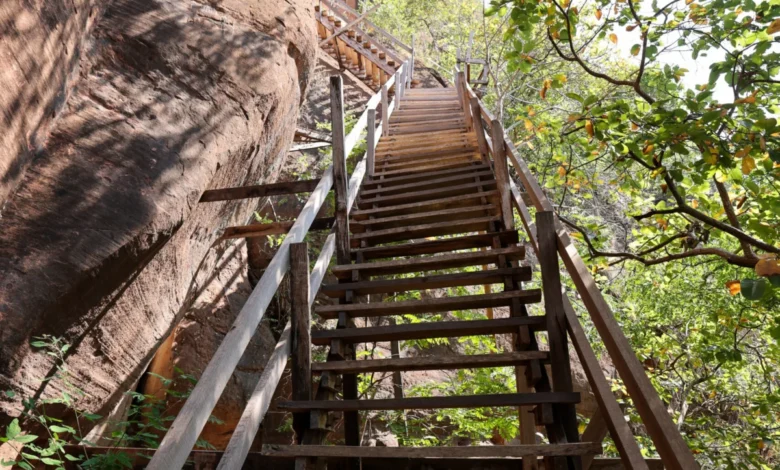
The structural centerpiece of the temple is its intricate system of wooden scaffolding, ladders, and plank pathways. These walkways are meticulously anchored into the vertical sandstone cliffs of the mountain. While the initial ascent begins via standard ground trails and increasingly steep wooden staircases, the upper tiers transition into suspended pathways that hug the perimeter of the precipice. The entire architectural layout serves a dual purpose: facilitating physical circumambulation for ascetic monks and providing a metaphorical ladder of liberation from earthly attachments for visiting practitioners.
Historical Chronology and Development

The modern history of Wat Phu Tok is inextricably linked to the legacy of the revered meditation master, Luang Pu Juan. Historically, the rugged terrain, dense surrounding flora, and remote geographical isolation of the Isan region made Phu Tok a dense sanctuary for indigenous wildlife, most notably including populations of venomous snakes. These very environmental hazards, combined with the profound solitude of the landscape, rendered the mountain an ideal site for Buddhist asceticism, known locally as Thudong practice.
In the decades following its establishment, Monk Luang Pu Juan spearheaded the monumental construction effort to render the mountain accessible for spiritual retreat. Laboring without modern heavy machinery, local artisans, devout followers, and monastic residents manually hauled timber and iron fixings up the vertical rock face to construct the initial staircases and ladders. Over time, this infrastructure expanded to encompass seven distinct levels, each corresponding to a specific tier of Buddhist meditative attainment.

Despite the tragic death of Luang Pu Juan in a subsequent aviation accident, his disciples and the regional monastic community have continuously maintained and restored the wooden architecture. Today, the structural integrity of the walkways is subjected to routine maintenance to ensure safety for the thousands of annual visitors who navigate the heights.
Architectural Breakdown: Navigating the Seven Levels

The ascent through the seven levels of Wat Phu Tok offers distinct structural features, varying degrees of physical challenge, and escalating vistas of the Mekong River basin and the verdant countryside of Bueng Kan.
Levels One through Four serve primarily as the transitional threshold of the journey. The trail begins at a formal entrance gate before deteriorating into increasingly vertical wooden stairs and ladders. While the wood may flex slightly underfoot, the structural foundation remains anchored securely into the bedrock. These initial tiers feature sparse monastic shrines nestled within the forest canopy, encouraging visitors to maintain their momentum upward.

Level Five represents a significant geographical and architectural shift. Unlike the narrow cliffside trails of the upper tiers, the fifth level broadens into extensive ground-level pathways. This plateau houses the primary ordination hall and a concentration of additional religious shrines. From this level, visitors can also access a prominent detour leading to an isolated rock temple situated on a separate shoulder of the mountain. This off-shoot path requires traversing an elevated stone walkway and a small wooden bridge, offering some of the most striking architectural framing of the entire complex.
Level Six is universally acknowledged by travelers and local guides as both the psychological climax and the most visually dramatic segment of Wat Phu Tok. Approximately half of the sixth level’s circumference consists of wooden plank walkways cantilevered directly over sheer drops, anchored horizontally into the vertical rock cliffs. Although structured with safety in mind, navigating this section requires absolute concentration due to the sheer exposure and the expansive panoramic views of the surrounding Mekong basin and lowland forest canopy.

Level Seven marks the summit of the mountain. Historically recognized as a habitat for venomous serpents, access to this final tier is undertaken at the visitor’s own risk. Unlike the engineered infrastructure of the lower levels, the seventh tier features no artificial walkways or shrines. It consists strictly of the natural apex of the sandstone formation, offering unobstructed panoramic views for those who complete the arduous climb.
Supporting Data and Tourism Implications

Tourism data regarding Bueng Kan province indicates a steady growth in eco-tourism and cultural heritage travel, propelled largely by attractions like Wat Phu Tok. Established officially as Thailand’s 77th province in 2011 after separating from Nong Khai, Bueng Kan has strategically positioned itself as a sanctuary for travelers seeking low-impact, nature-centric experiences.
Economic analysts note that while major tourist hubs such as Bangkok, Phuket, and Chiang Mai absorb the vast majority of international arrivals, emerging secondary destinations like Bueng Kan play a vital role in regional economic diversification. The influx of visitors to Wat Phu Tok supports local hospitality providers, transportation networks, and small-scale vendors in the surrounding district.

Safety Standards and Official Guidance
Given the vertical nature of the temple’s architecture, managing visitor safety remains a paramount concern for local administrative authorities and monastic caretakers. Tour operators and provincial officials consistently issue advisories regarding appropriate footwear, physical preparedness, and behavioral etiquette on the cliffside paths.

While structural engineers and maintenance crews conduct periodic safety checks on the wooden scaffolding and anchor bolts, visitors are explicitly cautioned to exercise individual responsibility, particularly on the sixth and seventh levels. The lack of standardized handrails on certain traditional ladder sections and the sheer drop-offs necessitate strict adherence to safety protocols, including refraining from distraction while in motion.
Broader Cultural and Religious Impact

Beyond its status as an adventure tourism hotspot, Wat Phu Tok remains an active place of Buddhist worship and spiritual pilgrimage. The integration of architecture into the natural topography reflects a profound traditional Thai Buddhist philosophy wherein nature and the built environment coexist harmoniously. The physical exertion required to navigate the seven levels mirrors the mental and emotional discipline demanded by Buddhist meditation practices.
As Isan continues to gain traction as a distinct cultural tourism destination, Wat Phu Tok stands as a testament to human ingenuity and spiritual devotion. By preserving the remote, meditative character of the site while accommodating an increasing volume of global travelers, regional authorities and monastic leaders ensure that the "lonely mountain" remains a cornerstone of Thailand’s diverse religious and architectural heritage.
Related posts: