Unveiling Melaka’s Culinary Heritage: The Enduring Legacy of Kedai Kopi Chung Wah and Hainanese Chicken Rice Balls

The historic coastal city of Melaka, Malaysia, has long stood as a vibrant crossroads of global trade and cultural exchange. Long before the era of modern mass tourism, this strategic port along the Strait of Malacca drew merchants, diplomats, and travelers from across Asia and Europe, dating back to the mid-15th century. Today, Melaka’s enduring global appeal is anchored not only by its UNESCO World Heritage architecture but also by its distinctive culinary landscape. Among the city’s myriad gastronomic offerings, one establishment consistently commands top tier recommendations from food historians and culinary tourists alike: Kedai Kopi Chung Wah, a family-owned institution renowned for perfecting a unique regional variation of a Southeast Asian staple—Hainanese chicken rice shaped into hand-packed rice balls.
Historical Genesis and Cultural Migration
While Hainanese chicken rice is fundamentally rooted in the culinary traditions of China’s southernmost island province of Hainan, its evolution in Southeast Asia represents a masterclass in cross-cultural adaptation. As waves of Chinese migrants moved southward during the 19th and early 20th centuries, they brought foundational recipes with them, adapting them to local ingredients, spices, and environmental demands.
In Melaka, the convergence of Chinese culinary techniques with Malay flavor profiles produced a distinct subset of regional gastronomy. The creation of chicken rice balls—a departure from the conventional presentation of loose grains served in a bowl—was originally born out of logistical practicality. Historically, Hainanese laborers and families fashioned the cooked rice into tightly packed spheres to keep it warm during long journeys, agricultural work, or trekking excursions into the hills. Over generations, this portable survival food evolved into a signature local delicacy, preserving a centuries-old culinary heritage within the modern Malaysian food scene.
Anatomy of the Dish: Preparation and Culinary Technique
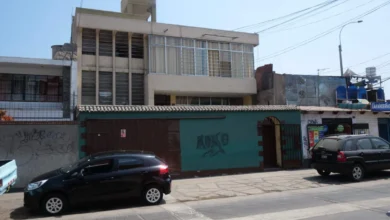
Operating daily from a prime corner location at the foot of Jonker Street—directly across the historic, flower-adorned bridge—Kedai Kopi Chung Wah executes a menu defined by minimalism, precision, and adherence to generational technique. Despite its deceptively simple menu, the preparation behind the scenes requires hours of labor-intensive work.
The dining experience relies on a straightforward ordering system tailored to high customer volume: patrons indicate the size of their dining party to determine the quantity of rice ball plates, followed by a selection of half or whole portions of poached chicken. The establishment opens promptly at 9:00 a.m., regularly drawing queues that stretch down the sidewalk before doors open.

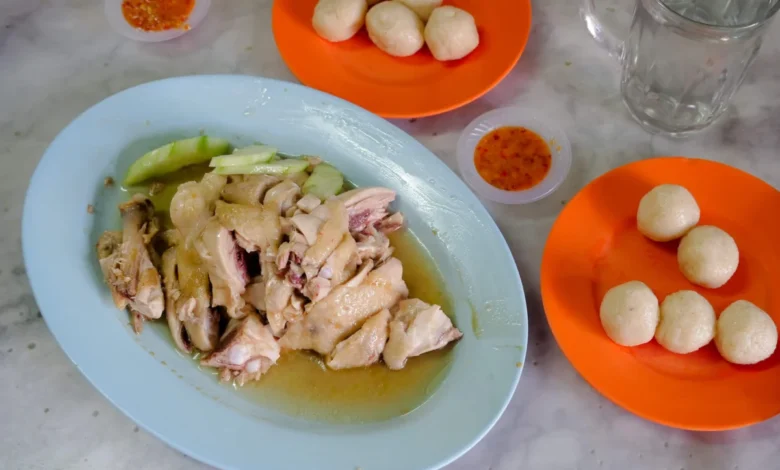
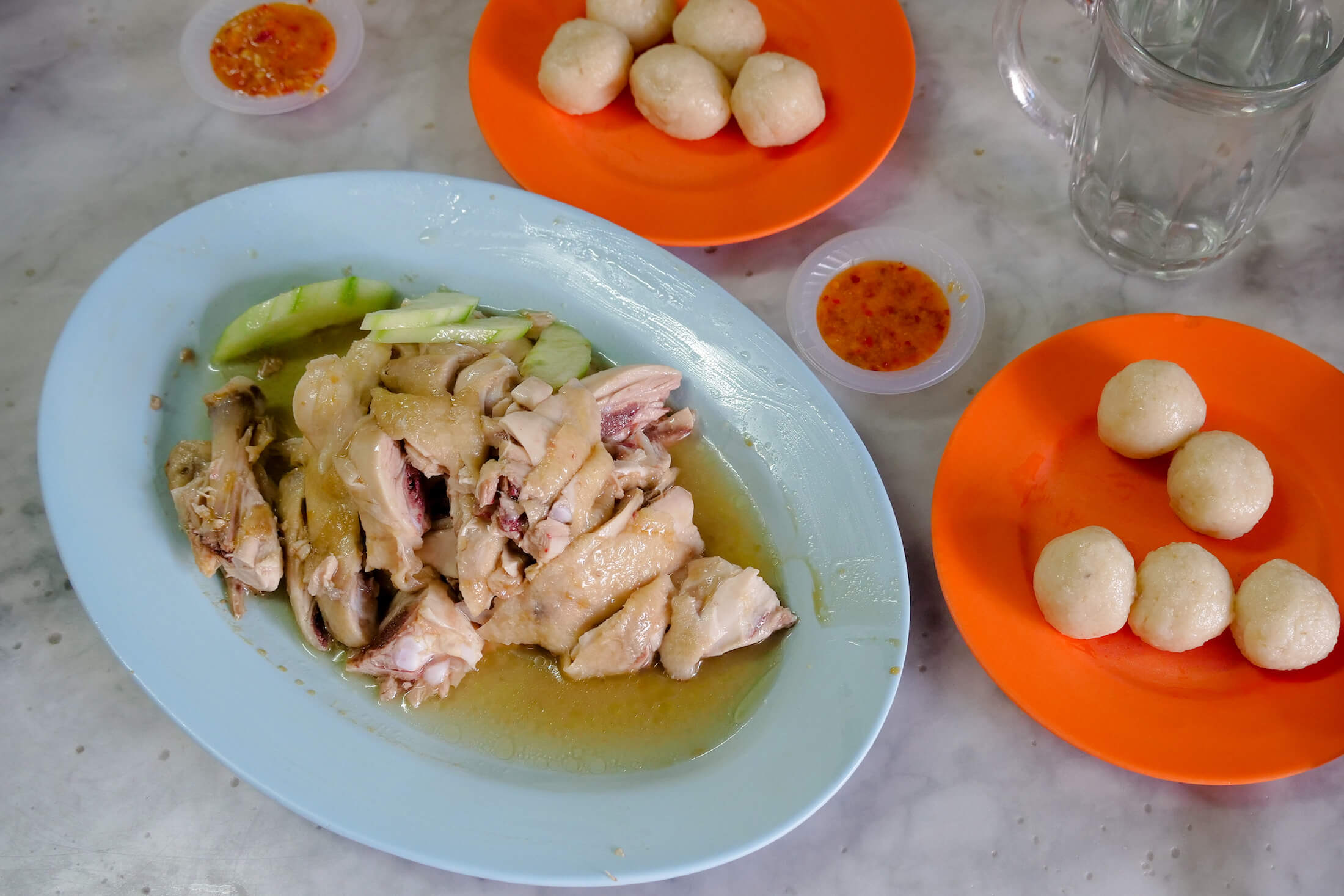
The culinary composition of the meal rests on three core elements: the chicken, the dipping sauce, and the rice balls.
The Chicken: Poached to a tender finish, the poultry is chopped rapidly by kitchen staff to keep pace with the morning rush. Served steaming hot, the meat is characterized by a delicate, gelatinous skin infused with subtle undertones of garlic and aromatics.
The Dipping Sauce: Culinary analysts frequently note that while the poached chicken provides a clean baseline, the accompanying sauce elevates the dish significantly. Comprising a vinegar base heavily infused with fresh garlic and local chili, the condiment delivers a sharp, tangy, and moderately spicy flavor profile that bridges Chinese poaching methods with Malay acidity and heat.

The Rice Balls: The undisputed draw for visitors is the rice itself. Formed by hand into firm, dense spheres, the rice exhibits a unique texture often compared to glutinous or sticky varieties, despite being standard white rice. Infused with rich poultry broths and subtle smoky undertones during the cooking process, the grains cohere tightly enough to roll across the traditional orange Melaka plates without falling apart. Food historians note that this texture mimics the prized, slightly scorched crust found at the bottom of traditional rice cookers—a textural element highly sought after by culinary enthusiasts.
Economic and Tourism Implications for Melaka
Kedai Kopi Chung Wah operates within a dense ecosystem of heritage food tourism in Melaka. The restaurant’s enduring popularity underscores the economic viability of traditional food preservation in urban historic districts. Culinary tourism experts point out that heritage eateries act as critical anchors for foot traffic, driving secondary spending across surrounding retail, hospitality, and cultural sectors in Jonker Walk.
However, the immense popularity of establishments like Kedai Kopi Chung Wah also presents logistical challenges for municipal planners and local business owners. High pedestrian volumes frequently lead to congestion along primary thoroughfares, while vehicular navigation and parking infrastructure in the historical core remain strained. Navigating the narrow, historic street layouts and ambiguous road markings requires patience from visitors arriving by automobile, prompting tourism authorities to continually evaluate traffic management strategies around the city’s primary culinary zones.

Broadening the Malaysian Culinary Horizon
For travelers and researchers examining Malaysia’s broader gastronomic footprint, Kedai Kopi Chung Wah serves as an entry point into a diverse national pantry. While the Chinese-influenced Hainanese chicken rice remains a cornerstone of Melaka’s identity, the surrounding region and the broader Malay Peninsula offer distinct culinary sub-cultures, including the complex herb-and-spice matrices of Peranakan and Nyonya cuisines.
Further north, states such as Kelantan and Terangganu present entirely distinct flavor profiles shaped by coastal geography and proximity to Thailand, featuring specialty items such as Tempoyak—a potent preparation of fermented durian that highlights the region’s penchant for bold, preserved flavor profiles.
Practical Visitor Information
For those planning a visit to Kedai Kopi Chung Wah:

- Location: Situated at the corner of Jonker Street, adjacent to the central pedestrian bridge in Melaka, Malaysia. Accessible via primary mapping services.
- Operating Hours: Open daily from 9:00 a.m. to 3:00 p.m. on weekdays, and extending until 4:00 p.m. on weekends, or until supplies sell out.
- Pricing: Reflecting its status as an accessible local staple, average meal costs remain modest, historically averaging approximately 28 Malaysian Ringgit (approx. $6.77 USD) for a standard party portion.
As urban centers across Southeast Asia modernize at a rapid pace, traditional family-run eateries like Kedai Kopi Chung Wah continue to provide tangible links to the region’s migratory and cultural history, proving that centuries-old culinary traditions remain powerful drivers of cultural appreciation and global tourism.