The Spectacular Rise and Fall of Monarch Tractor: A Case Study in AgTech Ambition and the Disconnect Between Silicon Valley and American Agriculture

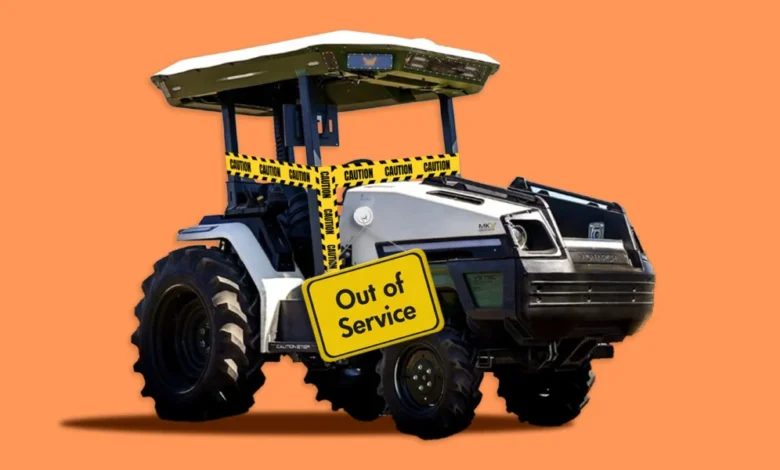
The promise was as grand as it was timely: a revolutionary, fully electric, autonomous smart tractor designed to transform modern farming while saving American producers hundreds of thousands of dollars in labor and fuel. Founded in 2018, Monarch Tractor arrived at a critical juncture for the agricultural industry, positioning itself as the "Tesla of the fields." Led by a trio of high-profile founders—Napa Valley winemaker Carlo Mondavi, former Tesla executive Mark Schwager, and robotics expert Praveen Penmetsa—the company sought to merge the heritage of viticulture with the cutting-edge innovation of Silicon Valley. However, despite raising more than $200 million in venture capital and achieving a valuation exceeding $500 million, the company’s trajectory shifted from a celebrated startup to a cautionary tale of technical failure and corporate dissolution. By April 2026, the company’s assets were acquired by the construction and mining equipment giant Caterpillar, marking the end of an era for what Forbes once called one of the world’s next billion-dollar startups.
The Vision: A Technological Salve for a Struggling Industry
Monarch Tractor’s flagship product, the MK-V, was designed to address a trifecta of modern farming challenges: labor shortages, rising operational costs, and the urgent need for environmental sustainability. Agriculture remains one of the most fossil-fuel-intensive industries on the planet, with diesel-powered machinery contributing significantly to global carbon emissions. Monarch’s solution was a zero-emissions, battery-electric tractor equipped with a 360-degree camera system and an AI-driven software suite.
The company’s value proposition was compelling. Monarch claimed that by eliminating diesel costs alone, operators could save an average of $18,000 per year. Furthermore, the tractor’s autonomous capabilities were marketed as a solution to the "overtime crisis" facing California farmers. Legislative changes, such as California’s Assembly Bill 1066, which phased in overtime pay for agricultural workers, significantly increased the cost of manual labor. Monarch’s AI was designed to navigate vine rows, mow, and collect data on crop health without a driver, theoretically allowing farmers to operate with thinner margins and higher efficiency.
Investors and major industry players were quick to buy into the vision. Funding rounds attracted $200 million from a diverse group of backers, including the Taiwanese manufacturing giant Foxconn. Industry heavyweights such as Jackson Family Wines, E. & J. Gallo Winery, and Constellation Brands participated in pilot programs. For a time, it appeared that the "green revolution" in agriculture had finally found its mechanical champion.
A Chronology of Decline: From Innovation to Litigation
The cracks in the Monarch narrative began to surface as the company transitioned from prototype demonstrations to mass production. While the initial feedback from early adopters like Wente Family Vineyards was positive—noting that the tractors helped optimize cluster counting and reduce fossil fuel usage—the move to scale production introduced significant quality control issues.
In 2024, Monarch entered a strategic partnership with Foxconn to manufacture the MK-V at a plant in Lordstown, Ohio. The shift was intended to utilize Foxconn’s world-class manufacturing capabilities, yet industry analysts noted that building sophisticated agricultural machinery is fundamentally different from assembling consumer electronics like iPhones. By late 2024, Monarch announced a 15 percent reduction in its workforce, a move that signaled underlying financial or operational strain despite a recent Series C funding round.
The situation deteriorated rapidly in 2025. In August of that year, Foxconn sold the Ohio plant where the tractors were being manufactured, leaving Monarch’s supply chain in a state of flux. By September, the first major legal challenge arrived: Burks Tractor, an Idaho-based equipment dealer, filed a lawsuit against Monarch. The dealership, which had purchased 10 tractors for approximately $773,000, alleged that the vehicles were "defective" and failed to operate autonomously as promised. According to the filing, Monarch acknowledged the functionality issues but refused to provide refunds or accept returns of the non-operational units.
By November 2025, the internal rift within the company’s leadership became public. Co-founder Carlo Mondavi exited the firm following a fundamental disagreement with CEO Praveen Penmetsa regarding how to address technical defects. Mondavi advocated for hardware changes to solve reliability issues he observed on his own farm, while Penmetsa reportedly insisted that the problems could be mitigated through software updates. Mondavi’s departure, alongside another co-founder, signaled a total breakdown in the company’s strategic direction.
The Technical Reality: Bricked Hardware and "Hazardous Waste"
The most damning evidence of Monarch’s failure came from the farmers who had integrated the technology into their daily operations. Unlike traditional mechanical tractors that can often be repaired in the field with basic tools, the Monarch MK-V was a "black box" of proprietary software and cloud-dependent systems.
When the company began to shutter in early 2026, the cloud-based infrastructure required to operate the tractors became a liability. Tom Gamble of Gamble Estates, who had purchased several units, reported that his five-figure investments essentially became "large piles of junk metal." Because the tractors were cloud-dependent, the cessation of company support meant the vehicles could no longer be started or operated. Gamble described a harrowing process of having to crawl under the machines to manually unlock the wheels just to tow them into storage sheds.
Social media platforms became a sounding board for frustrated owners. Reports emerged of batteries that would no longer hold a charge and autonomous systems that would unexpectedly veer off course, damaging expensive vines. The "right to repair" became a central theme of the backlash; because the tractors used specialized, encrypted software, local mechanics and farmers were unable to diagnose or fix even simple mechanical failures. Furthermore, the lack of a robust spare parts network meant that any physical breakage rendered the tractor permanently out of commission.
Analysis: The Silicon Valley vs. Agriculture Divide
The collapse of Monarch Tractor highlights a recurring theme in the "AgTech" sector: the mismatch between venture capital expectations and the realities of the farming lifecycle. Industry experts suggest that Monarch’s failure was rooted in a "Silicon Valley" approach to a "Rust Belt" industry.
Venture capital funding models typically demand rapid scaling and high-growth returns measured in fiscal quarters. In contrast, agriculture operates on seasonal cycles, weather windows, and decades-long equipment lifespans. Farmers do not view a tractor as a "device" to be upgraded every few years; they view it as a capital asset that must provide a return on investment (ROI) through rugged, unwavering reliability.
Patrick McIntosh, a farmer who worked with the technology, noted that if an autonomous tractor cannot prove its ROI under harsh field conditions, it remains a "showroom conversation" rather than a field tool. The reliance on a subscription model—often costing upwards of $10,000 annually on top of the $90,000 purchase price—also sat poorly with a demographic accustomed to owning their equipment outright.
Furthermore, the regulatory environment in California presented an unforeseen hurdle. The state’s "butt-in-seat" law (California Code of Regulations, Title 8, Section 3441) requires a human operator to be at the controls of any self-propelled equipment, effectively neutralizing the primary economic benefit of an autonomous tractor. While Monarch lobbied for changes to these safety regulations, the legal framework did not evolve fast enough to save the company’s business model.
The Legacy and Future of Agricultural Technology
Despite the dissolution of Monarch Tractor, the problems the company sought to solve remain more pressing than ever. The American agriculture industry is currently grappling with sky-high input costs and a diminishing pool of skilled labor. The failure of one high-profile startup does not negate the necessity of electrification and automation; rather, it provides a blueprint for what the next generation of AgTech must avoid.
The acquisition of Monarch’s assets by Caterpillar suggests that the technology itself has value, but perhaps only when backed by the infrastructure of a legacy manufacturer. Companies like John Deere, Kubota, and New Holland are also moving into the autonomous and electric space, but they are doing so with established service networks and decades of trust within the farming community.
Other players are already attempting to fill the void with more specialized, "nimble" solutions. In Europe, companies like Vitibot and Naïo Technologies are producing smaller, lighter autonomous robots designed for specific tasks like weeding and soil management. These machines are often less complex and less expensive than a full-sized tractor, making the barrier to entry lower for small-to-medium-sized farmers. Additionally, firms like Agtonomy are focusing on "retrofitting" existing mechanical tractors with AI software, allowing farmers to keep their trusted hardware while gaining the benefits of automation.
The story of Monarch Tractor serves as a stark reminder that in the world of agriculture, "moving fast and breaking things" is a dangerous philosophy. When a tractor breaks, it isn’t just a technical glitch; it is a threat to a harvest, a family’s livelihood, and the food supply chain. As the industry continues to move toward a more sustainable future, the lesson of Monarch will likely be that true innovation must be as rugged and reliable as the soil it intends to till.