Navigating the Labyrinth of French Fromage: A Comprehensive Guide to Over 1,000 Varieties of Dairy Excellence

Cheese has long occupied a foundational place in culinary traditions across the globe, but in few societies is it woven as deeply into the fabric of everyday life as it is in France. The European nation consistently ranks among the global frontrunners in per capita dairy consumption. According to recent market and agricultural data, the average French citizen consumes roughly 60.3 pounds (approximately 27.3 kilograms) of cheese annually. This staggering figure underscores a national gastronomy where cheese is not merely an accompaniment to a meal, but a revered cornerstone of the culinary arts, deeply tied to regional identity, agricultural heritage, and social ritual.
The Historical Weight of France’s Cheese Culture
To understand the scale of France’s devotion to cheese, one must look to both political lore and agricultural history. French folklore famously attributes a rhetorical lament to former French President and leader of the Free French Forces, Charles de Gaulle, who reportedly once boggled, “How do you govern a country that has 258 types of cheese?”
While that three-digit figure was enough to bewilder a historic statesman, modern gastronomic reality would likely send the late president into a complete tailspin. Today, France is officially recognized as home to more than 1,000 distinct varieties of cheese. This vast ecosystem of dairy production is protected by stringent regulations, such as the Appellation d’Origine Protégée (AOP) system, which ensures that traditional methods and specific regional terroirs are strictly preserved. From the windswept pastures of Normandy to the rugged peaks of the Alps and the sun-drenched hills of the Pyrenees, French cheese reflects the geography, climate, and micro-flora of its origin.
The Intimidation Factor of the Fromagerie
Despite—or perhaps because of—this extraordinary diversity, navigating the French section of a local cheese shop or a specialty monger’s market stand can be an intimidating undertaking for the uninitiated consumer.
At first glance, many artisanal cheeses appear virtually indistinguishable. For instance, a traditional Brie Fermier and a classic Camembert share a nearly identical visual presentation: a pristine, bloomy white rind encasing a pale, decadent interior. Yet, their flavor profiles, influenced by the specific milk used and the aging cellars in which they matured, can vary significantly. Similarly, distinguishing between a nutty Tomme Chebris and a rustic Tomme de Savoie requires an understanding of milk composition—whether it be mixed sheep and goat milk or raw cow’s milk from Alpine herds.
With such an expansive spectrum of regional specialties, the category offers a boundless array of textures and flavors. On one end of the sensory spectrum are soft, unctuous cheeses that release earthy, barnyard notes with every creamy bite. On the other end are dense, aged wheels that yield mild, milky, or intensely savory profiles in firm, crystalline slices.
Mapping the Landscape: 17 Essential Varieties
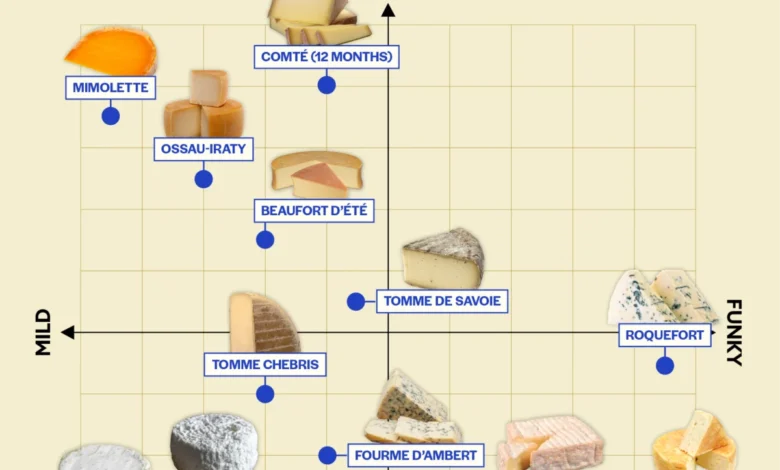
To help consumers distill the vast and complex world of French cheese into digestible knowledge, culinary experts and data analysts have mapped out 17 essential French cheese varieties onto a comprehensive flavor matrix.
This analytical approach sorts the diverse dairy products across two primary axes: the flavor spectrum, ranging from mild to funky, and the textural spectrum, ranging from soft to hard. By organizing cheeses in this manner, consumers can better understand where a particular wheel or wedge sits in relation to its peers. For instance, fresh, lactic goat cheeses occupy the mild and soft quadrants, while washed-rind stalwarts like Époisses or Munster command the heavily pungent and semi-soft territory. Hard mountain cheeses, such as Comté or Beaufort, anchor the firm and savory end of the map.
For anyone who has ever stood paralyzed before a sprawling holiday cheese board or a specialty market display, this structured methodology serves as an invaluable roadmap for identifying the ideal wheel to suit a specific palate or pairing occasion.
Economic and Cultural Implications
The vast ecosystem surrounding French cheese is not only a cultural treasure but also a massive economic driver. The dairy sector supports tens of thousands of agricultural jobs, ranging from small-scale family farms practicing transhumance—the seasonal movement of livestock—to large international exporters.
However, maintaining this tradition presents ongoing challenges. Artisanal producers frequently grapple with rising energy costs for refrigeration and aging, shifting consumer preferences among younger generations, and stringent regulatory compliance required to maintain AOP status. Furthermore, international trade dynamics, including tariffs and export regulations, continually influence how easily these perishable cultural artifacts can reach global markets.
As global interest in artisanal and terroir-driven foods continues to grow, initiatives that demystify traditional products like French cheese play a vital role in sustaining the industry. By providing consumers with the vocabulary and framework to appreciate the nuances between a delicate goat cheese and a robust alpine wheel, the culinary community ensures that the legacy of France’s 1,000-plus cheeses continues to thrive for generations to come.