The sharp pour, characterized by a meticulous two-step process and a distinct "golden ratio" of liquid to foam, represents a departure from both standard American "clean" pours and the foam-first philosophy of the Czech Republic. Although it has only recently begun to proliferate in American craft beer circles, the style has deep roots in Japanese brewing culture, dating back to the late 1990s. As taproom owners seek ways to differentiate their offerings in an increasingly competitive market, the sharp pour has emerged as a symbol of intentionality, hospitality, and technical precision.
The Mechanics of the Golden Ratio
At the heart of the sharp pour is a specific visual and textural objective: the "golden ratio" of 70 percent liquid beer to 30 percent foam. Unlike the Czech method, which often begins by dispensing a thick layer of wet foam into the bottom of the glass to create a creamy, low-carbonation drinking experience, the Japanese sharp pour prioritizes the preservation of effervescence and a crisp, "sharp" mouthfeel—hence the name.
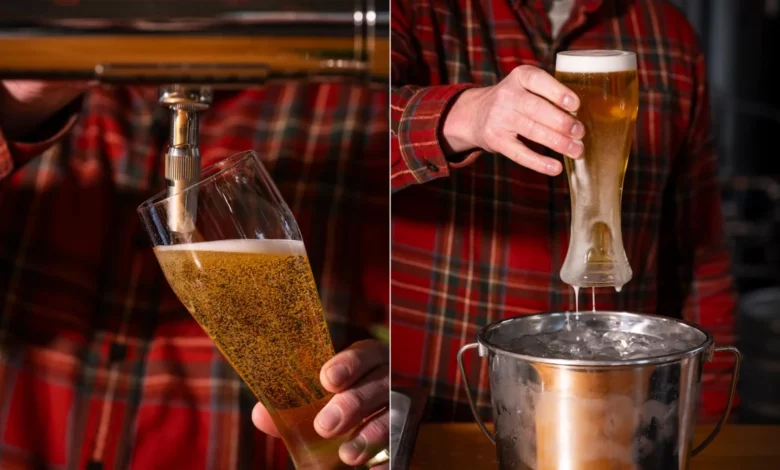
The process begins with the tapster pouring the beer directly into a chilled glass without creating foam. This initial stage is designed to retain as much carbon dioxide as possible within the liquid. Once the glass is nearly 70 percent full, the tapster "caps" the beer with a dense, fine-bubbled foam. To achieve the perfect aesthetic, the foam is allowed to overflow the rim of the glass. The tapster then uses a tool or a quick motion to scrape away the excess, leaving a perfectly flat, frothy head that sits flush with the top of the vessel.
This technique serves a dual purpose. First, the dense foam acts as a physical lid, trapping the beer’s natural carbonation and preventing the aromatic compounds from dissipating too quickly. Second, it ensures that the first sip is cold and crisp, emphasizing the "kire"—a Japanese term for a clean, sharp finish—that is highly prized in lager production.
A Chronology of the Sharp Pour’s Arrival in America
The rise of the sharp pour in the United States can be traced through a series of cultural exchanges and the influence of social media. While Japanese beer giants like Asahi have promoted specific pouring rituals for decades to highlight the "Super Dry" qualities of their flagship lagers, the technique remained largely a niche interest in the West until the last five years.
In the late 2010s, influential figures in the American beer scene began traveling to Japan, documenting their experiences at legendary establishments like Shimbashi Dry-Dock in Tokyo and Beer Stand Shigetomi in Hiroshima. These venues are renowned for their "tapsters"—specialized bartenders who treat the act of pouring as a high art form.
By 2021 and 2022, social media platforms like Instagram and YouTube became primary drivers for the trend. Zigmas Maloni, a curator and beertender at Chicago’s Beermiscuous, began sharing detailed videos of the sharp pour, catching the attention of brewers and enthusiasts nationwide. In Seattle, Colin Lenfesty of Holy Mountain Brewing Company was inspired by the "incredibly thoughtful ritual" he witnessed in Tokyo, leading him to implement similar standards at his own bar.
The trend reached a tipping point in 2024 and 2025 as breweries began naming beers after the technique. Chicago’s Hopewell Brewing Co. recently released a beer dedicated to the "move," while Argenta Brewing Company in Portland, Maine, has integrated the sharp pour into its core identity. Today, the method is no longer a curiosity but a benchmark for quality in taprooms that specialize in lager and sessionable styles.
Technical Requirements and Glassware Preparation
The sharp pour is not merely a matter of hand coordination; it requires specific equipment and rigorous temperature control. While many American breweries use Lukr side-pull taps—originally designed for Czech lagers—to execute the pour, the mechanics differ. A side-pull tap allows for precise control over the flow of both liquid and foam, but the sharp pour demands a different sequence than the traditional Czech hladinka.
Some specialized bars, such as Roaring Table Brewing Co. in Lake Zurich, Illinois, have gone a step further by installing two-spout faucets common in Japan. These systems feature a rear spout for dispensing liquid and a front spout specifically for creating the dense foam cap.

Temperature management is perhaps the most critical component of the ritual. At Argenta Brewing Company, owner Ryan Dunlap employs a method where tall glasses are inverted in sanitized hotel pans filled with ice water. This ensures the glassware is at the exact temperature of the beer. "You want the glassware to be the same temperature as the beer because you’re trying to reduce any carbon dioxide breakout or foam building in the glass during the first part of the pour," Dunlap explains. After the pour is complete, the glass is often dunked in an ice bucket one final time to clean the exterior and ensure the vessel remains cold in the customer’s hand.
The Science of Flavor and Aroma Retention
From a sensory perspective, the sharp pour offers measurable benefits. In a standard American pour, where the beer is often served with minimal head or a loose, "fizzy" foam, aromatic volatile compounds escape into the air almost immediately. The sharp pour’s dense cap functions as a seal.
For lighter styles, such as Japanese-style rice lagers or German pilsners, this preservation is vital. Ryan Dunlap notes that the method allows the delicate floral notes in Argenta’s rice lager to become more pronounced. By trapping the added carbon dioxide, the pour amplifies the "bite" of the beer, making it feel more refreshing.
Furthermore, the texture of the foam itself is different. By using specialized taps to create a "wet" foam—one with a higher liquid content than the "dry" foam produced by standard air-induction faucets—the tapster creates a creamy mouthfeel that contrasts with the sharp, carbonated liquid beneath it. This interplay of textures is a hallmark of the Japanese drinking experience.
Economic and Social Implications for the Craft Industry
The adoption of the sharp pour comes at a time when the craft beer industry is facing significant headwinds. With rising raw material costs and a shift in consumer behavior toward "drinking less but drinking better," breweries are under pressure to provide value beyond the liquid itself.
The sharp pour serves as a form of "hospitality lift." In an era where many taprooms have moved toward a semi-self-service model—where customers order via QR code and pick up their drinks at a counter—the intentionality of a three-minute pour ritual stands out. It justifies a higher price point by transforming a commodity product into a craft experience.
"There are so many places out there where you just line up, point at the number of the beer you want and move to the side," says Colin Lenfesty of Holy Mountain. "We want to give our guests a different experience, chat with them and let them know everything we do around here is with intention and care."
The trend also aligns with the broader American interest in Japanese culinary and beverage traditions. Much like the rise of Japanese whisky and the "omakase" dining format, the sharp pour appeals to a consumer base that values minimalism, precision, and historical context.
Future Outlook: A New Standard for Lager Service?
As the sharp pour continues to spread, it is likely to influence how new taprooms are designed and how staff are trained. The "tapster" role, once a concept largely foreign to American bars, is becoming a recognized specialty. Brewers like Jenny Pfäfflin of Chicago’s Dovetail Brewery have already begun hosting "Tachinomi" (standing-style drinking) events that center entirely around the art of the pour.
While the IPA may remain the king of sales volume, the lager is the king of the "craft" conversation in 2025. The Japanese sharp pour provides the perfect vessel for this conversation. It respects the technical difficulty of brewing a clean lager by ensuring the service is equally flawless.
In the long term, the sharp pour may move beyond a "trend" to become a standard service requirement for specific styles. Much like the Guinness pour became the global benchmark for stouts, the sharp pour is setting a new bar for how the world’s most popular beer style—the lager—should be enjoyed. For the American consumer, the sight of a beer overflowing its glass is no longer a sign of waste, but a signal of a meticulously crafted moment.